No compromises in this powerful cruiser
Issue 30 : May/Jun 2003
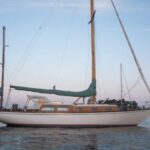
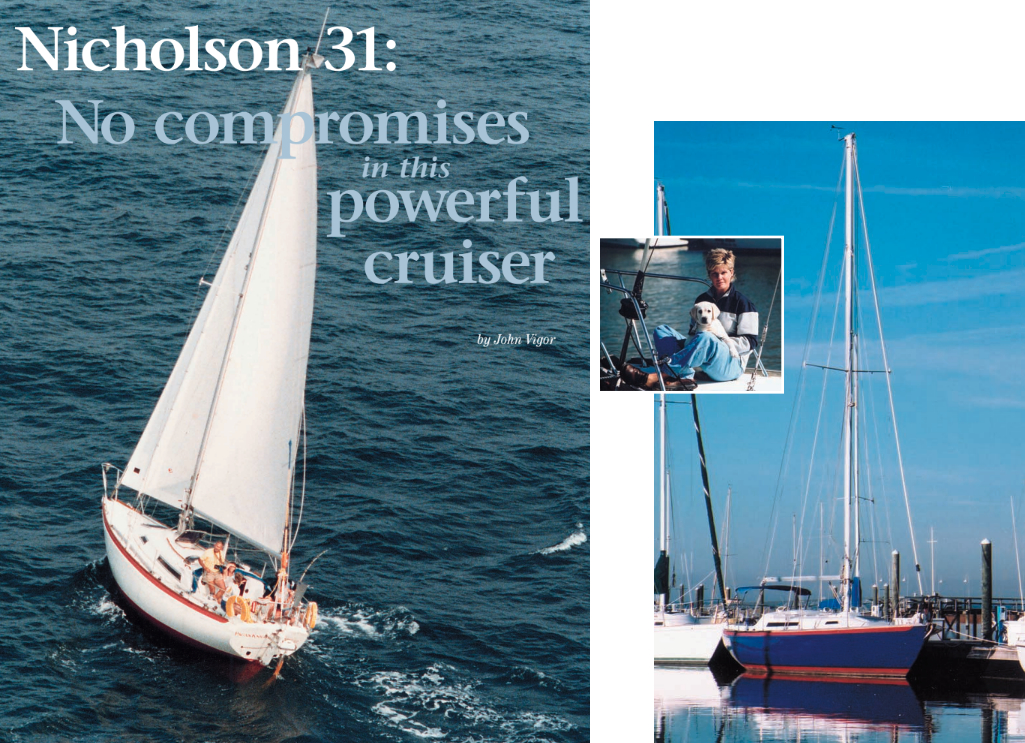
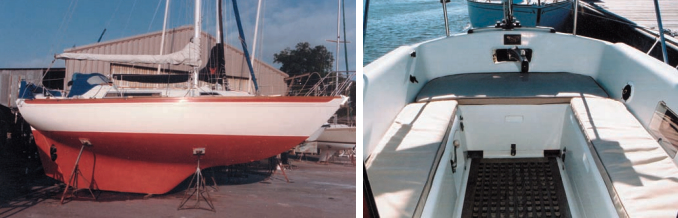
The Nicholson 31 is a deceptive boat. Above the waterline she has the lines of a sleek modern racer/cruiser. Her cabintop is low and streamlined, with elongated Eurostyle portlights and aluminum-framed hatches. Her bow protrudes forward enough to give her an appearance of constant movement. Her no-nonsense stern is clipped off short and businesslike, and her tall masthead sloop rig looks powerful and efficient.
But below the boot stripe it’s another story altogether. She lies deep in the water, and her full-length keel is cut away in the forefoot in the modern fashion. Her long rudder hangs outboard from the transom and the keel, and her tiller pokes through an elongated slot in the aft cockpit coaming. You begin to realize that this is no club racer/weekend cruiser after all. There are no compromises here. This is all pure cruiser/cruiser. And not a bowsprit, a bumpkin, or a bit of baggywrinkle is in sight.
She is the replacement for another dedicated cruiser, the Nicholson 32, which went out of production in the late 1970s. The 32 was a landmark boat for the British boatbuilding industry because she had ushered the venerable boatbuilding firm of Camper & Nicholsons into the era of the fiberglass production boat in the 1960s. Before that, for two centuries or more, Camper & Nicholsons had produced only one-off wooden boats, usually a lot larger than 32 feet.
At first, the fiberglass hulls of the 32s were fitted out entirely in wood, but in the very latter part of their highly successful production run, which went through 11 “marks,” the 32s started receiving plastic liners and molds for the accommodations, trimmed with teak to detract from their sterility. But by the mid-1970s the Nicholson 32 was beginning to look dated with her springy sheerline, low freeboard, long overhangs, and that protruding doghouse in the aft end of the coachroof.
The Nicholson 31, therefore, was born with plastic liners, upgraded construction methods, great new looks, and a drastically modified keel, so she really represented the first of Camper & Nicholsons’ “modern” plastic boats.
Her construction befits her design intent. She is strong and efficient without any show of ostentation. The real deceit is that while she looks so clubby and racy in such a non-flashy way, this is actually a boat fit to go anywhere. The Nicholson 31 is a true Cape Horner.
Basic design
The 31 is a heavy-displacement ocean cruiser with a single-spreader, mast-head sloop rig. She’s quite beamy, although not excessively so by today’s standards, and has a healthy draft with her ballast carried down low. Her midship sections show a fairly tight turn to the bilges, which speaks of form stiffness additional to that provided by the beam.
Her ballast is molded lead; a 5,300- pound chunk of it glued into the hull’s keel cavity and glassed over on top. It gives her a ballast ratio of 33 percent.
Because of her displacement of nearly 15,000 pounds, her interior is voluminous for a 31-footer, and she is able to offer full standing headroom without having to resort to a high cabintop that could be vulnerable to damage in heavy seas.
You can see from the words “Camper & Nicholson 31” molded into the gelcoat of her stern quarters that this hull is made in two halves and later joined down the middle. The nameplate is situated on a stretch of tumblehome that disguises the boxiness of the topsides and at the same time adds great strength to the hull, but you’d never be able to pop that shape out of a single female mold.
As a matter of interest, Camper & Nicholsons didn’t make the hulls of their 31s anyway. That job was contracted out to the specialist firm Halmatic, and C&N finished them off and fitted them out.
The hull is solid fiberglass and is reinforced with the kind of foam-filled longitudinal stringers that are missing, but badly needed, on some other makes of so-called ocean cruisers. The coachroof, the cabin sides, and the decks are fiberglass, cored with balsa.
The sidedecks are wide enough to move about on easily, even when the boat is heeled, and the foredeck is clean and uncluttered, thanks to the enclosed anchor locker, which is capacious enough to hide a 35-pound CQR as well as an anchor winch and a hefty pair of mooring bitts.
If you ever need to be convinced that the Nicholson 31 was designed for rugged cruising, take a look at her stemhead fitting. To call it massive would be an understatement. Apart from anything else, two solid bronze rollers almost the size of golf-cart wheels are encased in a flak-proof jacket of stainless steel that must weigh as much as Jenny Craig’s worst failure.
The cockpit is more than 6 feet long and it’s deep, so that the seats seem to have unusually high backs and tend to isolate you from the water. Many people will prefer a higher seating position, one that affords a better view forward, but there’s no denying that you’re well protected in there, especially as the forward part of the cockpit is covered by a full-width dodger that comes as a standard fitting.
The cockpit floor is unusual in that part of it is the top of the 25-gallon diesel fuel tank. The real cockpit sole is a teak grating that keeps you from walking on the tank. It’s a self-bailing cockpit, of course, and a really efficient one at that. Two large drains simply exit through the transom above the waterline, so there’s never any worry about drain hoses going bad (or their clips rusting away) and flooding the boat. Top-hinged flap valves fixed to the outside of the transom prevent following waves from washing back up into the cockpit.
A single propane bottle finds a home in a special locker that drains into the cockpit, but it would make sense to do some modifications here so you could stow at least two 10- pound bottles for a long cruise.
To port, the cockpit seat lifts up to reveal a cavernous sail locker, which should help keep the V-berth clear for its intended use: a “catchment” area for soiled underwear, orphan socks, and old shackles that have lost their pins.
The standard engine is a three-cylinder Yanmar diesel of 22.5 horsepower, adequate but not overly muscular for this heavy boat. It pushes her along at more than 5 knots in calm water at about 75 percent of full power, and it will take her up to hull speed of slightly more than 6.5 knots with the throttle wide open, at which stage it will consume about one gallon of fuel an hour. If you’re happy to cruise along gently at 4 to 5 knots, as you might in the doldrums, your fuel consumption will shrink to about half a gallon an hour, greatly increasing your range under power and adding substantially, through diminished noise and vibration, to your quality of life. There are 25 gallons of fuel in the tank under the cockpit sole, enough if used wisely to take you 200 miles or more.
Owners replacing the original engine with the newer 27-hp Yanmar report that the extra 5 horsepower makes a difference when it comes to pushing the Nicholson 31 into strong headwinds and choppy seas.
Accommodations
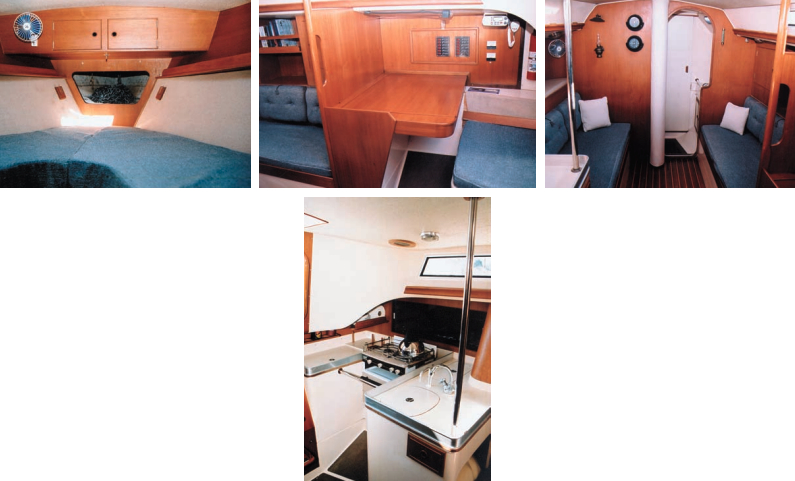
The Nicholson 31 philosophy is so determinedly fixed on long-distance cruising that it seems almost whimsical to supply her with six full-sized berths. Boats of 31 feet with six berths were more likely designed to be weekenders or vacation boats, where people can go ashore or jump into the dinghy and ride around to get out of each other’s way. Nobody in his or her right mind would want to cross an ocean being cooped up with five other people in a Nicholson 31. And yet, to the consternation of any sane sailor, the berths are there: two up forward in a double V-berth, two settee berths in the main cabin, a pilot berth above and outside of the port settee berth, and a quarterberth whose head, peeking out from behind the chart table, accommodates the navigator’s rear end while he or she attends to the charts.
This is at least two berths too many, and the two most easily sacrificed would be one V-berth, which would make way for a more sensible workbench, and the pilot berth, which is mostly a vexing waste of space. The galley could benefit from more storage, and this would be a good place for it, along with a shelf for books and an additional locker or two. In most other respects, this boat is ideal for a cruising pair, even one with a couple of small kids.
There’s a huge locker under the V-berth that will hold a year’s supply of canned goods for two people.
Aft of the forward cabin is an athwart head compartment, with a vacuum-operated Lavac toilet and a hanging locker to port, and a large washbasin and vanity to starboard. There’s a pressure shower in there, but it’s for masochists only. There’s no hot water.
The two sliding doors that separate the head/vanity compartment from the forecabin and the main saloon are heavy and tend to stick in their slides — that is, when they haven’t broken loose from their magnetic restraints at sea and tried to ram their way out the hull. Not the cleverest of ideas.
Most owners end up leaving them permanently open at sea, sacrificing the modicum of privacy they offered in exchange for the safety of the boat. Others have discarded the sliding doors and, with a little ingenious shaping, have fashioned a hinged marine-ply door that shuts off the toilet only. It will also close off the main saloon and hinge back against the main bulkhead inside the toilet compartment, out of the way.
Between the settee berths in the saloon is a very solid table with a small, fiddled central section that stays permanently in place. It has leaves that hinge up on each side when required. It’s a nice piece of furniture.
The galley, as usual, was designed by someone more interested in providing sleeping berths than decent cooking space. It’s adequate, but only because most sailors’ expectations are unusually low. Considering the importance of a galley, particularly on a liveaboard world cruiser, it’s a wonder the layout doesn’t get more attention — and not just on the Nicholson. There are two stainless-steel sinks, with fresh and salt water supplied, on a peninsula adjoining the aft end of the starboard settee. Outboard there is stowage for condiments, crockery, and cutlery. There is also a propane-fed two-burner stove and oven in gimbals.
The icebox suffers from the usual north European malaise. In their culture, ice is a sinful luxury equated with decadence and the most wicked form of high living. They really lust after it quite badly, but they know they shouldn’t have it, so they quell their consciences by making it difficult to get at. The lid of the icebox is so small that you have to chop even a modest block of ice in two to get it in — which makes it melt twice as fast, of course. And, having got the ice in, there’s precious little room for anything else. Even if you can squeeze a steak or two or a pack of ice cream in there, you’ll find no shelves to keep stuff off the ice. In addition, the restricted amount of space over the icebox makes it inconvenient to stow or retrieve anything there. Deliberately inconvenient, presumably.
To compensate, there is a wonderful, sit-down navigation desk, big enough to take a full-sized chart folded only once. It faces forward, so the navigator doesn’t get more confused than usual when plotting a course, and it hinges up to reveal stowage space for about 100 charts. Bulkheads and shelves forward of the desk and to the side of it offer convenient sites for navigation instruments, books, radios, GPS, and the other paraphernalia that stir a navigator’s heart.
The rig
The standard mast is a powerful aluminum extrusion from Proctor, untapered all the way up. The single pair of aluminum spreaders is shaped in an airfoil section. The basic sail area of this masthead sloop is a little short of 500 square feet, split almost evenly fore and aft of the keel-stepped mast.
The boom is equipped with easily worked slab reefing, and the mainsail comes with two rows of reef points sewn in. A third row is a good idea if you’re not planning to carry a storm trysail.
She has a single forestay and backstay of rugged proportions and twin lower shrouds on each side. The mainsheet attaches well aft, clear of the cockpit, and foresail sheet winches are ready to hand. Everything is nicely set up for the singlehander.
Performance
You wouldn’t expect this boat to be particularly close-winded or fast to weather — and she’s neither. That is not to say, however, that she won’t pluck herself off a lee shore with a lot of crashing and bashing when the need arises. She will plug away into heavy head seas far longer than most other boats of her size, using her considerable weight and momentum to punch her way through and gradually gain an offing.
But as soon as the wind is freed a bit, she comes into her own. She is beautifully balanced, requiring only the lightest touch on the tiller in any weather, and she tracks straight and true when running before the wind in heavy weather, rarely showing even the faintest inclination to broach. With a reefed jib only, a self-steering vane gear will take her safely downwind in big following seas in 40 knots.
Under twin headsails, steered by a windvane, she’ll peel off 140 miles a day like clockwork with no help from her crew at all.
She has the ability to heave to under a reefed mainsail only, riding the seas like a gull with her head under her wing. In storm conditions too heavy even for heaving to, she lies ahull with reassuring steadiness, heeled over by the pressure of wind on her mast, and presents her strongest area — the rounded sections of her hull — to the breaking waves.
Known weaknesses
She needs large headsails for decent light-weather performance. Like all British-built boats, she’s expensive in dollar terms.
The icebox is miserable.
There’s no provision belowdecks for a propane shut-off valve for the cooker. Perhaps Europeans don’t blow themselves up as frequently as Americans do, but for your own safety you should fit a valve that complies with the standards of the American Boat and Yacht Council.
Owner’s opinion
Art Stamey sails the Nicholson 31 Desormais II out of Everett, just north of Seattle, on Puget Sound. He bought her in 1986 from a Canadian who had already sailed her around Cape Horn.
He had been wanting a Nicholson for some time. “Ferenc Maté’s books sensitized me to the worth of Nicholson yachts. And the fact that they made Nelson’s flagship, Victory, made it an acceptable yard for me.”
In April 1992, Art sailed her singlehanded to Raiatea, one of the islands of the Society group in the South Pacific. Later, he sailed her to Hawaii, a voyage of about 8,500 miles altogether. As a busy dentist, he had little spare time, so he had a friend sail her back from Hawaii to Everett for him.
When Art left Neah Bay, in the Strait of Juan de Fuca, on his outbound leg, it was in the face of a storm warning.
“I was well prepared,” he says. “The storm was forecast for 48 hours hence and I thought, ‘Well, let’s get out to sea and see what she can do.’ I was a good 100 miles offshore when it struck, and she was surprisingly comfortable.
“The outstanding feature of this boat,” he adds, “is her ability to heave to with the tiller lashed to leeward slightly. She sits like a duck on the water in winds up to 50 knots under a third-reefed mainsail only.”
Her best point of sail, he says, is a broad reach. “She handles beautifully then, carrying a full main and a working jib in winds of 25 knots with the Aries self-steering vane doing all the steering. It’s a very seakindly point of sailing.” Desormais II carried a bit of weather helm, but not much: “On the whole she was nicely balanced.”
Art ’s first action in rising wind was to reduce the roller-furling 110-percent headsail down to about 90 percent. Then, if the wind increased further, he’d take the first reef in the mainsail, followed by a second reef in the main. In even stronger winds, he’d furl the foresail completely and set a storm jib. Finally, in storm-force winds, he’d strike the jib and heave to under just the mainsail with three reefs in it — the equivalent of a storm trysail.
He never felt apprehensive about the cockpit being too big: “It has huge scuppers draining out through the transom. I never felt scared of a pooping.”
He says the original Yanmar 22.5- hp diesel engine was perfectly adequate with a twin-bladed propeller.
In summary, he says: “She’s a seakindly, dry boat, very well constructed. I have no complaints about the interior. It’s not luxurious, but it’s not Spartan either.”
His advice for anyone planning to take a Nicholson 31 across an ocean:
- Check the mast inserts for the shroud terminals. They’re stainless-steel liners. His cracked, and he replaced them all.
- Bulwarks would afford a better foothold on the sidedecks in bad weather.
- Fit a boom gallows: “It’s great for grabbing on at any time, and it’s a very handy place to steady yourself against while you take sextant sights.”
Conclusion
This is a boat you can trust in any weather far out to sea. She doesn’t have the “traditional” looks of a round-the-worlder — neither bowsprit nor teak-laid decks — but she’ll perform as well as any Colin Archer type and, in some situations, much better.
She has just the right amount of room for a cruising couple and plenty of stowage space for their gear and provisions. She’s docile, undemanding, and responsive to the helm — a delightful boat to sail on long passages.
A used Nicholson 31 will set you back between $30,000 and $50,000, depending on age and condition. You might have to be patient, because they are fairly scarce in the United States, and owners tend to hang on to them. But if you can’t wait, there are usually plenty for sale in Britain. Why not buy one over there and sail her back?
Thank you to Sailrite Enterprises, Inc., for providing free access to back issues of Good Old Boat through intellectual property rights. Sailrite.com