A classic Alden yawl becomes a treasured family cruiser once more
Issue 34: Jan/Feb 2004
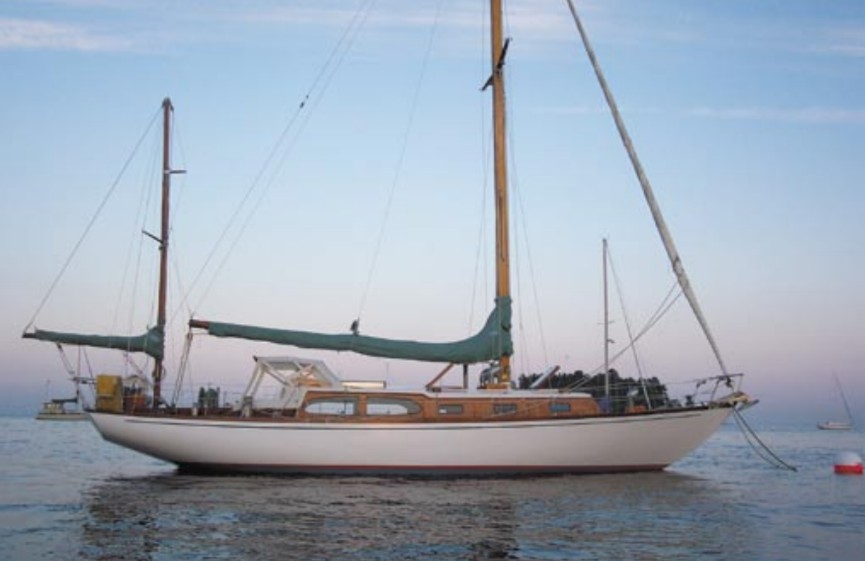
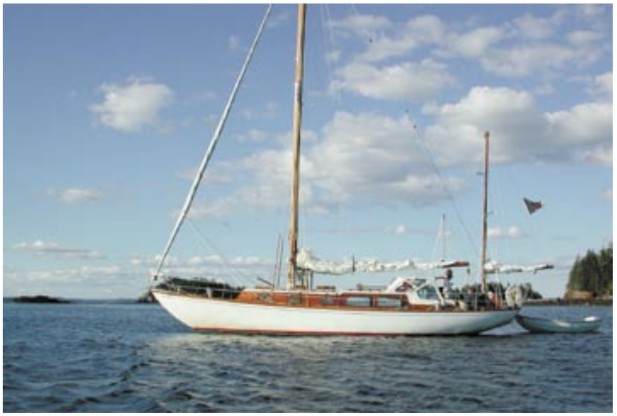
THE 1961 ALDEN CHALLENGER yawl looked quite large on the jackstands that brisk fall day. The price and this somewhat rare boat made me curious. “Only taking a look,” I told myself. I wasn’t prepared for a pretty boat though. With her long overhangs, large shapely ports, stepped cabinhouse, and oval spruce spars with the sails still bent on, there was no mistaking the era of the design: Cruising Club of America (CCA) Rule, the 1950s and ’60s. She was lovely to look at. Before long she would be ours. We would name her Christmas.
A long, sharp, spoon-shaped bow loomed overhead as I approached. It was easy to imagine it slicing through a wave, gently pushing the sea aside as I walked aft along the waterline. A moderate beam and somewhat slack turn at the bilge amidships looked like it would move easily through blue water. Following her lines aft to the graceful stern, I saw smooth water and a tiny wake in the shadow of her counter quietly moving away.
Above the solid fiberglass decks, the boat was built entirely of wood. Long wide sweeping decks framed the graceful mahogany cabin sides. A white cabintop met the sides in finely shaped moldings. Hatches, Dorade boxes, coamings, cockpit . . . these parts were built of fine teak and mahogany.
Dorade ventilators, heavy hatch hinges, stanchions, and cleats were all nicely forged of thick nickel-plated bronze. Details such as the boathook and its carved mounting block; the spruce spinnaker pole and chocks; the hand-cut, dovetailed corners on her deck box and Dorade boxes — all showed a high degree of quality. The spars looked fit to be displayed on a wall. The workmanship was splendid.
All wood below
An old bronze lock under the John Alden identification plaque turned easily. The heavy mahogany hatch slid smoothly into the stainless-steel sea hood.
She was all wood below. Her large, shapely old ports lit the interior as if the sun were in there. She was nearly all original after 40 years of what looked to be a lot of use. The boat wasn’t ancient, just old enough to have some history.
Only about 50 Challengers were built in the 1960s. The fiberglass hulls and decks were laid up by hand at the Halmatic yard in England. This hull was then shipped to the Molich yard in Denmark. There the rest of the boat was constructed following the blueprints supplied by John G. Alden Naval Architects, Inc., of Boston. Designed to the CCA racing rules of the day, she resembled several similar boats of the era.
The boat I was looking at was priced below the lower end of the few Alden Challengers for sale or recently sold. She wasn’t moving either. She needed a lot of work. So here I was: faced with the “old boat fixer-upper dilemma.” A second offer had fallen through when the survey came in, lowering the boat’s price . . . again. Her disrepair was obvious. Was this last fallen offer a ploy by the buyers to lower her price one more time for a third offer? After much thought and inspection, I decided not to find out. Was the boat worth it? Despite its problems, I thought it clearly was and more. I made a fair offer with no survey contingency. I wanted the sellers to know this was a real offer and I wanted the boat. (I don’t recommend this tactic; it usually turns out to be a mistake.)
I had done my own survey. The design has some common problems in the built-in fuel tanks and chainplates. These were repairable. But I believe her general disrepair caused the other offers to fall through. To someone without the skills to bring her back, the yard estimates would have been staggering.
High-quality yawl
But I saw a different boat that day. I saw a 38-foot 6-inch CCA Rule design . . . a high-quality yawl. The Alden name alone put the boat in a class few others share. There was nothing like her in this size, quality, and price range. She had a bomb-proof 1960s-style heavy fiberglass hull, external full lead keel, and bronze centerboard. She was fully equipped; few parts were missing. She had good sails: a Harken furled genoa, five spinnakers, and lockers full of sheets and blocks. She had gleaming two-speed self-tailing winches and secondaries. She had two full sets of ground tackle and a well-installed electric windlass for hauling them up.
There were well-installed compressed natural gas (CNG) tanks, a beautifully built original pedestal, and a fine compass as well as a lovely, old, finely joined wooden wheel with an added stainless rim. Docklines were coiled in a beautiful wooden deck box on the aft deck. What a wonderful idea.
There were shapely and well-built stanchions, pulpits, and double lifelines, all heavily installed with large stainless backing plates. A well-built hull-to-deck joint was sealed, through-bolted, and glassed together. On deck were the highest quality fittings, a well-designed dodger attached to a high mahogany curb, and stout yet well-finished wooden parts expertly joined and as strong today as the day they were assembled 40 years ago. With care, they’d be good for another 40 years. This was quality construction.
Below I saw the same complete high quality. An old freshwater-cooled Japanese diesel looked to be installed nicely and had been well cared for. Cases of spare oil filters and fuel filters were a good sign. She held 80 gallons of fuel low in the bilge (and the tanks were full), and she had three stainless-steel water tanks holding a total of 120 gallons of water.
No-nonsense electrical
There was an older no-nonsense electrical system with two house batteries and a separate engine battery, plus heavy and well-installed wiring, meticulously led throughout. There were adequate electronics. Her galley stove was nearly unused. Plates, tableware, cooking utensils … everything was still with the boat.
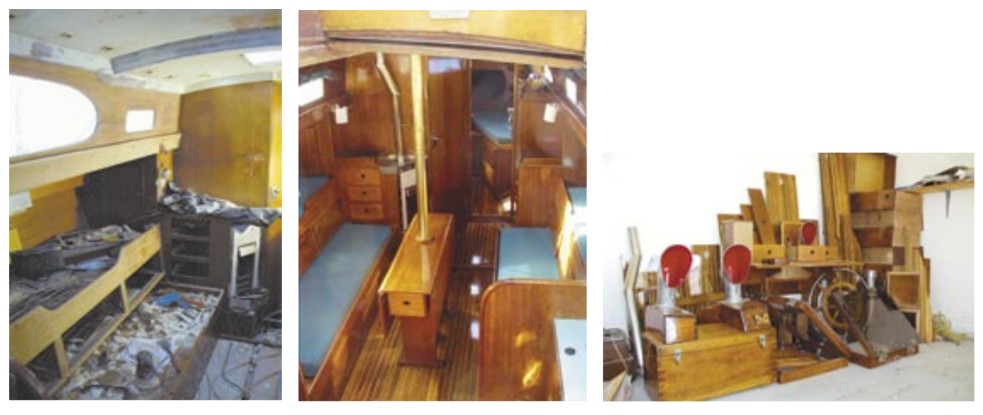
Dozens of drawers and doors held tons of spares. Even a full complement of tools — from tiny screwdrivers to huge bolt cutters — was with the boat. Solid teak-and-holly floors were hidden under years of use. There was something else below: the 40-year-old work of skilled Danish craftsmen and the fine materials they used. To someone like me, this was priceless. She even had a beautiful old fireplace.
Another example of quality was in the two overhead hatches. These were well designed structurally and expertly joined in their day. Now crazed beyond recognition, the 1⁄2-inch-thick Plexiglas would have to be replaced with new Lexan. One of my first projects was to strip the ports of finish and hardware, replace the windows with Lexan, refinish, reassemble, and reinstall the ports. With simple maintenance, these wooden hatches and their heavy hardware are once again strong and finely finished.
Fortunately for me, other buyers didn’t see what I saw that first day. They saw peeling paint and varnish above and below the decks and realized the boat was in need of total stripping and refinishing. It was hard to see the fine wood below a sun-bleached layer of peeling finish.
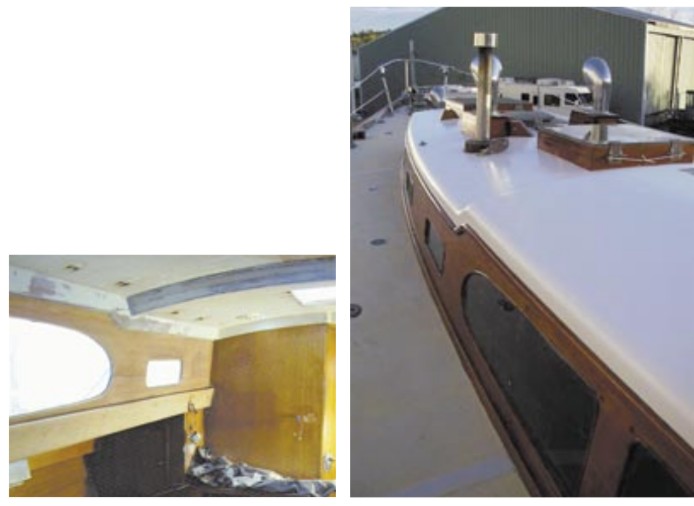
The cabintop, built of 3⁄4-inch plywood with a layer of fiberglass over that, was cracked and peeling. All ports had been leaking into the interior for some time. There were water stains and lifted varnish throughout. Water had damaged many under-deck ceilings as well. There were leak and rust stains through handholds, hatches, and other parts all over the overhead. Paint was peeling off in large chunks.
Common dilemma
Labor costs are high today. These repairs would no doubt bring boatyard estimates nearly as high as the selling price, a common dilemma today. A full boatyard restoration, added to the cost of the boat, would quickly surpass her value. Luckily, I could supply the missing care she needed. Despite the obvious damage, I suspected the boat had been well cared for with only a few years of recent neglect. This turned out to be true; research showed me that she was a New England boat that had been loved by members of one family for 35 years. She had been stored inside during the off-season.
I knew this restoration would require more than a few nights and weekends. Christmas needed to be on the water in season; that’s our first priority for a sailboat. I would have to split the restoration into parts to be performed over time.
The biggest trick with a project like this — as I have learned during 25 years of building and restoring homes — is keeping the tasks achievable. There are times to step back and look at the total project, but the actual work is done in small increments. My advice is to cut the project into parts. To restore a cabintop, the first project is to remove everything. Even that may be daunting. Just get one part off first. It starts with removing one screw, then another. When removing parts gets frustrating, go home and start stripping the ones you have. Keep yourself motivated by applying yourself where you are most productive and you can see results. With the “parts removal project” completed, the top itself is an easy project.
The first spring consisted of removing all ports, stripping the exterior cabin sides, rebedding the ports, and applying varnish to the cabin exterior. The next winter under cover involved removing everything from the cabintop. Refinishing the parts in a warm shop when time was available became a project within the project. Seeing the parts begin to build up ready for re-installation was a mental boost. I stripped the interior of paint and varnish. In my shop, I refinished any interior parts easy to remove.
Once weather permitted, I made fiberglass repairs to the top and followed that with a new coat of epoxy paint (brush applied). With the cabintop parts rebedded and fastened, the interior overhead was repainted. It was wonderful to see the leaks stop.
And so a restoration goes. Step by step. A little more this year. Above all, every year she sails. Every year she gets better. A lot of work? Sure, but there are rewards. Christmas has become a welcome addition to our family of four. She is nearly perfect for our coastal sailing in New England. She’s wonderful and very responsive, even in light air. She’s well suited to our Maine coast cruising grounds. Since she’s easily balanced under way, we often watch her sail herself. The large cockpit and wide decks make time under way and at anchor very comfortable. With her board-up draft of 4 feet, we go where many can’t. Her yawl rig is easy to handle and fun to sail. When it pipes up around here, she can get us home.
Except for cutting down her enormous center table with seating for six, I left the old tried and true belowdecks layout alone. Although they were designed for racing crews, the two pilot berths are about as good as it gets for two kids. The lower extension berths make great seats and pullout couches for lounging around an evening fire. The forward cabin is large, private, and airy with tons of storage space. The head is the warmest spot below when the fireplace is burning, thanks to a grating in the bulkhead.
The no-nonsense galley/navigation area just works well. We love to cook at home and aboard. The huge stainless-steel icebox with a separate sump holds tons of food and ice and makes a good navigation station with a full-sized chart drawer above. These old boats hold so much gear and stores in countless lockers and drawers that the temptation to take off in them is always dangerously appealing.
More character now
The newly refinished African mahogany belowdecks glows like soft sunlight. Water-damaged ceilings over bunks provided templates for new contrasting birch veneer ceilings. The satin-painted overhead has more character now. There is nothing like fine old wood, renewable yet enhanced with age. There is a feeling of a little history as you climb below. She raced to Bermuda in the 1960s. Would she do it again?
This isn’t a boat for everybody. But if gently brushing varnish onto a newly prepared cabin side lowers your blood pressure, maybe an Alden Challenger is for you. Many good old all-fiberglass CCA designs are out there. Some will require similar labor-intensive restoration. High yard costs to refurbish these boats may drive the price down on boats in disrepair. It will also drive up the value of performing these tasks yourself. Look closely. If the boat has the other important parts, supplying the restoration part may be cost effective.
Take a close look at some of these older neglected boats. Get a survey. What parts are missing? I still remember my first look at this boat that wasn’t selling. That brisk fall day I saw a different boat.
What did Christmas cost? — Tom Young
WHEN I FOUND CHRISTMAS, SHE HAD RECENTLY BEEN APPRAISED FOR INSURANCE purposes at $50,000. I made no offer at that time. Nearly a year later, after buyers backed out of contracts due to survey reports, I offered — and bought the boat for — $30,000. After a year on the open market, a little down on her luck, I believe that was her value on that day.
I estimate that I have spent around 400 “mostly pleasant hours” on the general refit over 3 years. The high level of quality and workmanship that was evident when I surveyed the boat has resulted in little repair or replacement of major parts or systems. For me, this is the key in choosing a boat for a refit. The high labor costs necessary to refit older, tired boats with sound fiberglass hulls and quality parts reduce their value. High boatyard labor costs will create “project boats.”
Restoring boats is no way to make money. Nonetheless, sailing a pretty classic that doesn’t cost too much is, for some of us, a real pleasure.
This CCA era in the 1960s produced some elegant designs with lasting appeal and now, for some, rising values. Alden Challengers in good condition have listing prices in the $60,000-range and go up from there for the really-well-cared-for boats.
What Christmas is worth now can best be summed up by a surveyor who gave me an overview of the boat, prior to purchase. “A 38-foot Alden Challenger yawl, CCA classic, high Alden quality, and with the equipment that boat has in that price range . . . there is nothing else like that out there, nothing,” he told me, and he was so right.
Thank you to Sailrite Enterprises, Inc., for providing free access to back issues of Good Old Boat through intellectual property rights. Sailrite.com