As pretty a little sloop as ever graced a Minnesota lake
Issue 31 : Jul/Aug 2003
We figure Hal Newell can probably do just about anything, and lately sailboat refits figure prominently in what Hal wants to do. The most recent boat touched by his magic wand is a Victoria 18, and the trend is toward bigger boats. He’s looking for something in the 30-foot range.
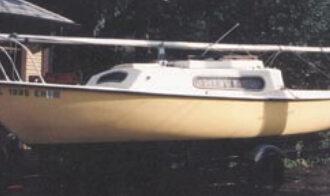
The Victoria was designed by William and George McVay and manufactured by McVay Yachts in Nova Scotia and Victoria Yachts in Debary, Florida. Approximately 1,000 were built, starting in 1977 and ending in the early 1980s. Most were slooprigged.
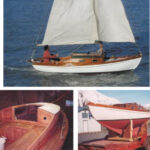
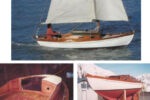
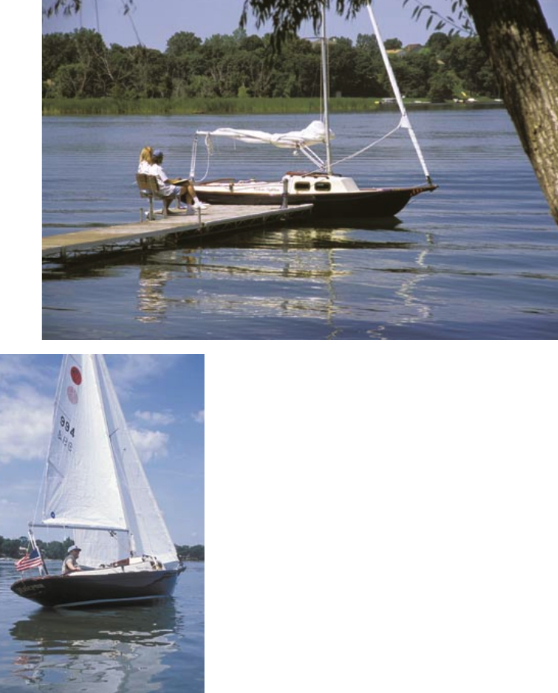
The boat at the end of the dock in front of the Newells’ Minnesota lakeside log home is a sloop. Her sweeping lines are Albergesque with a long counter stern, cockpit coaming, and pedestal winches. She has bronze ports and hardware, immaculate brightwork, brand-new sails, and navy blue topsides that can be used as a mirror.
Among other things, Hal and his wife, Jen, collect antiques that contribute to the feel of the log home. A gleaming Victoria 18 sitting at the dock is just one part of the whole. Even before the visitor takes in this scene, there is one hint of the creativity of this energetic couple.
A brick driveway leads down a hill to their home. Hal and Jen laid the 33,000 (plus a few) bricks one summer a couple of years ago. “Our goal was to make the herringbone brick pattern look like it just ‘flowed’ into and in between the rocks,” Hal says. Indeed, it is perfectly executed.
Early in their marriage, Jen began to understand Hal’s interest in renovation when the two bought a Victorian home in need of work. Hal gutted it and started over. “He likes to tackle a project, and when he does, he does a good job,” Jen says. “He’s fearless. Nothing fazes him. He can fix anything.”
Right beside him
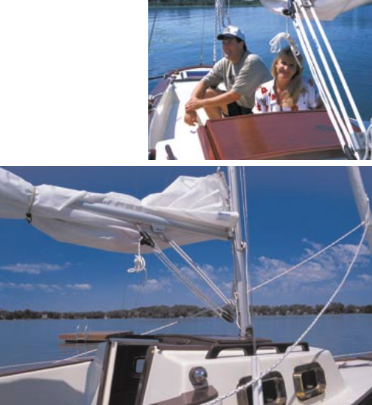
Hal may be the mastermind behind these projects, but from the sounds of things, Jen’s been right there beside him whether the job is bricklaying or sanding brightwork. They run a family business together also. In between, they’ve also raised two children, Charlie and Lindsay, now 16 and 14.
Both Hal and Jen grew up with powerboats and waterskiing in the foreground and sailboats in the background (a Sailfish or Sunfish here, a Snark there). The sailing bug bit Hal at summer camp when he discovered E-Scows. “They had several big ol’ aircraft carriers moored offshore,” he recalls. “I soon discovered firsthand that these were a heck of a lot faster than the other camp watercraft offerings (canoes). Speed and danger: just what a young teenager wants. I will always remember hiking out and watching those sideboards slicing through the water!” There was something else about those E-Scows in comparison with the towboats of Hal’s waterskiing days: “They were fast,” he says, “and there was no noise to propel them.”
Next came marriage, children, and starting a couple of businesses, the first in carpet cleaning and the second an outgrowth of their hobby — racing radio-controlled cars — and eventually supplying products for that specialty niche. Even in the racecar field, Hal came to prominence as the guy who took honors in the concours d’élégance arena, which involves making the most beautiful car in the competition. This seems to be the thread that runs through Hal’s life.
Sailboats crept in
Eventually sailboats crept into his dreams. He’s not sure when or why. “Not to pigeonhole the powerboaters or sailors, but by all rights I should probably be a power guy,” he says. “I like red meat with lots of salt (hold the granola), I’d vote for Genghis Khan if he were running, and I’m sure the internal combustion engine will not be humanity’s ultimate demise.
“As for sailboats, well,” he adds, “I simply like the quiet lapping of water on the hull and the natural beauty of moving via the winds. It’s the ultimate for true relaxation. In contrast, my Mercury-powered jet boat has been in the shop more than on the water. That is the quintessential antithesis of relaxation.
“Being a tinkerer and frugal (OK, cheap), I wanted to find a boat that needed some work and would hold its value,” Hal says. He consulted with Gordy Bowers, a well-known local sailor and sailmaker. Gordy shot down one “opportunity” after another until a fixer-upper Catalina Capri 14.2 entered the picture. This one seemed right for a couple with young children. Hal naturally turned this boat into a gem and set his sights on the next boat. “As time passed,” he says, “I wanted to move up in size. I wanted something with winches! It’s been Hal’s ‘Easy Down Boat Club’ ever since.”
He prowled the Internet looking for a Cape Dory Typhoon and wound up buying both a Typhoon and a Victoria 18. That was one boat too many, so the Typhoon was resold soon afterward. The Victoria became the object of his attention. He replaced the taffrail, tiller, boom, and a bent chainplate; did some fiberglass work; redid the sliding hatch; added a wooden toerail and a bowsprit; and added bronze cleats and a flagpole. And there was a new sound system, new standing and running rigging, new sails, and a complete paint job for the topsides and bottom. The topsides were rolled and tipped with two-part urethane. Jen was there throughout the process. They named their “brand-new” 1982 boat Halcyon.
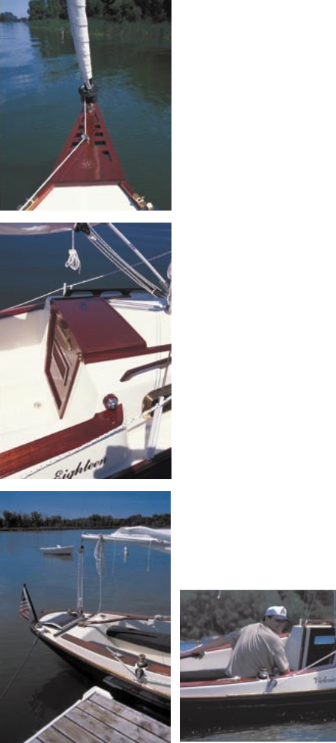
Caught his fancy
Since he’d had made so many inquries on the web, it’s no surprise that in the middle of all this work, another boat caught Hal’s fancy. This one was a Sparkman & Stephens Pacific Dolphin/Yankee Dolphin, a 24-foot beauty with classic lines that he bought and disassembled, ready to doll it up in teak and bronze. But a cruising class on Lake Superior turned Hal and Jen’s attention to somewhat larger boats, and this one will be sold to make way for the ultimate cruiser. Someone else will buy this classic boat, which has been scrubbed and polished and is ready to finish.
“Why sailboats with classic lines?” Hal asks thoughtfully. “Some guys like the more contemporary Ferrari ‘lead wedge’ designs, and others like the more curvaceous classics of old. I can appreciate other boats, I just prefer boats that look ‘right’ on the water over the ones that look better suited for the cargo hold of the space shuttle. I also think the classic-lined boats tend to be better-built boats. They’re often more seaworthy — boats that would do their best to keep you alive if Mother Nature decided she wanted you. To me, classic-lined boats are more romantic and rich with lots of brightwork and bronze. I’ll take a green patinated bronze winch over a shiny chrome winch any day. Even though all that wood equates to a higher maintenance factor, modern finishes/chemistry are decreasing the down time.
“Classics are oftentimes in need of TLC (which I enjoy obliging),” he says. “That conveniently translates into ‘deals’ to be had, and I love a good deal. Finally, many of the old ‘classic plastics’ are pretty well depreciated. Unlike buying a newer boat that is usually sold for less each time it changes hands, these boats will hold their residual value — some are even appreciating.”
As Hal and Jen discover their once and future cruising boat, it’s likely that a veritable procession of lovely restored classics will pass through Hal’s large, heated indoor boatshop. The rest of us need only follow a step behind, picking up the finished projects. There will be more stunning beauties of all sizes restored as well as Halcyon, the Victoria 18. And as they’re completed, the sailing community will be the better for it.
Thank you to Sailrite Enterprises, Inc., for providing free access to back issues of Good Old Boat through intellectual property rights. Sailrite.com