Tom Green’s daughter remembers him traveling around the Northwest giving advice to sailors completing their own Chinooks and Cascades.
Issue 34: Jan/Feb 2004
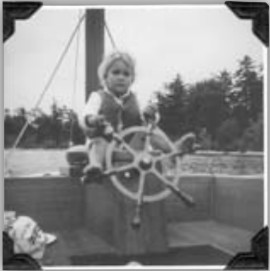
I CAN’T REMEMBER A TIME WITHOUT BOATS. The day after my first birthday my father, Tom Green, launched the first Chinook. He was one of a handful of sailors at Rose City Yacht Club (RCYC) who wanted freedom from dry rot and varnishing. The graceful, 34-foot sloops, made from a material that until then had only been used to build sailing dinghies and small powerboats, made their first appearance on the Columbia River in April 1956.
By the time I was 25, Dad and two of those five pioneers, Wade Cornwell and Merle Starr, had formed Yacht Constructors, Inc., and were building five sizes of Cascades, having phased out the Chinook. Although the Columbia River at Portland, Oregon, was by then teeming with fiberglass sailboats from many manufacturers, the local boats had collected a loyal following.
As a child, I saw little of Dad during the week. After working days at the Hyster Company, he came home for a nap and dinner, then headed down to the “boatworks” to put in a few hours before the 11 p.m. news.
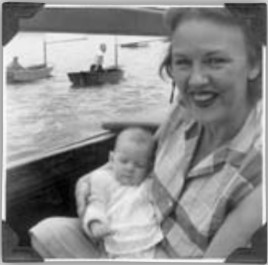
Weekends, however, were for family and usually spent at the river. When we weren’t proving our mettle against competitors’ boats, Dad was making the rounds at the club or on cruises, advising those who were building their own Cascades.
As much as he promoted his boats during those sunny days on the water, he couldn’t simply relax on a rainy weekend. Sunday drives could lead us to half-completed dreams hidden in backyards and garages. Dad offered his suggestions as the owners showed off their handiwork. Then he beamed like a proud parent all the way home.
Neither were family vacations an excuse to suspend his enthusiasm. Whether we were sailing the Columbia River or cruising British Columbia’s Desolation Sound, he always stopped to talk to other Cascade and Chinook owners or to answer questions posed by those who were making do with less. The Christmas vacation we flew to California and rented a car was no different. We visited Disneyland and Golden Gate Park like other families, but we also toured backyards and garages.
At 12 I was baffled by the excitement one man expressed over finding a pair of shiny new winches under his Christmas tree. I understood Mom’s giggles, however, when his wife pointed out the dusty white hull outside her kitchen window. She’d grown so tired of the long-term project framed in that view that she’d arranged rows of potted geraniums on the patio in front of it.
In his footsteps
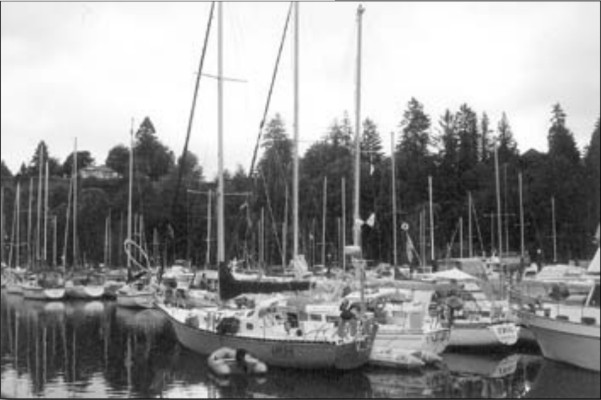
From Newport Beach, California, to Newport Bay, Oregon, we visited customers and searched for “our boats.” Though I may have whined at each new stop, the tradition stuck with me. Now, whether we’re cruising the San Juan Islands or driving Florida’s A1A highway, whenever my husband and I travel, we head for the nearest body of water to count “our boats.”
My husband, Dave, and I have also found that other Cascade sailors seek us out wherever we cruise. The camaraderie among the owners of these boats goes beyond the usual comparison of factory-installed features. There seems to be a desire to continue to network in hopes that someone else’s innovations will improve upon a vessel that’s never quite finished.
“Did you build it or buy it?” a woman asked us in Astoria. She alluded to the unfortunate fact that not all who took home a hull to finish were capable of the same quality found in the Cascades completed by the shop. Her words got me thinking about what had made Dad so successful as a salesman.
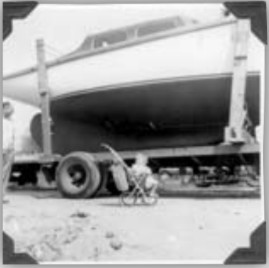
He had an unshakable confidence that any man could build a boat, that any man could be a craftsman, that any man could do what he had done, given the bare hull, a few shop-made components, and the inspiration gleaned from a tour of a well-built boat.
Renewing the enthusiasm
It was not until Dad was gone and I started meeting Cascade owners from other ports that I realized he must have been disappointed when some boats fell short of his ideal, landing squarely in the category of “kit boat.” I remember him shaking his head one day when a Cascade 29 named Covered Wagon cruised by us. That I didn’t recognize it seemed a relief. “Maybe others won’t notice it’s a Cascade, either,” he winked.
I recalled that conversation the summer Dave and I cruised to Port Townsend, Washington, and another Cascade 29 escaped my notice. The wooden sides of its non-traditional trunk cabin were weathered and molting varnish, and the gelcoat on the hull was dulled by too many docks and too few fenders.
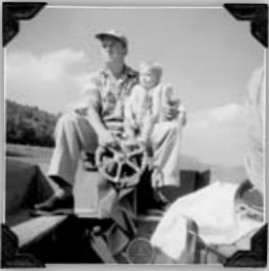
That evening we heard the now familiar greeting, “Isn’t this a Cascade?” It was the owner of the 29. As he described his refit plans, his eyes sparkled with anticipation. I couldn’t help but remember the winches under the tree and was reminded that the passion that had belonged to Dad and the first generation of builders still burned in the souls of those who bought second-hand boats and poured their hearts into refurbishing them.
As we begin our own upgrade of Dad’s Cascade 36, Dave looks at the yard at Cascade Yachts and calls it a “field of dreams.” It could be true that some of those boats will sit on the hard until they’re eventually sold, but I like to believe, as Dad did, that their owners will see their dreams through. No one has arranged geraniums in front of their work in progress, but at least there is progress. With a few more hours and a few more dollars, those boats may yet sail again.
“I always hated to bother him about boat stuff on the docks,” RCYC’s Commodore recently told some perspective members. Larry Corderman, himself the owner of a lovingly rebuilt Cascade 36, summed up Dad’s gusto: “It turned out, there was nothing Tom liked better than to talk about his Cascades.”
Thank you to Sailrite Enterprises, Inc., for providing free access to back issues of Good Old Boat through intellectual property rights. Sailrite.com