A prominent yacht designer discusses the importance of beds
Issue 34: Jan/Feb 2004
IN THE NOVEMBER 2003 ISSUE OF GOOD Old Boat we discussed arrangement plans: aft cockpit, center cockpit, and pilothouse. It’s time to take a closer look at interior furnishings but — regardless of type — the average cruising yacht is not going to provide palatial accommodations. Essentially, sailors want an interior that will accommodate a reasonable number of adult crewmembers in modest comfort and provide space for them to store their spare clothing and other amenities.
Unfortunately, far too many designs have an excess of berths at the expense of a workable galley, comfortable head, and adequate stowage. Indeed, the number of berths has no relation to how many the boat will accommodate in comfort. Usually it’s the reverse: more berths equals fewer accommodations and less comfort. Most readers know how I rant and rave about six-berth 25- to 28-footers. Who in their right mind would want six people aboard a small boat overnight? Even the smallest cruising yachts require a certain minimum of amenities if they are to provide snug comfort for anything more than a cramped weekend. Sacrificing a decent galley, head, or stowage for unnecessary berths makes absolutely no sense at all. ’Nuff said.
Deserves thought
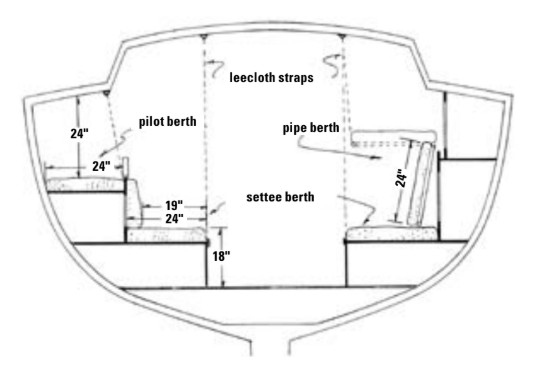
For a true cruising boat, a comfortable berth is every bit as important as a workable galley and deserves an equal amount of thought. Size is important, and though a tired crew can sleep in a berth as narrow as 22 inches, 24 to 26 inches is desirable, particularly for chubby old-timers like me. With people growing taller, the minimum length is 6 feet 3 inches, while 6 feet 6 inches is better yet. The distance between upper and lower berths should be 24 inches or more, as much less makes it impossible to roll over. However, you need about 36 inches clearance in order to sit up in a berth.
Mattresses are usually a semi-rigid foam these days and should be 3 inches thick for modest comfort, while 4 inches is very desirable, and 5 or 6 inches is a pleasurable luxury. I’ve slept peacefully on 2 inches of foam, but then I’m one of those lucky sailors who can sleep on a wet cockpit sole if need be. Indeed, I’ve done just that in my younger days. Most sailors will be happier with a bit more padding under them, and a 3-inch-thick foam mattress is a reasonable minimum. For safety at sea, all berths should be fitted with a bunk board or, better yet, a leecloth, at least 8 to 10 inches high above the mattress, about 40 inches long, and with the ends left open about 18 inches for ventilation. In order to keep the crew in place in a serious knockdown, a wooden bunk board should be very strongly hinged and a leecloth triced up to pad-eyes in the overhead with husky straps or lacing.
Settee berths
This is the most common type of berth on small and medium-sized cruising yachts. The seats in the saloon double as berths. Settee-berth cushions are usually held in place with a wood trim rail, but this should not be too high or it can cut off the circulation in your legs while seated or of a limb flopped over the edge while asleep. These days, Velcro can be a better way to hold the cushions in place.
The cushions need to be about 18 to 19 inches wide for comfortable seating, but that is too narrow for a reasonable berth. One answer in the good old days was a pullout extension of the seat bottom (see photo on Page 6), but this is not as common as it used to be in the days of all-wood interiors. It’s more usual now to see a removable or hinged seatback that can be shifted to widen the seat to a reasonable berth width. Thought should be given to stowage if the seatback cushions are removable; using a shock cord or Velcro tabs to fasten the cushions to the overhead beats storing them on a wet cabin sole any day.
The settee berth upholstery needs some thought as well. Naugahyde and leather are slick and sweaty in hot weather. I prefer good canvas sailcloth myself, as it is tough, durable, and comfortable in any clime. Unlike some of the fancy materials you’ll see at the shows, sailcloth is also washable. Fancy and costly upholstery is completely out of place in a yacht where it will be subjected to sea water, spilled coffee, spaghetti sauce, and even the contents of upset stomachs.
Pipe berths
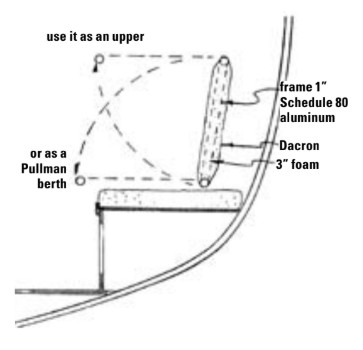
In former times it was not unusual for the seatback to hinge up to form an upper berth that would be held in place by webbing straps or Dacron lashing line running to pad-eyes or a strong wooden handrail fastened to the overhead. This is still a sensible solution to an extra berth on a small cruiser.
Experienced sailors often chose an upper berth on a long cruise as the straps could be adjusted to level the berth at sea. I learned this on the 1969 Transpac Race. Being the last man to join the boat, I was stuck with grabbing an upper berth. But I had the last laugh, sleeping level and comfortably while the yacht was heeled 15 to 20 degrees for days on end. Then, when we finally jibed, I simply readjusted the straps and slept on the level again.
The hinged upper can be made of sturdy plywood, but a frame of 1-inch or 1 1⁄4-inch Schedule 80 aluminum pipe with a Dacron bottom tightly laced in is better. A thinner cushion can be used with this cloth bottom so 2 inches of foam is generally quite adequate for comfort, and in hot weather the cloth bottom is even cooler if used without a mattress. A point to note is that a sturdy grabrail is highly desirable above the inboard edge of the berth in order to aid the sleeper in getting in and out of it. Leecloths are very much an essential as well since the level upper can become terribly unlevel if the boat is tacked in the middle of your off-watch.
Pipe berths are often fitted in other areas, in the forepeak above sail bins, for example, or above workbenches in order to provide extra sleeping accommodation for racing crews.
Root berths
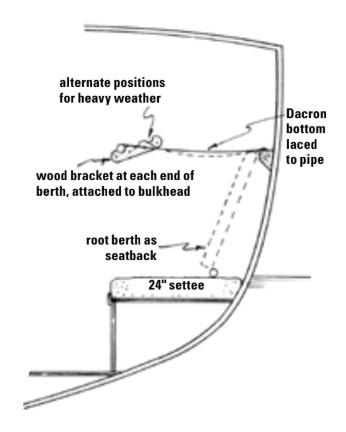
This is another Dacron-bottom berth, having its outboard edge fastened to a sturdy strip along the hull and its inboard edge sewn to a length of pipe. This pipe is pulled out to sit in racks fastened to bulkheads at each end of the berth. There are usually several positions in the racks so the berth can be stretched taut or allowed to sag, not unlike a hammock, to hold the sleeper in place in heavy weather. The berth takes virtually no space at all when stowed and makes a very useful upper when additional sleeping accommodation is needed. A leecloth will provide safety if the berth is used at sea.
A root berth can also be used as a seatback if a lower rack is fitted to lock the pipe down in place and keep the Dacron berth-bottom taut. The mattress could be held in place on the Dacron with Velcro and would provide the padding necessary for comfort when the root berth is in its seatback position.
Pilot berths
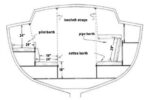
Pilot berths are built outboard of saloon settees and are usually just enough lower that the seatback forms a low bunk board. In any case, the berth should be low enough that there are 22 inches or more above the mattress. The pilot berth, being located roughly amidships where the motion is least, is often the most comfortable berth on a small yacht. Sleepers are well out of the way of traffic so they can usually get a good kip, even in rough weather, without having someone occasionally falling or sitting on them.
The pilot berth requires a good leecloth, as the seatback is usually too low for safety in extreme conditions. A friend of mine was thrown from the weather to the lee side of a beamy 54-foot keel-centerboarder in a knockdown, simply because there was no leecloth. Since it was about an 8-foot drop to the leeward berth, it woke him up in a painful hurry! A judiciously located hand grab is also useful, as it will help the off-watch exit the pilot berth gracefully without having to step on someone snoring away on the settee below.
Unfortunately, a pilot berth will steal about 2 feet of width out of the accommodations and use up useful locker and bookshelf space outboard and above the settee. For this reason, only one pilot berth is usual in yachts under 40 feet, although larger, beamier craft may fi t pilot berths port and starboard in the saloon to good effect.
Quarter berths
The quarter berth, located under the cockpit alongside the engine, is not my favorite setup in a yacht. To the best of my recollection, I’ve never slept in one. All too often the exposed part of the quarter berth is used as a seat for the navigator, while the tunnel is simply a catchall for clothing and loose gear.
The problem with the quarter berth is that it is often poorly ventilated and therefore stuffy. It can be warm in hot weather and both warm and noisy other times, particularly if the engine is running. In addition, the sleeper may also get a refreshingly cool shower of rain and spray or an invigorating dollop of icy sea water whenever the companionway hatch is opened. He’ll also be able to overhear everything that’s going on in the cockpit above: pounding feet, grinding winches, and the skipper’s screamed orders.
Unfortunately the quarter berth is de rigeur on many production cruisers today where it uses up valuable cockpit sail bin stowage space. Indeed, some yachts have two of the things or, often, a doublewide quarter berth is made into an even stuffier aft “stateroom” to waste even more useful stowage space.
If a boat must have a quarter berth, it should be arranged so the sleeper does not have to scrunch into a long narrow tunnel. The berth should be comfortably wide — 26 inches or better, have ample height so the sleeper can pull his knees up, and have enough length of berth in the cabin proper so that access and egress do not require him to be a contortionist. Getting in and out of the typical quarter berth can be a problem for large or less agile crew members, so convenient hand grabs are desirable here. If the berth is to be used at sea, some kind of curtain to protect the sleeper from lights in the galley and the occasional spray of water also would be welcome.
V-berths
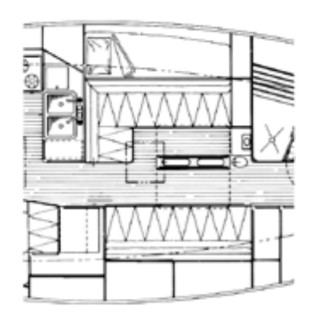
The forward cabin often poses a problem to the designer. It is not a good place for sea-going berths, as the berth is laid out at a sharp angle to the boat’s centerline. As a result, sleepers have either their head or their feet elevated when the boat is heeled under sail or both alternating if the boat is rolling in a beam sea. V-berths usually taper, being narrower at the feet than at the shoulders, and this can pose problems for anyone using standard sheets and blankets.
Still, the V-berth is one that is readily converted into a double by using a filler and, as the cabin can be given some privacy with a door or curtain, the V-berth is almost essential for a couple cruising on a smaller boat with guests or children. If the berth is to be used with a filler, the side rails should not extend above the berth bottom, or they will dig uncomfortably into the sleepers.
In the typical boat, the V-berth gets wider the higher it is fitted, due to hull shape forward. The temptation is to make it high and wide then, but remember that 36 inches is required for sitting upright so the V-berth should not be too high in the boat. If the berth is located well above the sole, and I’ve seen a few 3 feet high, it’s very desirable to have a good step in order to ease access and add to safety. Since boats also tend to get pointier as you proceed toward the stem, while feet don’t, the V-berth should not be fitted too far forward in the hull either. The foot of the V-berth should be a minimum of 16 to 18 inches wide. Even that is on the snug side for two average adults, yet I’ve been aboard boats where the berths actually came to a point just behind the stem. That would hardly suit my size 11 triple Es!
Double berths
You’ll see “double berths” as narrow as 36 inches advertised in many small cruisers, but they’ll only fit tiny and anorexic couples who will still be miserably uncomfortable in warm weather. A tight double is at least 42 to 43 inches wide, while a regular double berth is 48 inches wide, at least at the shoulders. Indeed, on larger yachts most owners request 60-inch-wide queen-size beds.
Leecloths are essential and, if a double berth is to be used at sea, the mattress should be split down the middle and a leecloth fitted. This way the sleepers do not wind up getting crushed together on the leeward side if the yacht is sailing at a good heel angle or rolling in beam seas. I shared a queen-size berth with the owner on another Transpac race and was very glad indeed that I’d specified a sturdy central leecloth! We both slept better.
One problem with double berths on smaller yachts is that they can rarely be located so each sleeper can get in and out easily. Too often the berth is tucked against the hull side or a bulkhead, so the person who draws the short straw has to crawl over the other in order to get into the sack. That can be a real nuisance. A double berth on a large yacht can have good access to each side.
Dinette tables are often used in smaller yachts to convert the dining area to a double berth. This can work satisfactorily if the table is sturdy and the fiddles are removable, but the climb-over problem remains. In any case, I do not favor dinettes on a sailboat, as athwartship seats are difficult to sit on comfortably when the boat is sailing at a steep angle. A U-shaped dinette gives some usable space on the outboard side when the boat is heeled, but I prefer a fixed table for the seagoing yacht with perhaps one L-shaped leg for additional seating.
Athwartship doubles are not uncommon but, unless they’re king size, they are not very convenient at sea since either your head or your feet are raised when under sail. They’re better suited to coastal marina hopping or lying in a quiet anchorage each night.
Incidentally, I started this article as a single feature about yacht furnishings in general, but it hasn’t yet progressed beyond berths. I had no idea there was so much to say about the simple berth. Even so, I’m sure I’ve left out something that keen readers will remind me about. Right now I’m going to start an article about galleys. Watch for it.
Thank you to Sailrite Enterprises, Inc., for providing free access to back issues of Good Old Boat through intellectual property rights. Sailrite.com