A catboat with standing headroom and fixed keel? Here’s onesuch
Issue 32 : Sept/Oct 2003
I’ve always loved catboats but never owned one. There always seemed to be limiting factors that made me look for a sloop or cutter. It boils down to lack of headroom. I love the look but want to be able to stand up to pull my pants on! Hackett Cummins had cruised a Marshall 22 for a number of years and had come to the realization that it would be nice to be able to stand up down below. He bought a Nonsuch 26 and named her Pelican. I guess Gordon Fisher felt the same way.
The Nonsuch was the inspiration of Gordon Fisher, a respected Canadian sailor who was, at that time, CEO of Southam, Inc., Commodore of the Royal Canadian Yacht Club, and co-skipper of the custom C&C Red Jacket when it won the Southern Ocean Racing Circuit.
When this hotshot sailor decided to go cruising, he had some distinct requirements that were not represented by production sailboats on the market. He admired the Ljüngstrom rig with a freestanding mast and no boom, believing it to be a perfect singlehanded rig. He took the idea of a one-sail catboat with a keel and full headroom, to yacht designer Mark Ellis for further development.
Mark drew an unstayed mast but convinced Gordon to include a sailboard-style wishbone boom for better sail control. It was a viable idea, but it did not have a builder.
Enter George Hinterhoeller of St. Catherine’s, Ontario. George was cool to the idea of the Nonsuch. He was not in love with New England-style catboats.
Eventually, Gordon and Mark convinced him that a fin-keeled balanced hull, with a single sail and a spade rudder, would not have to have the undesirable characteristics of a catboat, primarily heavy weather helm.
She could have full standing headroom and a balanced helm in a whisper and a blow. The Nonsuch was born.
More than 1,000
Production started in 1978 and continued until 1995, with two breaks due to changes in company ownership. In all, more than 1,000 boats were built. Nonsuch sailboats were built in 22, 26, 30, 33, and 36 feet. Two additional models were introduced — the 324 and the 354 — which were versions of the 30 and the 33, respectively, but with different interiors.
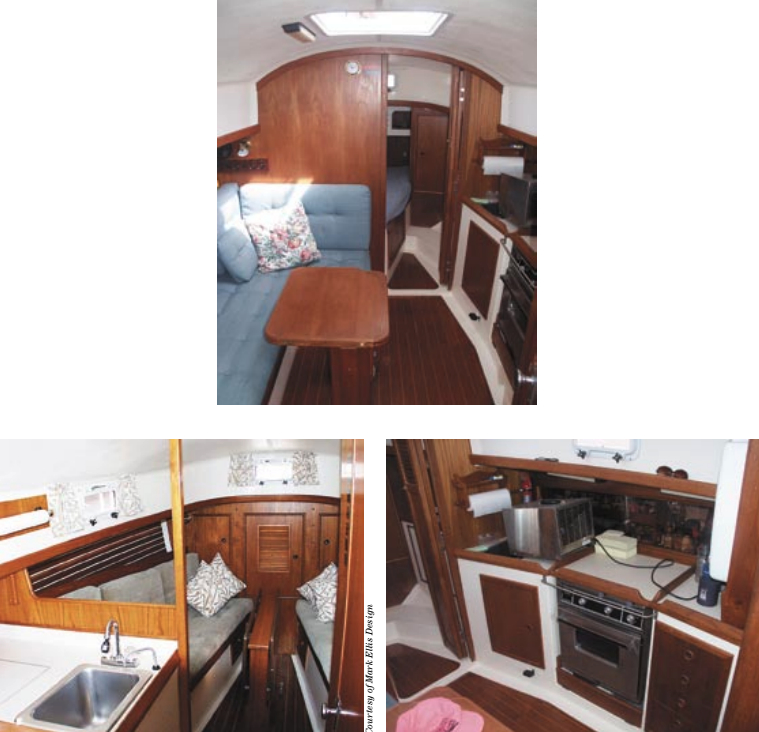
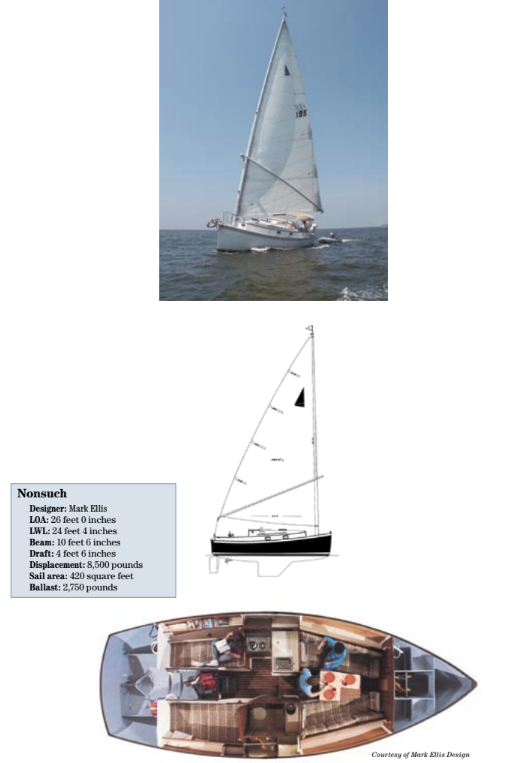
The 26 and 30 were both built as “Classics” with the galley and head amidships, port and starboard settees, a single quarterberth to port, and a double quarterberth to starboard (see illustration on Page 8).
The “Ultra 26” layout had a starboard-side galley, head aft, no quarter berths, an L-shaped dinette opposite the galley to port, and a double bunk forward of the dinette to port. A hanging locker and small seat was opposite the double bunk to starboard. Hackett Cummins’ Pelican, hull #195, has the Ultra interior.
The 26-foot Ultra is well laid out for a couple, while the 26-foot Classic sleeps up to five on two settees forward and the two-and-one-half quarter berths aft. It is something of a stretch to call the starboard quarter berth a double, but it would be a luxurious single for most anyone.
The name Nonsuch is interesting. Whether she was named because there was nothing like her on the market or for a Canadian historical personality — Baroness Nonsuch of Nonsuch Park in Surrey England — is open for discussion. I prefer to think it was named because there was “none such” designed when it was introduced. (Actually, Mark Ellis tells us that the name came from the first trading ship used by the Hudson’s Bay Company. Perhaps the ship was named after Baroness Nonsuch. A replica of this 60+ foot ship is on display in Winnipeg, Manitoba. –Ed.)
The fit and finish of Pelican are to George Hinterhoeller’s high standards. He also built the Niagara line of sailboats and had a sterling reputation.
Large and beamy
As befits a catboat, this is a large 26-footer with a beam of 10 feet 6 inches and a waterline length of 24 feet 4 inches. There is 6 feet 3 inches of headroom in the main cabin. In many ways this 26-footer is the equal of my 31-foot Eldridge-McInnis sloop which is 31 feet overall and 24 feet 6 inches on the waterline with a beam of 9 feet 6 inches. It has more than 6 feet of headroom down below, too.
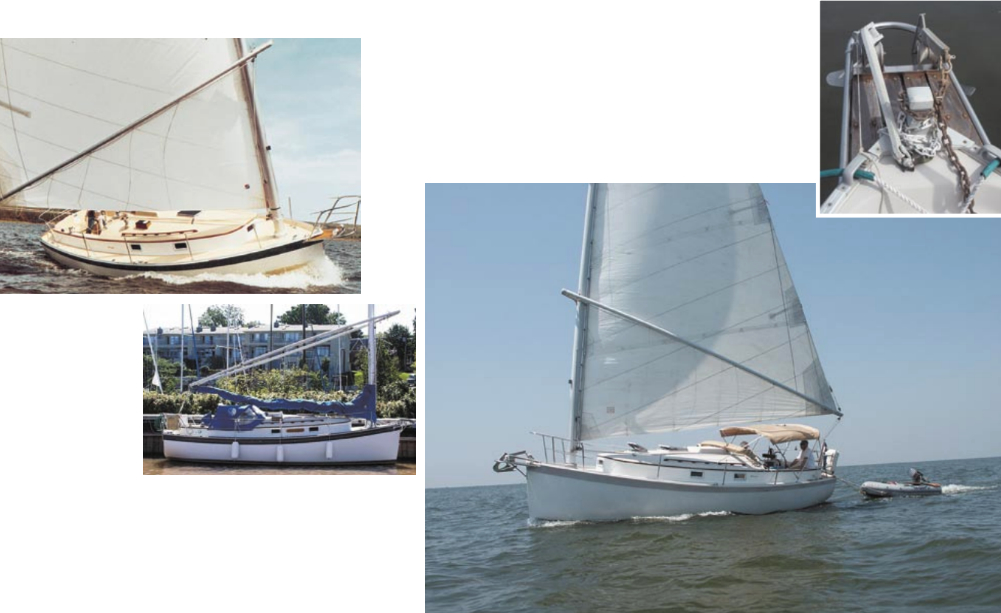
Pelican is a really big boat with a plumb bow and vertical transom . . . simply speaking, a lot of boat. The cockpit, catboat style, extends almost to the hull sides and is extremely roomy. There are usable sidedecks outboard of the cockpit but no lazarette. The boat is therefore missing some stowage that my boat’s lazarette offers. As I only store mops, buckets, and fenders there, I wouldn’t miss mine as long as there were good cockpit lockers.
Fortunately, the Nonsuch has good, big, easily accessed cockpit lockers. One of the items in my lazarette is a spare anchor, but the Nonsuch 26 takes care of that with a short, but robust, bowsprit with plenty of room for two anchors.
Once you are forward of the cockpit, going forward is easy. The grabrails run the full length of the coachhouse, and you can hold on to the mast at the bow. Pelican has lifelines, but I would rather be bent over a little lower and inboard, holding on to the handrails. The lifelines are fine for grandchildren to hold on to in quiet water, which is what Hackett’s grandchildren like to do.
Rain or spray is kept in control by recessed drains in the deck at the low spot. These empty through pipes below the waterline. There is no stain running down the topsides. The hull-to-deck joint is covered by a heavy-duty aluminum extrusion that incorporates built-in chocks. There is a substantial stern rail incorporating the stern boarding ladder.
Halyards led aft
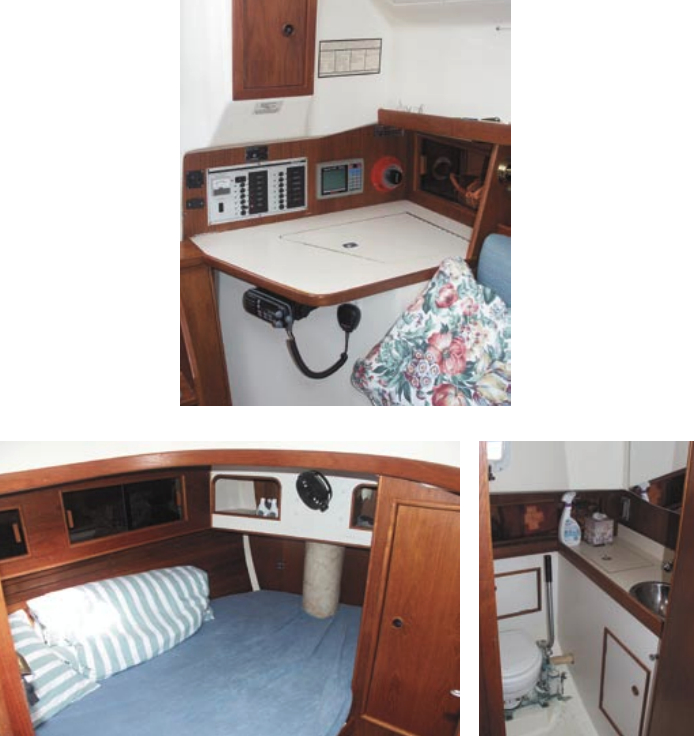
Pelican has winches mounted on the coachhouse for the main halyard and two reefing lines and the mainsheet winch in the cockpit aft. All halyards are led aft to the cockpit under the dodger.
The only other things on deck are the varnished eyebrows over the five opening ports and two hatches in the coachhouse roof. With the companionway hatch sliding open under the sea hood, there is plenty of ventilation below. Pelican is not fitted with an anchor windlass, but there is room for one forward of the mast. Fitting it with the mast in place would be a good exercise for a contortionist.
Pelican is equipped with aWesterbeke 18 A diesel. Some Nonsuch 26s were fitted with a Volvo Sail Drive, some with a 13-horsepower Westerbeke, and some with engines up to a 25 horsepower. I prefer the 18- to 21-horsepower diesel for its smoothness (4 cylinders), but the Nonsuch will be responsive with any of the engines mentioned — just be sure the prop is free of barnacles. More on this later. With a fuel tank capacity of 24 gallons, a water tank capacity of 64 gallons, and a 24-gallon holding tank, the boat has good cruising range.
Average fuel consumption should be between .7 and l.2 gallons per hour at hull speed for a range under power of about 130 miles at 2,500 rpm. Maximum speed under power should be about 6.6 knots. Hackett reports that Pelican does 6.5 knots with a clean bottom. This is excellent for a 26-foot boat. The displacement is 8,500 pounds with a ballast/displacement ratio of 32 percent on a long waterline. Draft is 4 feet 6 inches and, as already noted, beam is l0 feet 6 inches. Sail area is 420 square feet with some real power for light conditions. With a cat’s cradle of lines between the two spars of the wishbone boom, reefing is easy. Drop the sail into the cradle and tie off the reefing lines. The sail hangs below the boom when stored, making it easy to cover the sail for an evening.
Sails like a dinghy
Hackett says sailing the Nonsuch is different from what you might expect. The boat sails like a big dinghy with just a genoa flying. In fact, the big sail trims like a genoa, rather than a main. She is very responsive to the helm as long as you don’t overtrim the sail. According to Hackett, there is no weather helm up to about 20 knots of wind, at which point it is time to reef anyway. The unstayed mast is very flexible and bends to leeward in the puffs, spilling wind from the sail. When Hackett first owned the boat, he deliberately tried to put the rail under and found he could not make the boat do it. He believes the keel and mast balance each other so well that the result is one very stiff, but not uncomfortable, boat.
While the Nonsuch and Freedom rigs have the wishbone spar in common, the details vary significantly. The Freedom wishbone rig uses a two-ply sail that surrounds the mast like the sock on a boardboat sail, and the wishbone moves up and down with the sail. The Nonsuch rig uses a single-ply sail attached to a track with slugs. The forward end of the boom hangs from hanger lines, and the spar is pulled toward the mast with a “choker,” a line which is led to the cockpit. Tightening the choker pulls the forward end of the boom toward the mast, which has the effect of flattening the sail by moving the after end of the boom away from the mast. The choker is used like an outhaul to control the amount of draft in the sail. As with all catboats, reefing early rather than late is good seamanship. Reefing is simply a matter of slacking the main halyard, taking up on the pre-rigged reefing line, and re-tightening the main halyard. All this is easily accomplished from the cockpit. The sail area that has been reduced falls into the lazy-jacks below the wishbone boom.
Propeller changed
When she was first purchased, Pelican had a fixed three-bladed propeller. This was changed to an automatically feathering three-bladed prop with marked improvement in sailing quality and no decrease in powered performance. Last fall, when we attempted to sail, the prop was encased in barnacles and would not function. There were so many barnacles, the prop could not be rotated to provide power. A diver was called, and we put off sea trials for another day. Hurricane season arrived before we had another opportunity to sail Pelican.
On Memorial Day weekend of this year we got out at last for a fine sail. The boat handles as reported with none of the weather helm usually associated with catboats. Raising the sail is easy. We had a most pleasurable day and a good sail.
Thank you to Sailrite Enterprises, Inc., for providing free access to back issues of Good Old Boat through intellectual property rights. Sailrite.com