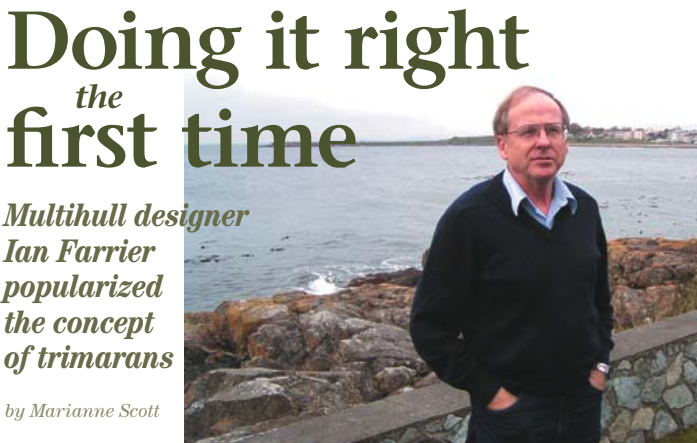
Multihull designer Ian Farrier popularized the concept of trimarans
Issue 35 : Mar/Apr 2004
The wind was blowing only 13 to 14 knots in Canterbury Bight off Timaru on New Zealand’s South Island, yet we were ripping along at nearly 10 knots over the turquoise water on an F-9A/F-31, one of multihull designer Ian Farrier’s well-known folding trimarans. It’s the first time I’d sailed without a heavy lump of lead hanging below me. My host, Ken Wood, who was building Farrier’s 36-foot trimarans at his local plant, had parked me on the netting between the main hull and starboard float (or ama as the Polynesians call them). Lying on my stomach, I watched the water flash below me. “Am I in a NASCAR race?” I wondered.
It seemed most natural to experience the thrill of sailing a trimaran during our down-under holiday, because 800 to 1,000 years ago these islands were colonized by skilled sailors who arrived there from Southeast Asia in proas and outrigger canoes. Moreover, Timaru is only a few miles south of the major New Zealand city of Christchurch, where multihull designer Ian Farrier was born in 1947, lived his young years, and grew enamored of boats. And it was particularly the speed of tri’s — or “troi’s” as Ian calls them in his soft Kiwi accent — which kindled his love of multihulls.
Learning the ropes
Ian learned to sail early. His father was “into powerboats,” but when Ian was about 10, the family bought a “bach” — the New Zealand term for cottage — on Charteris Bay, not far from Christchurch. The bach came with a Takapuna-class dinghy, a heavy, gaff-rigged, 14-foot wooden boat. Ian remembers how a neighbor, Harold Smart, showed him and his brother, Peter, the ropes, although the dinghy was rigged with rusty steel wire and “other nightmare stuff.”
When Ian’s father noted his sons’ zeal for sailing, he decided they should build something nimbler — a Cherub, a New Zealand class designed by John Spencer. Plans were purchased and the garage converted into a boat shop. The elder Farrier enlisted a Dutch carpenter named Henk to help the kids on weekends. “Henk showed us how to construct a plywood dinghy,” Ian remembers. “We built the frame, mixed the glue, and bent the plywood. That’s how I learned the basics of boatbuilding. I couldn’t have had a better teacher than that Dutchman.”
Ian enjoyed sailing the Cherub, the first boat he could get up again after capsizing. But the 14-footer required a crew of two, so Ian opted to build a 12-foot Zephyr, a cold-molded dinghy resembling a Laser, which he raced in a one-design fleet. “Small monohulls are great fun,” says Ian. “I’d rather sail a monohull than a small cat; monohulls are responsive and more comfortable because you can sit in, rather than on, them. I don’t like Hobie Cats and other small catamarans because they won’t tack, but a dinghy can flick around and tack out.”
Life changed significantly for Ian when his father died of a brain tumor in 1966. New Zealand had death
duties, and Ian’s mother was forced to sell the bach and downsize the family home to pay the taxes. “I think they took about a third of the assets,” Ian says with a wry shrug. “It certainly ended my sailing days in Charteris Bay.” All this took place during Ian’s second year of mechanical engineering studies at the University of Christchurch. An unhappy student, he found bridge-building tedious, and felt “bored out of my brains.”
In retrospect, Ian believes he had a touch of what is now called attention deficit disorder. He struggled to concentrate on lectures. “I could do the work but found it very hard. Even now, if I go to a lecture or a symposium, it just drives me nuts. Fortunately, if I need to learn something, I can get a book and grasp the material with no problem but only on that particular subject. If it covers anything else, I’m not interested. There should be a university for people like me.”
His first trimaran
Ian left the university in 1967, raced cars as a hobby, and worked at various jobs until the boatbuilding bug bit again. He dreamed of traveling and began searching for a boat. Around this time he chanced on an article touting trimarans in the popular British magazine, Practical Boat Owner, so when a local man advertised an unfinished tri for sale, he investigated. “I was attracted to trimarans because, to some degree, they look like airplanes. I like fast cars, and I like fast boats.” He also liked the deck space, shallow draft, and easy handling, so after surveying the unfinished tri, which was on a mooring, he shelled out $700 — a modest purchase, perhaps, but one that transformed his life.
The trimaran was based on a design by Arthur Piver, the California yacht designer who popularized plywood trimarans during the 1960s and whose plans allowed amateurs to build them using lumberyard- and hardware store-grade materials. “Piver put tri’s on the map,” Ian says. “He sailed one across the Atlantic and to New Zealand. He was also a promoter, putting out tons of publicity about tri’s and what they could do. It both irritated and converted a lot of people.”
Ian’s new boat was only a shell and needed work. He pulled it out of the water, rented space, and spent two years finishing it. To finance the project, he worked as a toolmaker, a skill he acquired quickly. “I’ve always done well with my hands, so toolmaking came easy. And handy. I fabricated chain plates, rudders, and other pieces in the shop. And I learned to run the machines, lathes, and presses — that became valuable when I designed the folding trimaran, which used lots of metal.”
In 1969, having rebuilt his trimaran, it was time to put her to the test in the famous Roaring Forties. The way Ian tells it, his shakedowns would give nightmares to all parents of intrepid, 22-year-old sons. He teamed up with a mate, saying, “It’s going to be hell today — 45 knots at least — so let’s go out there and break the thing.” A southerly “buster” (Kiwi for sudden gale) was forecast. In New Zealand, southerly busters are preceded by strong northwest winds. While the pair was belting along with all sails up, the southerly hit from the opposite direction at 70 knots. The boat flew up in the air and the rig sheared off, which Ian reckons kept them from capsizing.
He disliked the fact that his tri, at slow speed, “wouldn’t tack worth a damn.”
“Piver had added little winglets to the floats,” explains Ian, “but all later trimaran designers added a daggerboard or centerboard to the main hull to improve the ability to point and tack.”
Ian’s mooring in Littleton Harbour was highly exposed and, if the boat wasn’t pointed in the right direction, she’d accelerate right onto the rocks. Nevertheless, it was the speed he found intoxicating. “You become your own worst enemy because you’re flying at 20 knots. Everything seems fine until you push it too hard and you pitchpole. You’ve got to keep yourself back from the edge.”
The safety issue
The tales of these foolhardy trials lead naturally to the persistent questions about multihull safety and their alleged inclination for turning turtle. Victoria, British Columbia, veteran multihull racer Nick Banks claims, only partially tongue-in-cheek, that “a monohull is happiest on the bottom, while a multihull is happiest upside-down.” Banks also adds that Ian’s boats are “wonderful designs, exciting to race, but leave little room for error. Like all multihulls, there’s little to counterbalance the load on the sails. The load translates into forward speed, creating massive acceleration. Like a high-powered automobile, you can push it beyond the limits, so if you’re racing the boat too hard, it’ll ‘assume the position.’”
Ian has countered safety questions for decades. His website, <http://www.f-boat.com>, asserts that “all Farrier designs are totally unsinkable, even with all hulls flooded.” One can certainly capsize multihulls, he explains, but you have to be doing something “completely stupid.” No one should go out with the family, put full sail up — including the spinnaker — and go 25 knots.
“When we raced in Australia,” he remembers, “we’d be out in 50 knots, which kicked the boat right up. But I’d never do that with my wife aboard.” An F-27, for example, can go 18 to 20 knots before you are pushing it, he states. With the spinnaker, it can do 20 to 25 knots, but you need someone on the sheet to release it when you’re nearing the “ragged edge.” He cautions that these speeds are only for racing, not cruising. He also believes that multihulls get a bad rap because any accident gets reported in “crash and burn headlines,” while monohulls, well, their accidents are taken for granted and ascribed to other causes.
Ian also believes that during storms, his trimarans, unlike many monohulls, can lie a hull in most conditions without capsizing. He stipulates that the floats must be sensibly sized and curved down on the sides so they’ll keep on surfing. Nor can the boat be overloaded. He recalls that during at least two storms, he took down all sails and allowed his trimaran to drift sideways to the waves. The vessel would crest each wave, then skim down. “If a breaking wave hits the boat, there’s a big bang, then the boat shoots off sideways.” He refers to Nigel Tetley, whose 40-foot Victress was the first trimaran to round Cape Horn. “His sole storm tactic,” Ian says, “was to take everything down and go below while the boat slid sideways down the waves.”
Having tested his trimaran as far as Auckland, on New Zealand’s North Island, and having weathered more storms, Ian decided not to risk going farther offshore. He became a “seagull” — a day worker on the wharves — unloading freighters in Wellington and Napier. Then, in 1970, with a few dollars in his pocket, he joined two others on a 38-foot Woollacott ketch and sailed off to Tonga. Ian quickly learned that a monohull’s behavior in a storm isn’t necessarily any better than a trimaran’s and found the ride “damned uncomfortable.” He disliked the weight of the monohull’s full keel, her tendency to broach, and most of all, her top speed of only 6.5 knots. “That’s what converted me permanently to trimarans,” he says.
The Trailertri is born
Ian flew to Sydney, Australia, signed on again as a toolmaker and took a second job selling swimming pools to build up a nest egg. In 1972, he married Alicia Clephane, a nurse whom he’d been courting for some time, and the couple moved to Brisbane. Ian “tried a bunch of jobs like you do when you’re young,” even selling real estate, while Alicia continued her nursing. Six months later, another trimaran intervened in his life. An ad asked for someone to teach Fred Howard, the new owner of a 30-foot Piver Nimble, to sail his boat. Ian answered the ad and thus gained the opportunity to sail regularly on Brisbane’s Morton Bay.
One day he found himself sailing through a group of monohull trailersailers. He concluded that a trailerable trimaran was unusual enough to be a good bet: it would sail well, it was unique, it was fast, and it was a good business opportunity. Although without formal yacht design training, Ian was fully confident he could design and build what he called the Trailertri. He bought L. Francis Herreshoff’s book, Common Sense of Yacht Design. “He’s a man I like,” explains Ian. “Like me, he believed that if it looks right, it’s going to be right. Just by looking at it, I can see if something’s going to work or break. Afterward, I check it engineering-wise, and 99 percent of the time I’m right.”
To make trimarans better able to point and tack, he added a centerboard to his model — an addition made to all his subsequent boats. His next challenge was to map out how the trimaran could be folded to fit onto a trailer. He knew about an English “swing-wing” folding system designed by John Westell but thought it lacked structural integrity. He also rejected the approach Tony Smith was developing for folding his Telstar 26-foot trimaran, because the system folded the floats below the waterline.
So, while sitting in an old armchair, Ian dreamed up new folding systems, discarding many because, in his mind’s eye, he could see them flop, bend, or break. After playing around with the geometry, he built a plywood model and was delighted that when he “folded it, it folded.” He obtained patent protection for his folding system and built an 18-foot prototype under his house, which, like most Brisbane homes, was built on stilts (“stumps” in Australian). “My wife was very supportive,” he recalls. “She worked full-time as a nurse and was paying all the bills.”
After testing and retesting his prototypes (“it must be strong, dependable — it must be right”), he teamed up with Brisbane boatbuilder Haines Hunter. Calling his new design the Tramp, about 300 fiberglass copies were built. It won the Australian 1981 Boat of the Year award.
Corsair Marine comes calling
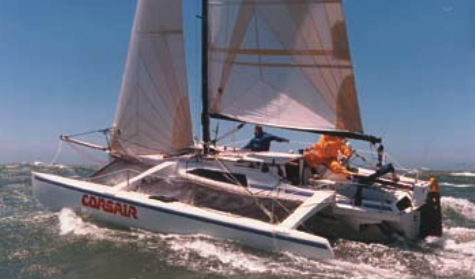
Then, in 1983, John Walton, scion of the Wal-Mart empire, invited Ian to build his boats in the United States. Ian accepted the job, with the stipulation that he could manage the plant. So he and Alicia, along with their sons, 10-year-old Michael and 6-year-old Stephen, moved to San Diego, with Ian heading up Walton’s newly founded Corsair Marine — serving as designer, builder, and marketer. The first F-27, called Super Fox, was launched in 1985, and Ian set a record in the Two Men Around the Catalinas Race, beating a 65-foot maxi monohull. Two years later, Mark Robson’s Killer Frog completed the Transpac, and in 1990, the F-27 was recognized as an official class by the Nippon Ocean Racing Club, the first trimaran to be thus acknowledged.
About 450 F-27s were built and their success established Ian’s North American reputation as a quality trimaran designer and builder and solidified the trimaran as a viable part of the sailing scene. It also confirmed Ian’s desire to stick with trimaran design (he’s only designed one catamaran: the F-41, which has not yet become a production boat). Even with the growing popularity of cats, he believes that trimarans sail better in all conditions, handle better, and go faster. He also cites the ease of their trailerability, thus extending range. And, of course, a foldable trimaran on a trailer “can save you hundreds of dollars a month in moorage fees alone,” he says emphatically.
In 1991, Ian and Corsair Marine parted ways. He’d run into the controversies dogging every yacht designer: he wanted to design a certain range of boats and wanted them built to his specifications. “Basically,” he says, “we disagreed on where the company should go.” Both Ian and the company wanted to develop the F-24, but their views differed on how it should be built. Although Ian could understand the company’s position (“they were paying the bills”), both parties wanted to control the company’s direction. So Ian got out. As designer Robert Perry says of this familiar conflict, “It’s an ongoing war. You do what you can to make the yard conform to your specs, but in the end, the yard always wins.”
Ian moved to Seattle and formed Farrier Marine, while Corsair continued production of its version of the F-24. Meanwhile, Ian began working with OSTAC, an Australian boat-builder which launched a production F-31 the following year. Success Down Under led Ian to take another chance on licensing the F-31 to Corsair for North American production, but new controversies over what Ian calls “Corsair’s penchant to redesign” again severed the relationship.
When, in 1994, John Walton sold Corsair to an old friend of Ian’s, Australian Paul Koch, Ian resumed working with the firm. The F-24 and F-31 production models sold well — about 200 and 300 copies respectively — and the F-31 won the 1992 Australian Sailboat of the Year award. Ian also designed the F-36, which he considers his first fully capable offshore yacht (despite the fact that many smaller Farriers have crossed oceans), and a few were built under license in New Zealand. He then created his first catamaran — a 41-footer — of which 38 are being built by amateurs and yards — followed by the F-44, another trimaran. He licensed production of the F-28 to Corsair and the F-25 to MPG Marine. His various models continue to win numerous races and awards for innovative and influential design.
Corsair and Ian divorced again in 2000, disagreeing about quality and design features. Corsair is still building trimarans but no longer under the Farrier name. Although the parting of the ways was loudly announced in various publications, the details are sketchy. Ian doesn’t like to discuss the breakups, partly because he wants to avoid legal problems. It seems that Ian doesn’t bend easily to compromises in construction, especially when the boat has his name on it.
“Boatbuilders and designers always differ on quality issues,” says Ian. “Designers worry because if something fails, it’s their neck.” He subscribes to the tenets of W. Edwards Deming, the American quality-control engineer whose “doing it right the first time” concepts revolutionized postwar Japanese industrial production. “Even though I’m not a perfectionist to the extreme,” says Ian, “building quality is cheaper. The old saw of ‘measure twice and cut once’ speaks to me. I tend to measure three times and cut once. If you build it right the first time, you don’t have to go back and fix it.”
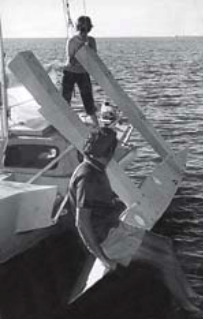
New designs keep coming
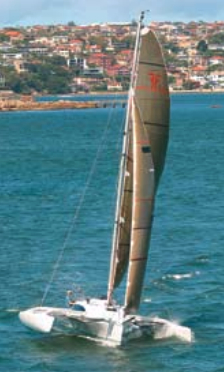
Today, more than 2,000 Farrier designs are afloat on the world’s waters. Their owners tend to be Farrier aficionados. Victoria, British Columbia, sailor Dennis Morgan is a recent convert. After sailing a J/27 for years, he and his wife, Cheryl, bought an F-9A in 2003. “We wanted something bigger,” says Morgan. “I wasn’t looking for a tri. But then I went for a ride. Terrific! The design detail is amazing. And its trailerability is attractive. We bought it to cruise, not race. But the boat is exciting enough to keep our children — and their friends — interested in sailing with us. It gets us places quickly. To us, the Farrier is the perfect family boat.”
Ian stresses that his boats are always designed as cruisers with places for people to sleep. “I create the maximum livable space inside and then concentrate on the boat’s performance. My boats are fast, but they’re not racers. Racers are impractical.” He sees his legacy as having popularized a folding, trailerable trimaran, a family boat that provides outstanding performance. He also thinks of his F-27 as true proof that trimarans are viable. He’s now concentrating on the F-33, of which six have been built at Keals Marine in Australia, with another 25 on order. He travels around the world, an extensive checklist in hand, to supervise the assembly of each new exemplar as it leaves its container. Wryly recalling how often early trimarans were the subject of ridicule, not only in Australia but around the world, he’s convinced that few people laugh today when they see triple hulls in the water.
He’s hoping to have enough time in 2004 to develop his latest, the F-22. In the meantime, Ian speculates that the time for multihulls is coming. “People sail on a multihull and are amazed how it can do 15 knots with everyone dry and unafraid. I can see them going away, shaking their heads and saying, ‘There must be a catch somewhere.’”
Thank you to Sailrite Enterprises, Inc., for providing free access to back issues of Good Old Boat through intellectual property rights. Sailrite.com