Inspecting and maintaining seacocks
Issue 38 : Sept/Oct 2004
The hull of a boat is designed to keep water out, but most boats also have through-hull fittings and seacocks that are designed to allow water to enter the boat safely. These seacocks are metal or plastic valves that are screwed onto through-hull fittings. They can be opened or closed to allow you to control movement of fluids either way through the hull. BoatU.S. reports, however, that seacocks are responsible for a large percentage of the sinkings that occur every year. These sinkings are most often due to improper installation as well as a lack of inspection and routine maintenance.
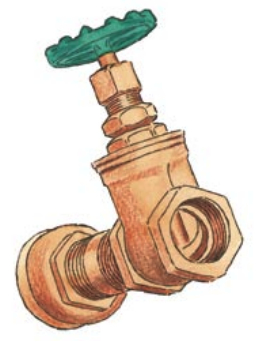
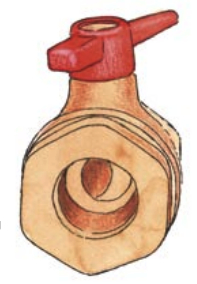
There are three basic types of seacocks: the traditional bronze tapered-plug seacock with a handle that rotates 90 degrees between open and closed; ball-valve seacocks that also have a handle that rotates 90 degrees between open and closed; and gate valves, which require several rotations of a faucet-style handle to open or close.
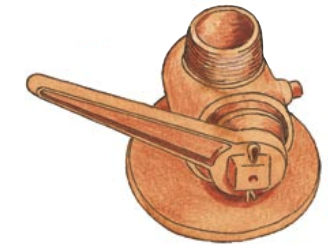
The traditional material for seacocks is bronze, but there are also non-metallic seacocks available. Although many sailors are skeptical about these “plastic” seacocks, the best ones — such as those made from reinforced nylon marketed under the name Marelon — have enormous tensile strengths. For owners of steel or aluminum boats, these non-metallic seacocks eliminate the corrosion problem caused by the galvanic action of dissimilar metals.
If gate valves are used, they should be bronze, not brass, but even the bronze ones usually include parts, such as the stem, which are made of dissimilar metals, inviting trouble. Another problem with gate valves is that they do not have a positive action. In other words, you can never be sure if they are completely closed or whether there might be a foreign object lodged inside. Also, they usually don’t have large flanges that can be secured directly to the hull and can therefore be broken off accidentally if subjected to a strong sideways blow.
Backing plates
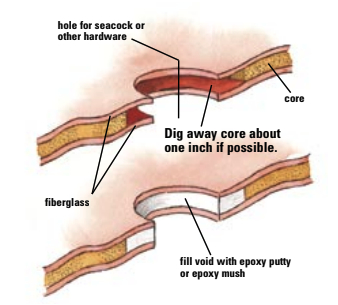
All seacocks should be mounted with a backing plate or hull-reinforcement with bolts that go through the hull, backing block, and flange. Wood backing plates should not be used with synthetic seacocks, since the wood’s expansion can strain the plastic. Also, whenever a through-hull is installed on a cored hull, the soft core must be cut away between the fiberglass layers and the void must be filled with epoxy and fiberglass to increase the compression strength of the area where the through-hull will be mounted.
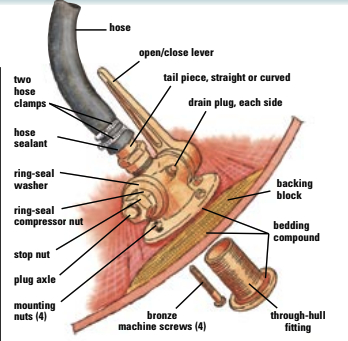
The through-hull is the part on the exterior of the hull. It screws into the seacock, which is inside the hull. The threads on this mushroom come in either straight, termed NPS for “National Pipe Straight” (sometimes called parallel threads) or tapered, termed NPT for “National Pipe Tapered.” Proper modern seacocks have a female straight pipe thread on the inlet side and a tapered pipe thread on the outlet side, while ball valves and gate valves without the flange have tapered pipe threads on both the inlet and outlet. When installing a seacock, it is of vital importance that the thread type on the outside through-hull fitting match that of the valve thread. Unfortunately, many boats have been built with, or later equipped with, a through-hull with straight threads and a valve with tapered threads. This gives about two threads of engagement and is easily broken.
Only heavy-duty reinforced hose should be fastened to seacocks, and it must be secured with two stainless-steel clamps, since ice inside the hose can exert enormous pressure and easily lift a single-clamped hose off the seacock tailpiece. As for those clamps, be sure you get them at a reputable marine-supply store. Very often those purchased at a hardware store will be labeled “stainless steel,” but only the band is stainless, and very soon you’ll find the screw mechanism rusted, weakened, and unusable. All through-hulls, except for the cockpit drains, should be closed whenever you leave your boat.
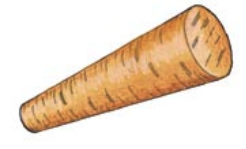
A selection of tapered softwood plugs should be kept on board. These can be used to stop the water flow from a deteriorated hose and inoperable seacock, or they can be pounded into place should there a be a catastrophic seacock failure. If such a failure occurs, there’s not much time to react. A 1 1⁄2-inch hole, 2 feet below the waterline, will gush more than 70 gallons of water a minute into the hull. For this reason, it’s a good idea to tether a wooden plug to each seacock, so one will be readily available if needed.
Tend to seize up
Most tapered-plug seacocks tend to become hard to rotate if they haven’t been used in many months. To prevent this seizing, they should be worked open and shut occasionally. (To make it easier to remember, I make it a point to exercise mine the first week of every month.)
All seacocks should be serviced annually. Follow the manufacturer’s recommendations. For ball-valve seacocks, just a small amount of grease is necessary. For tapered-plug seacocks, disassembly, inspection, cleaning, and regreasing with a waterproof grease should be an annual task. Special seacock grease works better than an automotive grease.
Occasionally you’ll find that sand or mud may have scored the tapered plug. For light scoring, smooth out the scratches with an emery cloth. For heavy grooves, apply a valve-grinding compound and rotate the plug inside its housing until it fits snugly; then thoroughly clean both parts and regrease. Since tapered-plug seacocks depend on this grease for their watertightness, they should be greased liberally and not overtightened.
Finally, avoid using a seacock to supply water to both an engine and a saltwater galley pump, air conditioner, or watermaker. If this is done, very often the suction of an engine operating at high speed will draw air back through that second device and decrease the engine’s cooling capacity. This use of a “manifold” to supply more than one source from a single seacock has been the cause of many perplexing engine-cooling problems.
Thank you to Sailrite Enterprises, Inc., for providing free access to back issues of Good Old Boat through intellectual property rights. Sailrite.com