Freedom Yachts founder believes something’s amiss in the sailing world
Issue 38 : Sept/Oct 2004
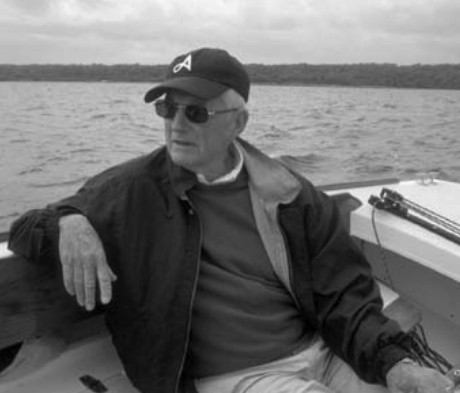
Garry Hoyt has a passion for sailing, there’s no doubt. At Newport Rhode Island’s Ida Lewis Yacht Club, to which he belongs, there is, down on the dinghy dock, one of the yellow-hulled Escapes he designed, ready whenever he wants to, well, escape. And up the western shore of Aquidneck Island at the East Passage Yachting Center in Portsmouth, there is an Alerion Express 28 ready to sail at a moment’s notice. Sometimes there’s an Alerion Cat and Alerion 38 yawl too.
If not a demo sail for a potential buyer, then perhaps an hour spent in solitude. It’s a daily routine, like walking the dog. To be enjoyable, nay, even possible, short outings like this have to be easy. Getting underway quickly is paramount. With too many boats, “sailing” and “easy” are mutually exclusive. It’s a beef Garry has had with the industry for years. For the last 25 he’s been taking his crusade to the street, or the dock you might say, trying to interest John and Jane Doe in the sport. The essence of his sales pitch is to keep it simple, safe, small, and affordable.
Listen in:
We’re sitting in Garry and Donna Hoyt’s Newport R&D office at the Little Harbor complex in Portsmouth. After brief salutations, he begins the rant.
“There’s a whole pool of used boats out there,” Garry says, “which is great for the buyer. But in terms of new boats, there’s not a lot of vitality in the sailing market. People are turning to powerboats. I think there’s a lack of design innovation. Fiberglass is forever so there is an abundant supply of used highly durable objects that are going to be there forever, that don’t have the good grace to rust away like cars do. The truth is there hasn’t been a lot of progress in hull design. There’s nothing wrong with a 20-year-old boat. You Awlgrip it, give it new sails and change the rig a little bit, and you’re laughing because the price is much lower than a new boat. That makes it tough to sell a new boat. The market is very tradition-bound, which inhibits progress. I think the problem has to be solved with small boats.”
All talk
Right now Garry is all talk, but he’s also a man who gets down and gets it done. A former marketing executive, writer, talented salesman, and self-taught designer, he backs up his talk with boats. The line of rotomolded polyethylene Escape sailboats he designed for Peter Johnstone is one of the more recent milestones in his long quest to simplify sailing. Like the Expo Solar Sailer, on which he developed the color wheel that helps beginners figure out how to trim the sail for any given wind direction (more on this later).
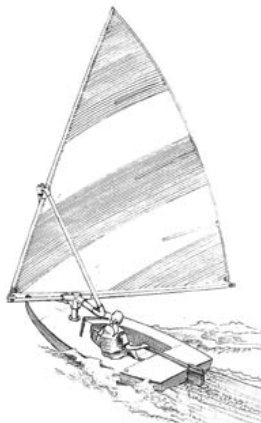
On the office floor Garry rolls out drawings of his current projects. The first is of a boat called Volare (see illustration on Page 17) that looks to be a cross between the Laser and Sunfish. But each, according to Garry, is flawed. (And he ought to know, being a one-time world champion in the Sunfish.) “Catboats,” he says, “suffer from weather helm, which throws the boat out of balance. Anytime you put up a big sail on one side, you’ve got weather helm. What I’ve done,” he says, pointing to the assemblage of pipes and fittings that support the Volare’s sail, “is try to get a clean leading edge on a fully battened sail (concept drawing shows short battens. –Ed.) using the lateen rig.” The advantage of the lateen rig is that some of the sail area is to windward of the mast, improving balance. To test the idea, he worked with John Harris at Chesapeake Light Craft, makers of high-quality plywood kayak kits, to build a 15-foot prototype.
Planned for plywood
“It certainly is an irony,” he says, “that the Sunfish and Optimist, the most popular boats of all time, were both conceived for plywood. Plywood is ideal for flat surfaces . . . and the best surface for planing is a flat bottom.”
He’s got plans for the Optimist too. It’s one of the country’s most popular sail trainers for junior sailors. “I feel we need a better boat than the Optimist,” he says. “After all, it has a square bow. I’ve never seen a fish with a square nose. It’s just not the right shape. It was dictated by the practicality of the plywood construction, which is excellent for that. But now we have fiberglass. Fiberglass doesn’t like flat. It likes curved surfaces.”
Garry believes the key to getting new people into sailing is giving them the thrill of singlehanding a small planing boat. Handling sheets for someone else just doesn’t do it. But what boat?
“If you’re 9 years old you’re stuck with the Optimist. Your next jump is up to a Laser, which is almost unmanageable until you’re stronger. So what do you do with a 9-year-old girl, who is probably better than the boys? Well, the Optimist is a great boat, and there’s great competition, but you can’t plane so you’ve got to go into a (two-person) 420 or something else.”
That something else could be a boat of his own design he calls the Escape Express, with a square-topped mainsail. “With this you unfurl the sail and you’re underway. It’s a bridge boat that would give the yacht clubs and their youngsters a singlehanded boat that planes.”
That cursed genoa
Garry thought the title of a September 2002 article in Sailing magazine should have been “The curse of the genoa jib,” rather than “Why the genoa is not a cruising sail.” It’s a measure of how intensely he feels about the problems caused by genoas, one of the major reasons, he believes, that sailing is more difficult than it need be. Their size makes them difficult to trim; the high headstay tension required to keep them from scalloping puts huge loads on the hull; their size often doesn’t match wind strength, requiring cumbersome sail changing (even a genoa on a furler has a limited range of effectiveness); and off the wind their shape is necessarily poor. Garry throws a pile of magazines at me, opening them randomly to photo after photo of genoas luffing and twisting.
“It’s on every page,” he says with agitation, “but no one sees it. It can be discouraging.” He says he’d be satisfied if his legacy was “only for people to put Hoyt Jib Booms on: they’d sail faster, they’d sail easier, and it would be a great thing.”
It also would make him a little money to help cover the cost of his prototypes, but more importantly, it would validate his ideas.
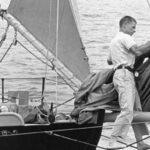
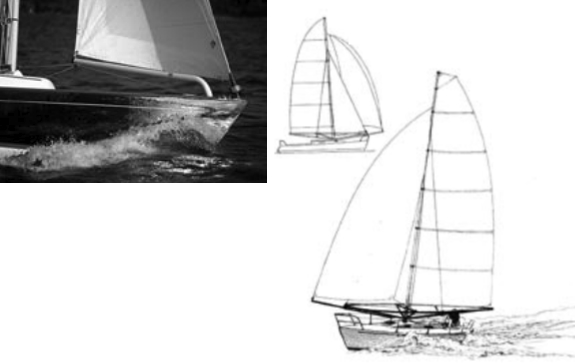
Garry advocates rigs with larger mainsails and smaller working jibs. If the boat is designed with this rig in mind, there is minimal loss in speed. The fastest boats in the world, he points out, have small jibs. “And the very fastest,” he wrote in Sailing, “— iceboats and windsurfers — have no jibs at all!” The patented Jib Boom makes the headsail self-tending, like a club, but it does one important thing the club doesn’t, and that is make the sail also self-vanging. “The Jib Boom does for the jib what the vang does for the mainsail,” he concludes (see photo on Page 16).
Bob Johnson bought the argument, and now every Island Packet comes factory equipped with a Jib Boom.
Battling traditions
But old habits die hard. Garry knows that; he’s spent half his life battling traditions.
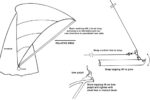
The AeroRig inspired Garry to find another and different way to solve the curse of the genoa jib. His variation is called the Hoyt Balanced Rig (see illustration on Page 16).
The AeroRig, developed in the United Kingdom by CarboSpars (now out of business) and built and distributed in the U.S. by Forespar, is essentially one long boom that extends forward and aft of a rotating, free-standing mast so that both the headsail and the mainsail are set on it and can be trimmed by a single sheet.
It’s a wonderful idea,” says Garry, “but so cumbersome and heavy it almost defeated the purpose. I really liked the AeroRig’s balance when I sailed on it. The feel of the helm, the way it jibes softly. You have balanced rudders (where part of the rudder extends forward of the rudderstock to balance and reduce loads), why not a balanced rig?”
As with most things having to do with sailing, Garry saw ways to improve it.
So he said to himself, “What if I take this idea in another direction? What I didn’t like about the AeroRig was they rotated the whole rig, which means you need a massive bearing at the mast step. And they have a backstay to get headstay tension. With the Hoyt Balanced Rig the mast is fixed, and the wishbone boom rotates around it.”
The wishbone boom, which would be made of carbon fiber, is self-vanging, which means it tensions the leech of the sail automatically. This eliminates the need for a backstay to tension the rig and allows a full-roached, fully-battened mainsail. The wishbone also helps contain the sail when it’s dropped, rather like lazy-jacks.
So far Garry hasn’t built a prototype or found a builder willing to try it. But he’s hopeful.
Hoyt’s background
Garry Hoyt was born in Elizabeth, New Jersey, and grew up in Plainfield. His family summered on Barnegat Bay, in Tom’s River. He started sailing in a Barnegat Bay Sneakbox and later raced with his brother in the Snipe class. He liked to win. In high school they placed third in the Snipe Nationals. He went to college at Colgate, then on to a business school out west, in Arizona, called Thunderbird. “It was a school for foreign trade, basically,” he says.
After college he joined the U.S. Coast Guard. “That was good,” he says, “because the Coast Guard gave me a whole lot of management responsibility early. I was executive officer on one 165-foot cutter and got to do all the ship handling there. And on occasion I was skipper of an 83-foot cutter, search and rescue, berthed out of Key West and then out of St. Thomas. And based in San Juan for a while.
“Then I went back to work for an advertising agency, Young & Rubicam, Inc. Earlier I spent a summer in Mexico where I started learning Spanish. Then Young & Rubicam opened an office in San Juan, and I was sent down there. I shifted from being a traffic man to the creative side, so I was a writer and an art director. Subsequently I became the creative director there. Creative director and director of Y&R’s office for Latin America. And then director for their offices in the Far East, which included Australia and Japan. Also in charge of Chicago, Detroit, and San Francisco.
“I did a whole lot of traveling back then, but mostly I was in San Juan. I kept a boat, and all the time I was sailing on the weekends. Sailing with another fellow, we got third in the Snipe Worlds. Sailed a Finn in the Mexico Olympics (1968) . . . got tenth. Third in the Finn North Americans. Then I won the Sunfish World Championships in St. Thomas.
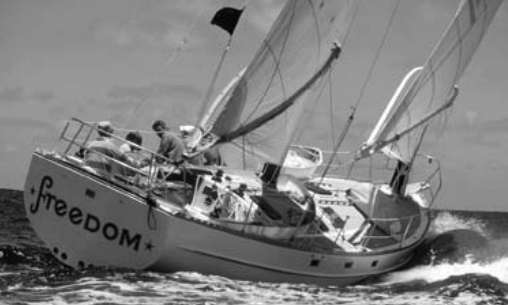
“Then I shifted over to cruising boats because I saw that I couldn’t hike very well anymore because I was getting old — creaky back and all those things. So I had big boats — first a 58-foot Alden Schooner. Then a 52-foot Herreshoff ketch called Mandarin. Then I developed the Freedom 40.”
Origins of the 40
Garry is fairly circumspect about the origins of the boat, perhaps because he’s tired of telling the story or perhaps because he’s more interested in tomorrow than yesterday. But here it is, in a big nutshell.
Unstayed masts are nothing new. Early American working watercraft, like the New Haven sharpies, and recreational boats, such as the 19th century Barnegat Bay catboats, had no stays holding up their masts. Garry, no doubt, was familiar with these boats. So on an airplane one day, as the story goes, he was looking out the window and studying the wing, thinking to himself, “If this wing can be supported without all those wires and turnbuckles and terminals, why can’t one build a sailboat mast without wires?”
The prototype Freedom 40 had big, round, unstayed aluminum spars. Soon Tillotson-Pearson Industries (TPI) found that a better method was winding carbon fiber on a mandrel and setting it in resin. The few early failures were quickly replaced and within a few years they had a reliable product.
To minimize turbulence caused by the large diameter spars, wraparound sails were used, though they were heavy and made reefing problematic. The platform on which Garry installed the freestanding cat ketch rig was a long, shallow hull designed by Halsey Herreshoff. The first Freedom 40, launched in 1977, had a centerboard.
And she had no engine. Garry called an auxiliary engine a “Freudian fixation, a petroleum boo-boo.” He fitted the boat with 16-foot sweeps instead. In an early brochure he wrote, “Hell, if you’re not careful you might even build a muscle or two. The really nice thing about oars is that you have total control. You can go forward or back, or spin in place — and there is no fuel, no noise, no smell, no hassle, and no cost. And that’s freedom, mon!”
Made new start
In 1980, Garry quit the advertising business and decided to make a new start by founding his own boat company. But when the design went into production, engineless boats proved to be a tough sell, and he was forced to offer an engine as an option, though he admonished, “But we don’t approve!”
To promote the boat, Garry drew on his advertising savvy and came up with a provocative challenge: he offered $5,000 to anyone who could beat him singlehanded in a 40-foot cruising boat on a triangular course. He knew his Freedom 40 wasn’t the fastest boat upwind, but she smoked everyone on a reach. The gambit paid off: no one ever challenged, and he got a lot of publicity.
Unfortunately, at least as far as Garry is concerned, the production version of that first boat differed in several significant ways. People at TPI, which built the Freedom line in Warren, Rhode Island, didn’t think a heavy centerboard was such a hot idea, so it was dispensed with in favor of a lighter board and deepening the keel by a foot. And when an engine was added, with a prop in the aperture, the result was a heavier, slower boat. “I made the mistake of listening to the production people,” Garry says.
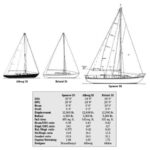
Nevertheless, the concept appealed to enough people that Garry sold 85 in the U.S. and 25 more in England, which was sufficient encouragement to develop a complete line of Freedoms: the 28, 33, 40, and 44 cat ketches and the smaller sloops at 21, 25, 29, and 32 feet. In 1981 a Freedom 44 won the Bermuda One-Two Race as did the F-32 later. A special three-masted Freedom 65, built in the U.K. by Fairways, entered a double-handed transatlantic race in preparation for the BC Challenge round-the-world race. Skippered by Laurel Holland and John Oakley, the boat showed speed on some points of sail, but one of the mast steps came loose, and the crew was forced to depower the boat in order to finish the race with the sticks intact. It was a disappointing conclusion to a campaign that had a lot of people anxious to see how Garry’s radical rig would fare over a long passage with varied winds.
Jibless rig
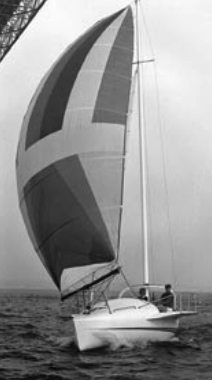
The first of the sloop group was the Freedom 25 rigged with just a mainsail, followed by the 21. Each came with the patented Hoyt Gun Mount, which enabled one to set a spinnaker on a “yard” without leaving the cockpit (see photo on Page 19). Because the sail was attached to the yard at both the tack and clew, one could actually sail the boat in circles without touching the sheets (I did this in Newport Harbor with Garry’s son, Jeff, some 20 years ago). The spinnaker will backwind, and if you like you can sail backward or hold the helm over until it fills again on the right side.
Eventually, however, Garry was obliged to admit that without headsails, the boats were slow upwind, so what were called vestigial jibs were added. And to avoid the curse of the genoa (or any headsail) off the wind, he fitted each with one of David Bierig’s Camberspars, a a curved aluminum strut that makes the sail self-tacking and self-vanging.
By 1985, Freedom Yachts was in good shape. “The company was pretty successful then,” says Garry. “We were up to $9 million in annual sales. Back then that was pretty damn good. At that point I sold it to TPI, who thought they could do it better. But I don’t think they did and in any case couldn’t make money at it. So they sold to a company which now concentrates on powerboats. That is regrettable because I happen to believe that the free-standing spar has merit. It’s never going to run the whole market, but it has a branch that I think has been neglected.”
One of the problems, Garry says, was that “they tried to bring Freedom into the middle of the road.” But that, he notes wryly, “is where you get run over. The big tree trunk of a mast ruined the windward performance, despite good designers (like Gary Mull and David Pedrick). They created a freestanding sloop with no discernible advantage over a regular sloop.”
Interesting projects
Following the sale of Freedom, two of Garry’s more interesting projects were the Delta 26 and Manta. The Delta 26 featured a mast in the rear, plus the Hoyt Gun Mount for the spinnaker.
The lightweight hull had winglets above the waterline for crew to hike out and help keep the boat sailing level. This was necessary due to the lightly ballasted keel. And here was the conundrum Garry was trying to solve: how does one take significant weight out of the boat in order to achieve superior performance, yet maintain
necessary stability? In the end, the Delta 26 was simply too tender.
But the rig concerned Garry more. “Had I had my self-vanging boom then, the rig would have been a lot better. It would have made the rig manageable off the wind. I penalized that rig with a radical hull with wings. It doesn’t pay to look odd.”
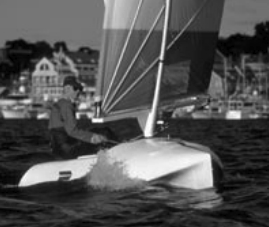
A somewhat different approach was taken with the Manta, a 30-foot cross between a monohull (with small, lightly ballasted keel) and a multihull, with quasi-amas resting on the water to provide additional stability. The Manta also had an A-frame mast and a large cockpit for entertaining. It was much more stable than the Delta 26, but much to Garry’s chagrin, she was far slower than he anticipated. Later he confessed that he’d been seduced by computer-generated performance predictions. “It was a case,” he said, “of ignoring instinct and going with the numbers. I’ll never do it again.”
No commercial success
He adds, “It had wonderful comfort, however, and it had the A-frame mast which I have to believe is a good idea because it offers great security plus a clean leading edge for the main. When you think about it, two furling sails, two clean leading edges — what’s wrong with that? But it’s not fashionable. It’s a marketing handicap. No one wants to spend their money trying to convince people it’s a good idea. It does take money — and nerve. Nerve and money are a little short in the sailing world. And probably for good reason. It’s not a profitable business. Anyway, we penalized a good concept by an outlandish-looking boat that didn’t perform to expectations.”
In 1995, with the introduction of the Expo Solar Sailer, Garry began turning to small boats as the key to getting more young people interested in sailing. With a small electric motor and solar panel to keep the battery charged, he hoped that beginners would feel more confident venturing out alone, knowing that if the wind piped up they could simply furl the sails and turn on the motor to get them safely back to the dock. Ted Hood designed the hull, Garry designed the rig, and Everett Pearson built it at TPI.
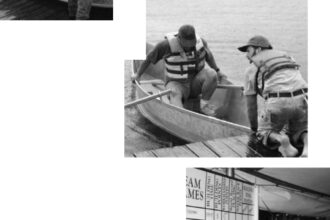
At the Newport Navy base, Garry conducted a controlled experiment using the Expo Solar Sailer and 30 women. His aim was to determine how quickly he could teach someone to sail. The goal was 90 minutes. Each woman was shown a video and then put in the boat with a set of radiophones to communicate with a coach onshore. They motored out, unfurled the sail, tacked, furled the sail, and returned to shore. Then they did it without the radiophones, sailing a triangle course four times.
Color wheel
“The mainsheet is divided into color sectors,” he explained. “If the wind indicator is in the blue sector you trim until the mainsheet jam is in the blue sector. And we had a big red sector that we called the ‘no go’ zone; that’s when you’re pointed into the wind. And the duck zone — the jibe zone. We had it all covered.
“They all did it,” he says proudly. “They could go home and say, ‘I sailed today.’”
But it didn’t set the world on fire. “My theory, naive at the time,” he says, “was that community sailing people and sailing school people would flock to this idea because we’d proven it could be done quickly. All of a sudden I realized they didn’t want to do it quickly because they had a vested financial interest in extending, instead of compressing, the process. So I was trying to make it shorter, and they didn’t want to hear that at all. As a matter of fact, they went out of their way to tell me what a lousy idea it was. As I look back on it, I understand it. It’s a lot more complex to handle an individual boat than it is to put five students and an instructor on a keel boat. So the idea went nowhere.
“And the boat was pretty expensive — $6,000. Because it had batteries, it was heavy, so you needed a trailer. It was a nice little boat, but perhaps not the best idea. We sold about 100 of them. We still get calls from people who want one. But there’s no way the sailing schools are going to buy one. And I suppose if I were running a sailing school, I would have looked at this idea and said, ‘Why is this a good idea? Are you trying to put me out of business?’”
Glass pedal boat
About this same time Garry collaborated with Harken Yacht Equipment, makers of sailing hardware, to develop the 9-foot 3-inch Waterbug, a tear-shaped fiberglass pedal boat. It had a space-age look with a cockpit canopy similar to a fighter jet. To get the most speed with the least amount of energy expended, Harken built a two-speed drive unit with 1:3 and 1:4 gear ratios turning a three-bladed propeller.
In 1996 Garry designed the first Escape, the low-cost rotomolded, polyethylene boat with a single sail on a Hoyt Jib Boom and the same color wheel for determining sail trim as was used on the Expo Solar Sailer. (“You should start with a single sail,” Gary is convinced. “They would never put a pilot in a twin-engine plane to start off.”) Nine-and 11-foot models followed the original 12-footer. Peter Johnstone of the J-Boat family of Johnstones commissioned the design. At the time, he owned Sunfish-Laser, which he later sold to Vanguard. And once he got Escape established, he sold that to the Leisure Life division of Johnson Worldwide, the conglomerate which, among many other things, makes Old Town canoes and pedal boats.
As noted, Garry’s design energies are absorbed in the Volare and the Escape Express projects plus new rig concepts. Garry and Donna manage Newport R&D, marketing and selling the Alerion line of boats. The first, the Alerion Express 28, is a Carl Schumaker remake of the famous Alerion designed by Nathanael Herreshoff. In the late 1990s TPI expanded the line with the addition of the 19-foot Alerion Cat, the Alerion 20, and Alerion 38 yawl, but only the 28 can be considered a success. TPI stopped building the catboat because they said they weren’t making any money on it, but Garry thinks he’s found another builder. He’d love to put his Hoyt Balanced Rig on it.
Expensive prototypes
“When trying something radically new,” he says, “you have to do a prototype. But prototypes are expensive. And you have to modify the prototype because rarely do you get it right the first time. Who’s going to spring for that cost? No builder wants to. An America’s Cup effort spends millions to get 1⁄20th of a knot. You’ve got four or five syndicates spending $50 million each. They talk about the trickle-down benefits, but c’mon, for the average person the trickle-down is really just a trickle. It kills me to see that much money available for that sort of thing, and there’s no money available for small boat development to improve sailing.”
The rant never really stops. Garry has something to say about every aspect of sailing. His energy and motivation are impressive. Spend an hour listening to him, and you come away thinking Garry Hoyt has got it right, and the rest of the world is wrong. He’s logical. He’s precise. He’s well-spoken. He’s convincing. But as time wears away, you begin to realize that other points of view are as valid. He knows it; it’s just the marketer in him that he can’t help.
And his legacy? Surely it will be that he rattled the cage, raged against convention, spoke out against the staid and status quo, that he proposed new and different and often better ways to sail. For Garry, that’s what all this reduces to: the simple pleasure of sailing.
“People look at failure and say, ‘Well, you failed.’ But if you’re not failing, you’re not trying.”
No one will ever accuse Garry Hoyt of not trying. That, and his many successes, will be his legacy.
Thank you to Sailrite Enterprises, Inc., for providing free access to back issues of Good Old Boat through intellectual property rights. Sailrite.com