She’s capable of cruising anywhere in the world in comfort
Issue 38 : Sept/Oct 2004
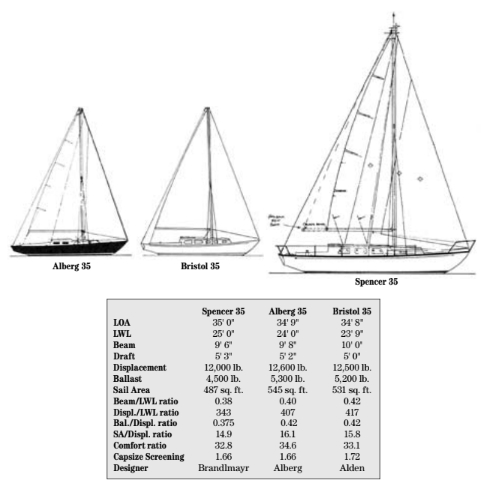
With this issue we have three yachts that are about as alike as peas in a pod — or peapods in Maine, if you prefer. Each is definitely of the old narrow-beam-long-ended school and all have husky displacement to boot. Interestingly, the seemingly great spread of displacement/length ratios, from 343 to 417, may seem extreme but it is really a matter of a mere 4 percent difference in displacement and 5 percent in waterline length, hardly extreme by any standards.
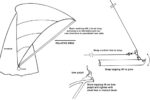
The differences in beam and draft are equally small. The major change is in the ballast ratio. The Spencer 35, with the longest waterline, is the most lightly ballasted of the three and, not surprisingly, carries the least sail area. Trying to handicap these three for a major race would be a real challenge as so much would depend on the hull’s form and wetted area, the breeze, and the skipper’s skill. The Spencer, with her longer waterline and smaller sail area, would not be at her best in light air, obviously, but how she would fare against the other two in average conditions or heavy air is anybody’s guess. Jim Kellam’s sail-area modifications are shown above.
None of the three will compete with a modern light-displacement, long-waterline, beamy auxiliary in all-around performance and, certainly, they will not go to weather like a fin keel/spade rudder performance cruiser. Still, when the going gets rough, I’d rather be aboard one of these husky old-timers than many of the modern lightweight beach balls.
The comfort ratio of all three is very high for 35-footers, right up there with many contemporary 40- to 44-footers. So while the narrow beam might cramp their interior accommodations, any one of the yachts could well be the boat of choice to be aboard in heavy weather. She might be a bit tight below, but she would have a relatively easy motion while the long bow overhang should help keep the spray where it belongs. While on the subject of accommodations, I have to say that the Spencer’s galley layout is one of the best I’ve seen on a boat this size. It’s remarkably good considering her relatively narrow hull.
The capsize screening factor of all three is also very low, thanks to the narrow beam and husky displacement of these old-timers. If capsized in extreme conditions, they would not remain upside down for very long due the narrow beam, good ballast ratio, and deep draft. In effect, they would be very unstable if inverted. However, all three have rather large cabin windows and — while this is great for a bright, cheerful interior — it’s not desirable when that cabin is under water. A broken window would quickly fill the interior if any of them were capsized, and then the chance of righting them would be almost non-existent. The best answer is to carry a good set of storm shutters and fit them before conditions become serious.
Given that, and having all other parts of the yacht in first-class shape, there is no reason that any of these vessels cannot cruise anywhere in the world. They have what it takes to get you there and bring you back in safety and comfort. These yachts, and others like them, have been doing just that for many years.
Thank you to Sailrite Enterprises, Inc., for providing free access to back issues of Good Old Boat through intellectual property rights. Sailrite.com