Making sense of the bewildering range of boating lines
Issue 44: Sept/Oct 2005
ROPE IS THE PRODUCT OF CORDAGE MANUFACTURERS BUT, with a few exceptions, when ropes of less than 1-inch diameter are used aboard a sailboat for a specific function, they are known as lines. (The etymology of the word line is from the Latin, linea, which means, um, rope.) Until relatively recently, the dimension given for a rope was its circumference — thus, a 3-inch hawser was one of 3 inches in circumference. Now, rope dimension is usually given as the diameter.
Until the middle of the 1900s there was a very limited choice of rope (or line, if you wish) from which the sailor could choose — hemp, sisal, and cotton. Now, many synthetic lines have come on the market and, surprisingly, they are often cheaper than their natural-fiber counterparts.
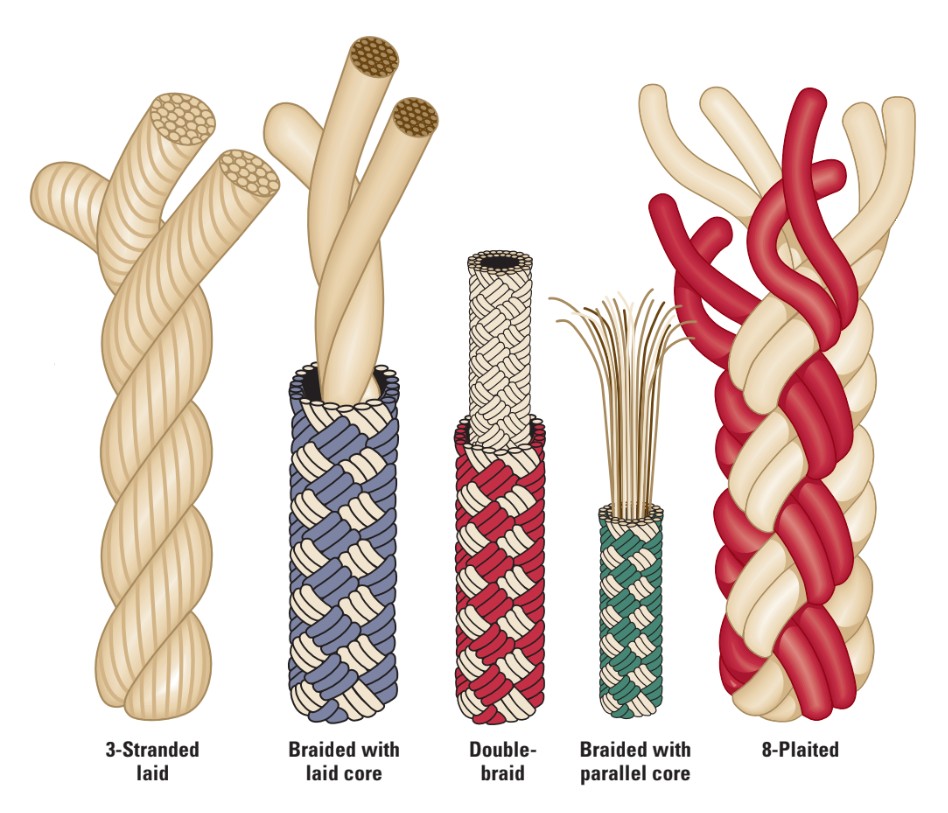
The manufacturing of three-stranded rope has not appreciably changed, however. It starts with a small fiber. Several of these fibers are twisted into a thread. These threads, in turn, are twisted into yarns. The yarns are twisted into strands. Finally, three of these strands are twisted into a “three-stranded laid rope,” the traditional form of rope that was first made from natural fibers.
It is common practice that three-stranded rope has a right-hand twist, although a left-hand twisted rope is sometimes encountered. With three-stranded twisted and laid rope, there is considerable stretch, however, since the three twisted strands tend to straighten out under tension. The construction of the more modern braided rope reduces this stretching tendency.
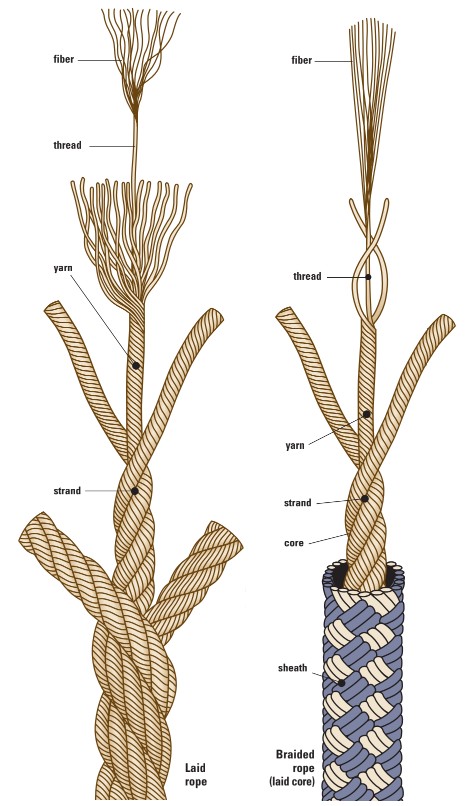
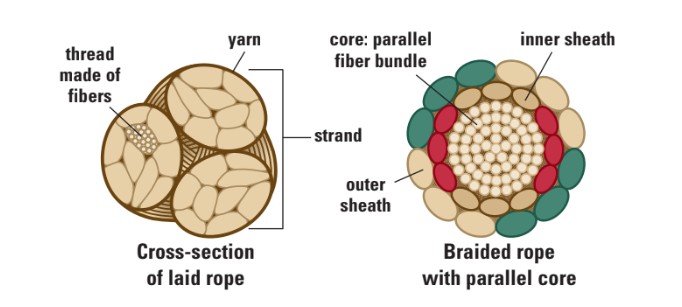
Braided rope has a braided outside sheath and an inner core, which can be one of several varieties:
- Parallel core is a braided cover enclosing a core whose bundle of fibers and threads are oriented parallel to the line’s axis.
- Double-braid is a braided cover over a braided core of the same material.
- Core-loaded double-braid is a braided cover over a braided low-stretch core of a different material.
There are three basic man-made fibers that have been used by sailors for decades: nylon, polyester (called Dacron in the United States and Terylene in Great Britain), and polypropylene. Of these three basic synthetic ropes, nylon is the strongest, with polyester a close second, and finally polypropylene.
Best choice
Since nylon has high-strength, excellent abrasion-resistance, and great elasticity, it is the best choice for use when there will be shock loads, such as for docklines and anchor lines. But those same attributes make it completely unsuited for use as running rigging, such as halyards, where stretch would be a detriment.
Polyester, on the other hand, provides almost as much strength as nylon, but with little stretch. When purchased “pre-stretched,” its elongation under load is even less. It also has good abrasion-resistance. This makes it the all-around choice for most other applications on board.
Polypropylene has the lowest strength of the three. It is relatively cheap and has the advantage of being lighter than water, so it floats. This makes it the line of choice for dinghy painters, reducing the possibility of its sinking and fouling the propeller. Polypropylene, though, is more susceptible to ultraviolet deterioration and is subject to melting when cornering through a chock under high tension.
Beyond these three basic fiber groups is a range of more expensive options, as well as their associated high-tech terminology. Some of these new terms are:
- High modulus, which basically means low-stretch. Most of the high-modulus lines are very slippery and, when tied using the knots that we know well, are prone to failure. Although a bowline in a nylon or polyester line decreases the strength of that line by about 40 percent, in a high-modulus line the strength is reduced by an astounding 70 percent or more. For this reason, knots should be avoided in high-modulus lines, in favor of splices.
- LCP (liquid crystal polymer), such as Vectran, is one of the latest rope-making fibers. These thermoplastics are very strong and abrasion-resistant, but they have low UV-resistance.
- HMWPE (high-molecular weight polyethylene) includes ropes such as Spectra, Amsteel, and Dyneema. Despite its high strength, HMWPE is so lightweight that it floats. Pound for pound, it has 10 times the strength of steel and is three times stronger than polyester. It is also low-stretch (stretching takes place during the manufacturing process). It has good abrasion- and UV-resistance, but it is high-priced and very slippery.
- Aramids are in the nylon family and are marketed under the names Kevlar, Technora, and Twaron. Although they are high-strength with relatively low-stretch, they have poor UV- and abrasion-resistance, especially when subjected to sharp bends under load.
Line care
There are general rules that apply to all types of lines to help extend their life:
During the boating season, hose off lines with fresh water to wash away dirt and salt crystals. At the end of the season, soak the lines in warm soapy water, then rinse them and hang them up to dry.
During the off-season, remove as many lines as possible from your boat, especially those with a low UV-tolerance. This will extend their life considerably.
Thank you to Sailrite Enterprises, Inc., for providing free access to back issues of Good Old Boat through intellectual property rights. Sailrite.com