Sloops and cutters — here’s a good look at the family tree
Issue 39 : Nov/Dec 2004
Most of today’s sailors think of cutters as having a rig much better suited for offshore voyaging than that of the ubiquitous masthead sloops that dot our coastal waters. Generally, the contemporary cutter tends to be a huskier yacht than the average sloop and — partly for this reason and partly for its rig — is considered as being more suitable for extended bluewater cruising. Also, due to its heftier hull as well as the inherent drawbacks of the double-headsail rig, the cutter is usually deemed to be somewhat slower than a sloop of equal size and, perhaps, not as weatherly. Unfortunately, this is too often true, but it was not always that way.
Back in the late 1700s, the average sloop was a burdensome cargo carrier sporting a single mast with a gaff-rigged mainsail, a fixed topmast, and a long bowsprit. This typical sloop was a money-making working boat, and the economies of commerce demanded a small crew . . . which would be at a severe disadvantage when handling a large press of canvas in a stiff breeze. For this reason the sloop’s sail area was kept to relatively modest proportions, and the result was that her performance was equally modest. Sloops primarily worked in the coastal trade, but long ocean voyages were not unusual.
Indeed, the Lady Washington, built in Essex, Connecticut, in 1750 or so as a sloop-rigged craft, crossed the Atlantic Ocean at least once, bringing Irish immigrants to the New World. She made a trading voyage to the northwest coast of North America in the early 1800s and eventually crossed the Pacific Ocean to China. There, in Hong Kong, she was converted to a brig, a more suitable rig for blue water. The Lady’s lovely replica can be seen plying the waters of the Pacific Northwest today.
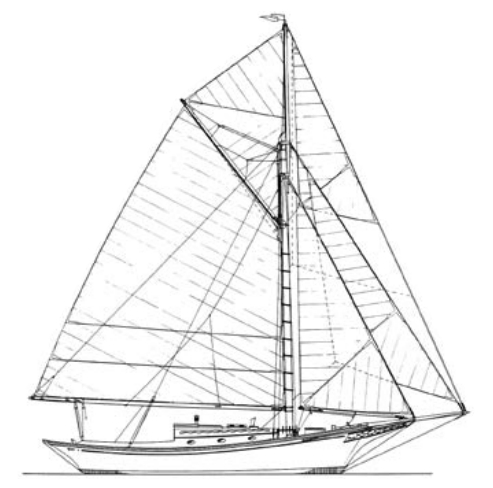
Beamy, chunky hulls
These small cargo sloops — beamy and chunky hulls, perhaps 50 to 80 feet in length — often set two or three headsails: a foresail, a jib, and a flying jib. They might even set one or two square sails as well for offwind work. Our inclination today would be to think of these craft with their multiple headsails as cutters. We could not be more wrong!
The cutter of that era was a racehorse, a thoroughbred built for speed. Compared to the cutter, the bluff-bowed cargo-carrying sloop was a plodding Clydesdale. The cutter hulls were finer and of deeper draft, designed for performance and weatherliness rather than conveying heavy loads of cargo from A to B. Cutters were used for carrying dispatches to and from the fleets, as scouting ships, and as anti-smuggling patrol craft. For these purposes, the cutter had to be fast, weatherly, and seaworthy. For naval and revenue work she would carry a large crew, perhaps 30 or more sailors, to handle her generous press of sail and, when occasion required, to man her numerous cannon.
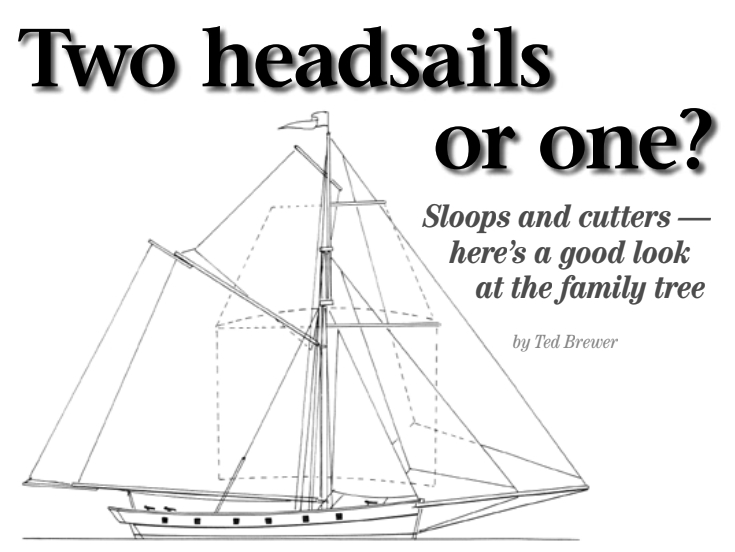
The rig of the cutter of the 1700s to 1800s generally resembled the sloop, but reefing topmasts and bowsprits were usual, as well as triple headsails, main topsails, and several square sails. There was even a special light-air sail that set on an aft extension of the main boom, like a reverse bowsprit (see illustration on Page 25.) Many years ago, a client gave me a model of the Diligence, a British revenue cutter of 1795, rigged in this fashion. She was a fine example of her type and was obviously a very handsome vessel in her day. Cutters, such as Diligence, spent their time in the English Channel chasing down the swift French luggers that were constantly trying to smuggle tobacco (shortened to “baccy” in the poem that follows), brandy, wines, and lace into Britain during the Napoleonic Wars.
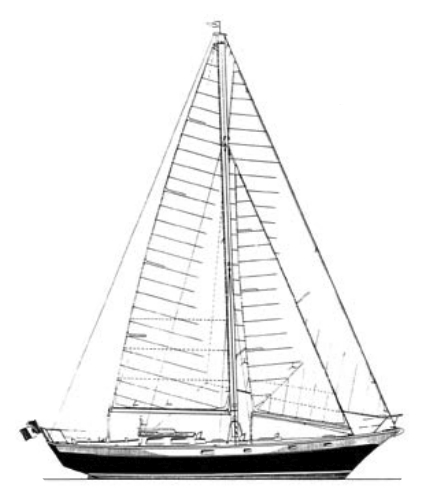
Smuggler’s song
You may recall Kipling’s poem, A Smuggler’s Song: “Five and twenty ponies trotting through the dark/Brandy for the parson/ Baccy for the clerk/ Laces for a lady/ Letters for a spy/ And watch the wall my darling, while the gentlemen go by!” There must have been literally hundreds of exciting races — and occasional battles — between British revenue cutters and French luggers in those years . . . cat-and-mouse games played out during dark nights in the thick fogs and swift tidal currents of the Channel waters while “the gentlemen” ashore anxiously awaited the outcome and the delivery of their illicit goods.
After the 1840s and ’50s, with the advent of steam power, the sailing revenue cutter, packet, and scout disappeared, as did most of the coastal cargo sloops. Over the succeeding years, the sloop and cutter were primarily used as yachts, refined for comfort and performance, and the hulls became more alike. This left the main variation between the two types in the rigs. The mast of the sloop moved forward, and the multiple headsails were reduced to a single jib in most smaller craft. There were exceptions, of course, one being the Maine Friendship sloop, many of which set a double headsail rig (see illustration on Page 26.) However, the Friendship’s mast was set so far forward that knowledgeable sailors would never call one of these handsome craft a cutter. Or would they?
Cutters and sloops were popular on both sides of the Atlantic but, generally, in smaller craft the cutter predominated in Britain and the sloop in North America. Still, there were numerous cutters on this side of the ocean. Indeed, as attested to in C. P. Kunhardt’s beautiful book, Small Yachts, Their Design and Construction, cutters of narrow beam in the English fashion, as well as more moderate-beam cutters, were not uncommon in U.S. waters. This wonderful book, first published in 1891, was edited and republished by WoodenBoat magazine in the mid-1980s. If you love yacht design and history, it’s worth whatever you have to pay for a copy, and then some.
Racing yacht design
Over the years, the rating rules on both sides of the pond, as always, ordained the design of racing yachts and, in turn, the racing yachts developed the fashion for the cruising vessels. The rating rule in the United Kingdom dictated that British boats would be narrower than North American yachts and generally favored the cutter rig. On this side of the Atlantic, the yachts were beamier, centerboarders were popular, and sloop rigs were predominant in smaller craft.
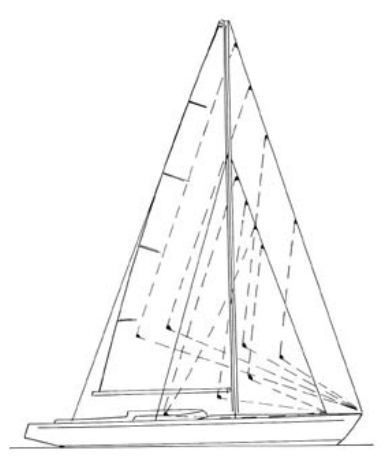
When I got into the boating business back in 1957, British yachts were being rated by the Royal Ocean Racing Club rule and American yachts by the Cruising Club of America rule. The RORC yachts tended to be narrower than U.S. yachts and, while the cutter rig was popular, many British sloops raced with a double headsail rig. Typical of these sloops was the successful Illingworth and Primrose design, Outlaw, shown above. Her sail plan is very interesting as it shows Outlaw with four different-sized staysails, and four different-sized Yankee jibs; a headsail combination for every little change in the breeze — pity the poor foredeck sailor.
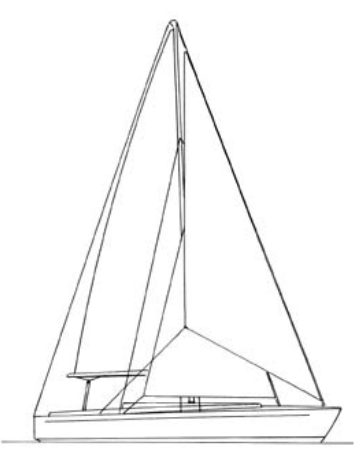
While many would call her a cutter, Outlaw is very much a sloop because of the forward location of her mast and her large mainsail. On the other hand, the 1946 Laurent Giles design, Myth of Malham, shown below, is a cutter despite her lack of bowsprit, due to her mast being located so far aft. Interestingly, Myth’s beam was only 9 feet 4 inches on a 33 feet 6 inch waterline; a mere 27.8 percent beam/ LWL ratio, and quite typical of the narrower British yachts of the time.
On this side of the briny, the sloop and yawl were favored by the CCA rule. Typical sloops of the late 1950s and ’60s were the Ray Hunt Concordias and the Luders 27s, while beamy keel-centerboard yawls, in sizes from 24 to 60 feet or more, tended to copy Olin Stephen’s famous Finisterre. Now almost 50 years later, the cutter has pretty much disappeared as a racing yacht, thanks to the development of international rating rules, and the typical ocean racer has developed into a masthead sloop with a large genoa. The cutter is still the bluewater cruising rig of choice for many, though, and will be for years to come.
Thank you to Sailrite Enterprises, Inc., for providing free access to back issues of Good Old Boat through intellectual property rights. Sailrite.com