A cruising crew figures one good tern deserves another
Issue 40 : Jan/Feb 2005
The first light of morning trickled through the portlights of St. Pauli Girl, our old Bristol cutter, anchored in the lee of Merritt Island. I silently made my way on deck past my sleeping shipmates to watch as the day was born. As I crept forward to lower the anchor light from the headstay, I flinched from the cold dew beneath my feet. “Savor that feeling,” I whispered to myself. “It might well be the only cool sensation this late summer day has to offer.” A thin mist was rising and glowing luminous in the dawn. I looked down at my reflection in the mirror upon which we floated and thought how fortunate I was to be a sailor.
One by one the crew awakened. First, Sally, my life-mate of 20 years, co-owner and chief purser of the sailing vessel St. Pauli Girl, joined me on deck. Then our guest crew: Sally’s nephew, Jimmy, and his new bride, Jeanette, emerged from the companion- way into the first rays of the sunrise.
This would be the last day of our cruise, and we were all looking forward to an ocean sail off Cape Canaveral. Ahead of us lay 6 miles of the Intracoastal Waterway, two draw-bridges, and one lock. It was time to get under way. Moving fluidly between my roles as executive chef, chief engineer, and captain, I lit the stove and put water on to boil, completed the daily engine room checks, and assigned deck duties for hoisting the anchor.
Anchor aweigh
Before the sun was fully above the horizon, Jimmy was signaling from the foredeck that our 35-pound plow was aboard. We began chugging out of our tranquil gunkhole to the rhythm of the Perkins diesel, which was older than half our crew.
The generous wind of the past few days had vanished as low pressure in the Gulf migrated toward Texas. An onshore breeze was promised for the afternoon, but motoring would be the order of the morning. With no sails to tend, Jimmy and Jeanette lounged on the cabinroof in the hot morning sun. Sally kept me company in the cockpit as I steered us up the waterway.
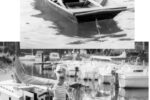
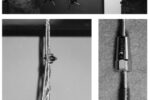
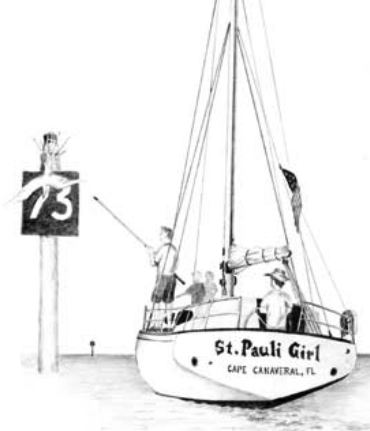
Passing a channel marker to starboard I noticed an entangled shorebird, probably a sea gull hanging inverted in the very wire devices intended to keep birds off the marker. “Ironic,” I thought, and the thought saddened me. Although no one spoke, everyone was watching the poor creature slide by. Suddenly Jimmy stirred from his reclined position and said, “He’s alive!” We all looked astern and saw the bird weakly flapping his wings.
Jeanette wondered aloud if there was anything we could do. “We should try to free him,” Sally stated resolutely. Jimmy was now surveying the bird with binoculars and said he believed he could untangle him using a boathook if I could bring the boat close enough. All eyes shifted to me. My own thoughts turned to the potential pitfalls of such a rescue attempt. The bird was dangling probably 6 or 7 feet above our deck level. How would we reach him? This was a wild animal. How much bodily harm might a panicked bird inflict? Was there shoaling around the marker? What about the danger of entangling our rigging on the structure? In our favor, there was no wind or current. We had plenty of crew. I decided it was worth a cautious try.
Rescue operations
I slowed St. Pauli Girl, brought her around, and started back toward the marker. My previously lethargic crew came to life. Sally and Jeanette went forward to watch for shoaling. Jimmy positioned himself, boathook in hand, just forward of the port shrouds. We approached dead slow and, as the marker came abeam, Jimmy hooked the offending wire and snapped the bird free.
We had imagined the bird taking to wing mid-fall and flying smartly away. Instead, he plopped into the water below and bobbed helplessly, wings spread, beak agape.
Turning slowly to starboard, we watched the bird with sinking hearts and began to speculate about his condition. Jeanette, a vet-tech who had worked with injured birds before, was certain she could determine the extent of his injuries if she could examine him. This of course would require bringing the bird aboard. Again we exchanged ideas and decided a large plastic bucket with a heaving line attached represented our best chance. We would simply scoop the bird up and haul him aboard. After a few tries, it worked.
Jeanette carefully removed the bird from the bucket and began to examine him. The bird’s right leg was severed, but he was otherwise unhurt. This seemed a grim prognosis, but we had all seen one-legged gulls before. Apparently they could adapt. Jeanette recommended we keep the bird immobile, allow him to regain his strength, and then release him.
Intricate beauty
We all began to look closely at our new passenger as Jeanette cradled him in her arms. We admired the intricate beauty of his markings. Consulting a field guide to Florida birds from our ship’s library, we identified him as a royal tern. On his remaining leg was a bright metal band with the inscription, “U.S. Fish and Wildlife Service,” and a series of numbers. Sally named him Jonathan, for Richard Bach’s mystical Jonathan Livingston Seagull.
Jonathan remained calm in Jeanette’s care. She nestled herself and her patient into the bow pulpit. Rescue and triage complete, the rest of the crew secured our boathooks, buckets, heaving lines, and other improvised gear, and we began once again to make way for the Canaveral Inlet.
After a long while Jeanette reported that Jonathan was growing restless and seemed ready for release. We were nearing our first drawbridge and decided it best to release the bird before reaching the bridge. There are some sandy spoil islands where the channel begins to narrow. We always see shorebirds there, so it seemed the logical spot. Jeanette carried Jonathan to the starboard rail as I slowed St. Pauli Girl to a stop just off a narrow strip of sand that we imagined would be inviting to him.
Looking ahead, I saw a tug and barge just emerging from under the drawbridge and urged that the release not be delayed. I wanted ample time to gain good steerageway before the traffic reached us.
Oncoming tug
Jeanette lifted Jonathan to arms’ length and gently tossed him aloft. He took to flight but, turning away from our intended landing site, circled our bow and made a water landing mid-channel directly in the path of the oncoming tug and barge. We all let our dismay be heard, but there was no time to do anything more. The tug was closing rapidly.
I shifted ahead, throttled up, and steered to port to move into position for the passing tug now only a hundred yards away. St. Pauli Girl did not respond. We had softly grounded. I imagined the tug’s wake driving us hard aground. I knew I had but one chance to avoid that fate. I shifted astern, brought the rudder amidships, and demanded maximum power from the ancient Perkins. After a few long seconds, she began to move. I held my breath, counted to 10, throttled to idle, shifted ahead, steered a quarter turn to port, and once more called for maximum rpm. The bow of the barge came abeam as St. Pauli Girl pointed toward the advancing wake, her depth sounder counting reassuringly upward.
My crew could not have been more oblivious to our narrow escape from a hard grounding and the ordeal that goes with it. They were all single-mindedly searching the churning wake of the tug Kathrine for Jonathan or, worse, his remains. It seemed unlikely that the poor tern could have survived, but there he was . . . surfing the Kathrine’s wake and paddling for the far side of the channel. He hopped ashore, ruffled his feathers, and stood looking back at us. A unanimous cheer went up from all aboard St. Pauli Girl.
Fading white speck
The Highway 3 bridge was opening ahead, and we continued our journey to the sea as Jonathan faded to a white speck on the sandbar far astern. We enjoyed a pristine ocean sail that day, made all the sweeter by the knowledge that we had helped a fellow creature. Sunset found us back in our home marina. The next day Jimmy and Jeanette were on a flight back to Denver, and I was off to job-related training that would keep me ashore for eight weeks.
It was a chilly, sunless, late November day before Sally and I sailed again. Despite the misty drizzle that had begun to fall, I was excited to be out on the water again. The timbers protecting the pilings of the familiar Highway 3 drawbridge were lined with shorebirds seeking shelter from the cold rain.
A royal tern squawked from overhead as we emerged from under the open bridge spans. We looked up to see the bird circle forward of our mast and land on the nearest ridge timber. He perched there, fluffed his feathers against the chill, and stood looking at us. He was perched on one leg . . . his left leg . . . his left leg circled with a bright metal band.
Thank you to Sailrite Enterprises, Inc., for providing free access to back issues of Good Old Boat through intellectual property rights. Sailrite.com