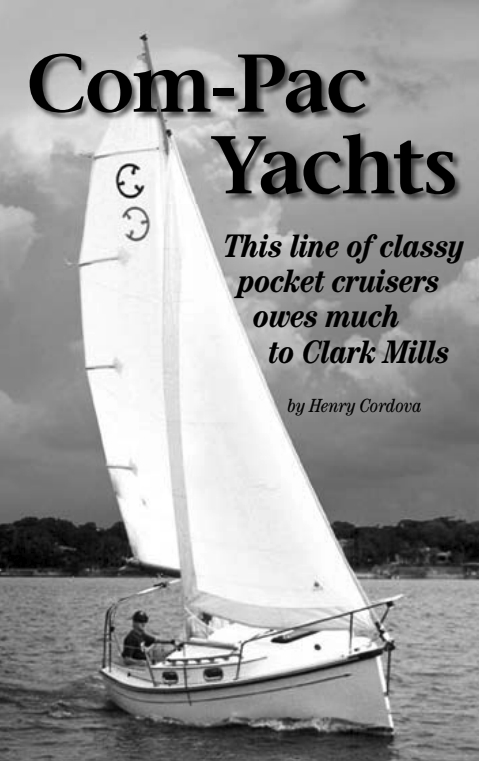
This line of classy pocket cruisers owes much to Clark Mills
Issue 40 : Jan/Feb 2005
My first encounter with a Com-Pac yacht was in the mid-1970s. Charlie, a school friend of mine in Florida, bought one of the first hulls sold by the Hutchins Company, a sweet little 16-foot sloop with salty lines and a saucy, turned-up nose. There was simply nothing like it in those days — a trailerable boat with a solid keel and shallow draft perfect for the sort of sailing we enjoyed and could afford.
My own boat, a centerboard, lugrigged catboat, was a good sailer and perfect for gunkholing in the mangroves, but the Com-Pac sported a level of luxury the rest of us could only dream about. It had a cabin with just enough cover for one to get in out of the rain and spend a night anchored on the turtle grass or the mud flats, protected from the weather and saltwater marsh mosquitoes.
Charlie’s exploits in the Com-Pac were legendary. He loved to tell the story of when he hove to in a squall, and a Coast Guard cutter, thinking the boat was abandoned, raced over, only to find the little white sloop perfectly balanced and giving ground sensibly, her jib backed, main reefed, and tiller lashed to leeward. Charlie was in the cabin calmly smoking his pipe.
When Charlie popped his head out of the hatch, the Coastie skipper knew he wasn’t needed. He shrugged his shoulders and went back to fulfilling his primary mission: rescuing powerboats in trouble. Another time, during a winter blow, Charlie, who sailed without an outboard motor, was forced to anchor off a lee shore just outside breaking surf. The Com-Pac gave him a wild ride all night but survived intact . . . except that his brand-new Danforth had a fluke bent so badly it had to be replaced.
The word spread
Apparently a lot of other sailors have had similar experiences. Although they were not specifically designed for the Gulf Coast, word of Com-Pac’s quality and seaworthiness quickly spread, and by the end of the 1970s more than 1,000 had been sold in Florida and beyond.
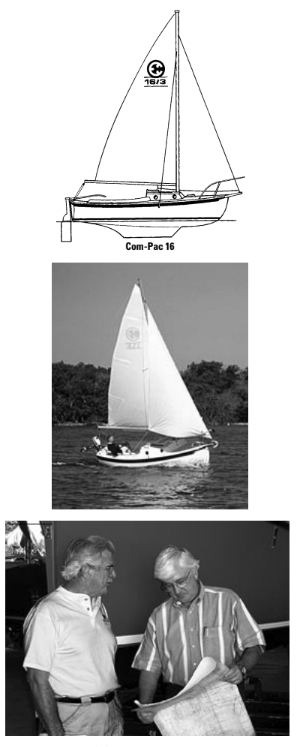
It certainly did not hurt that the Com-Pac was designed by Clark Mills, who in the late 1940s designed the one-design Optimist pram dinghy, the world’s most popular trainer for junior sailing programs. Other models follow: the Mills-designed Com-Pac 23 and, a few years later, the Bob Johnson-drawn Com-Pac 19. (Note: We’ll profile Bob Johnson, the founder and designer of Island Packet Yachts, in an upcoming issue. –Ed.) The line was distinguished by its traditional hull shapes, striking teak detailing, and round, metal-framed portlights set off against a gleaming white hull. Beamy, shoal-draft weekenders with high-lift NASA airfoil keels, these boats were not built for high speed or extreme windward performance, but they were safe, sturdy, and beautifully finished. The Com-Pac 16 sold in 1974 for $2,988, or about the price of a (then) new compact car.
Company origins
The Hutchins Company was founded in 1957 by W. L. “Hutch” Hutchins, Sr., an inventor and entrepreneur who provided parts and accessories for the automotive industry and the aftermarket trade. In the early 1970s his interest in sailing led to the development of the Com-Pac 16, an attempt, he said, “to build a small but highly efficient sailboat that would appeal to people who didn’t want to invest too heavily in a boat, yet one they could easily trailer behind a compact car.”
It is said that the overall concept for the Com-Pac 16, as presented to designer Clark Mills, was to build a boat that, when dismantled, would fit nicely into a standard shipping crate. This final specification was never achieved but the original idea certainly was.
The first few years for the fledgling boatyard were filled with all the melodrama of any new business. Working for almost three years from Clark Mills’ shed in Dunedin, Florida, the production bugs were worked out of the Com-Pac 16 by the elder Hutchins and Buck Thomas, a key employee in the company’s early days in both the construction and marketing operations, as well as builder of the Southern 21. They were soon joined by Hutch’s sons Gerry and Richard. Gerry had experience in the boatbuilding trade, having worked at Gulfstar Yachts, while Richard had run the metal stamping part of the family business.
Hutchins remains a family operation; Richard’s son is now in charge of the steel fabrication facility at the Hutchins yard. As sales of the 16-footer took off, it didn’t take long before the firm moved to a larger facility in nearby Clearwater.
Still the same
The Hutchins Company is still essentially the same business today, 30 years and 5,000 hulls later. It’s run by brothers Gerry, the president, and Richard. Their father, Hutch, remained active in the firm until his death a few years ago. The firm is no longer involved in the automotive market and has devoted itself entirely to building sailboats.
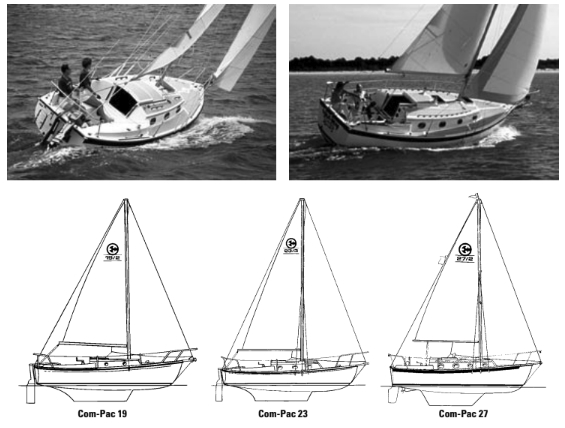
Richard says the secret to their success has been to build a good boat with passion, keep the company small and efficient, and not to compete with boat designs already capably delivered by other manufacturers. That also means not competing with their own boats on the used market. The philosophy works. Declining sales of the Com-Pac 16 finally led to discontinuation of that model in 2003, after 3,000 had been sold. The popular Com-Pac 19 met the same fate after a run of more than 600, but only after the tooling was damaged and it became prohibitively expensive to continue production. The Com-Pac 23 is still going strong after a history, of 644 hulls.
In 1985, Hutchins jumped into the potentially lucrative coastal cruiser market with the Com-Pac 27, also a
Bob Johnson design. With its 9-foot 6-inch beam and more than 3 tons displacement, the Com-Pac 27 was not a trailerable vessel but it was still an evolutionary outgrowth of the proven Hutchins philosophy — a roomy, shoal-draft sloop built more with convenience and quality in mind than racing performance. Its lines and overall appearance also shared the traditional looks and spirit that characterized the other Com-Pac yachts.
Flagship introduced
Eight years later, Hutchins had introduced the flagship of the fleet, the Com-Pac 35, an open-water cruiser designed to meet the criteria set out by designer Charley Morgan: “shoal-draft, stable, seakindly, and fast enough to give good results under Performance Handicap Racing Fleet (PHRF) rules.” It sports a high-tech Henry Scheel keel to provide decent performance yet keep draft to a modest 4 feet. Richard Hutchins makes no claims for the Com-Pac 35’s ocean-crossing abilities; he likes to say that “the boat might make it, but you won’t.” It’s not due to any lack of seaworthiness, but long-distance voyaging is not what it is designed for, lacking among other things the tankage for bluewater passages.
Not wanting to neglect their traditional trailersailer market, the Hutchins introduced a transitional model in 1995 to fill the gap between the 23 and 27 — the Com-Pac 25. The design was based on the Watkins 25, Hutchins having purchased the tooling from this short-lived Florida builder. Two short-production-run boats, the Com-Pac 14 and the Com-Pac 33, were produced during this period; the former retired after attracting little customer enthusiasm. The latter was a preliminary version of the Com-Pac 35. Meanwhile, the established models were evolving with modifications and improvements. In addition, Hutchins offers an impressive catalog of options and accessories for a production operation. According to Gerry Hutchins, the company does its best to “customize our boats, particularly the Com-Pac 23 and larger, to fulfill the customer’s needs.”
Boat hulls everywhere
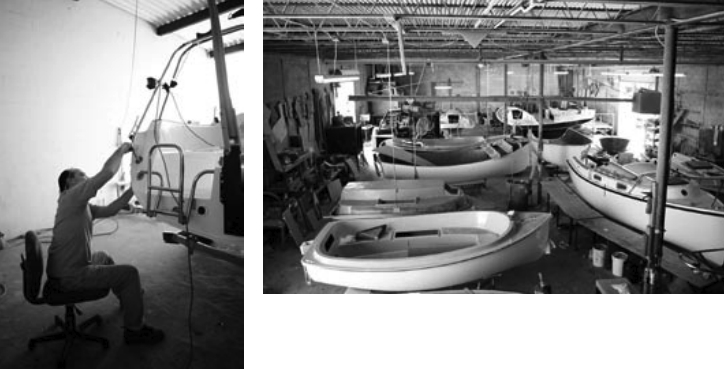
The Hutchins plant is located in a light industrial park and consists of several large, well-ventilated metal buildings, cluttered with tools, materials, and parts. Boat hulls are everywhere in various states of assembly and finish, from roughly shaped shells and decks still bristling with glass cloth to gleaming finished yachts on shiny new trailers, wrapped in plastic, and ready for shipment.
The challenge for many boatbuilders is to achieve the balance between quality and economy that produces good value. Hutchins has adopted a construction philosophy that seeks to reach this balance by using only quality polyester resins and knitted fiberglass fabrics. It also makes sense to subcontract the construction of hulls, liners, and decks to other firms. The parts are then shipped back to Hutchins’ Clearwater facility for assembly. The subcontractors are Custom Fiberglass Products of Clearwater, and JMJ Fiberglass of Pinellas Park, both in Florida.
The Dwyer Aluminum Mast Company, of North Branford, Connecticut, provides the mast and rigging for the Com-Pac 23 and the new catboat models (described shortly). U.S. Spars, of Gainesville, Florida, rigs the new Eclipse model. The masts and booms for the Com-Pac 25, 27, and 35 are fabricated by Charleston Spar, of Charlotte, North Carolina. All Com-Pac yachts have deck-stepped masts with the exception of the Com-Pac 35, which has a keel-stepped mast.
No adhesives are used to fasten interior furnishings such as cabinets and berths to the hulls. In the Com-Pac 35, an interior pan, or liner, is glassed to the hull, and the furnishings are then glassed to both hull and liner, contributing to the boat’s overall strength and rigidity. In the Com-Pac 25 and 27, a fiberglass pan incorporates all furnishings, including cabinetry, lockers, and shelves. On the Horizon, Eclipse, and Com-Pac 23, the interior is a single, prefabricated unit of plywood incorporating all the finished wood interior pieces; the entire assembly is lowered in and fiberglassed to the hull. The Picnic Cat has a simple fiberglass interior.
High-class construction
Positive-action seacocks, not gate valves, are used on all through-hulls in all models. Hulls and decks are joined together with marine adhesive sealant and mechanical fasteners, and in the 27- and 35-foot models the hull-deck joint is fiberglassed as well. There are no high-tech laminates or other spaceage exotics here, just good-quality conventional boatbuilding materials.
All Com-Pac keelboats are ballasted; the Com-Pac 25, 27, and 35 use lead ingots encased in concrete. The Com-Pac 23 carries concrete ballast only. The Eclipse and the new centerboard catboats (with the exception of the Picnic Cat) also carry supplementary concrete ballast.
In addition to the final assembly and finishing of the boats, Hutchins does all of the stainless-steel deck fittings and cabinetwork. Fully equipped woodworking and steel fabrication facilities are located on site, as are the administrative offices.
New catboat line
As the 20th century drew to a close, the Hutchins Company found itself in a remarkable position. Richard says the boats were being sold “as fast as we could pop them out.” Almost all its designs still in production were unqualified commercial successes. In an industry dominated by buyouts and corporate takeovers, with respected names bought and sold like worn-out plugs and molds, the firm was thriving, profitable, and still firmly in family hands. Choosing not to rest on its laurels, Hutchins embarked on a bold program of innovation: the introduction of an ambitious new line of trailerable sailboats.
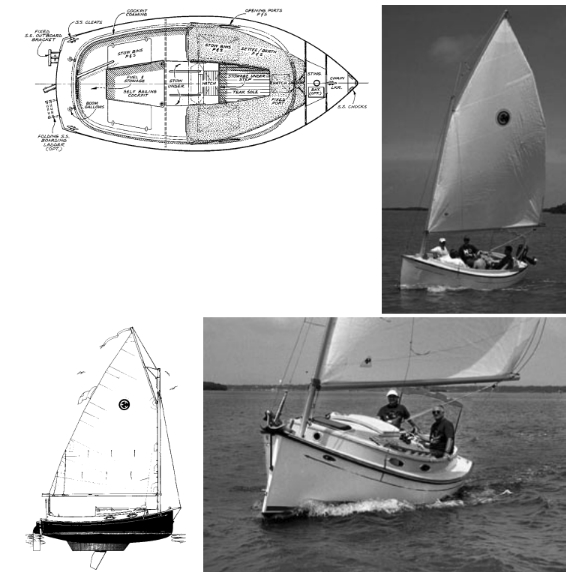
First, in 1998, came the Picnic Cat, a Clark Mills-designed 14-foot day-sailer featuring several departures from the company’s earlier models: it is an open boat, with a centerboard and catboat rig. The Picnic Cat also carries a Hutchins innovation — the Mastendr Quick Rig Sailing System, which allows the mast, boom, gaff, sail, and all standing rigging to fold down around a hinged pin arrangement onto a boom gallows, allowing fast singlehanded launching and recovery. The potential weak point of the small boat — the centerboard trunk — was eliminated by fabricating a heavy-duty stainless-steel centerboard frame bolted into a box, which is fiberglassed to the hull. This box is also stainless steel, so the boat requires no additional ballast. In the other cats, the box is fiberglass and is molded as an integral part of the hull.
The centerboard assemblies for each model are fabricated by Hutchins and produced to close tolerances. The centerboard pivot is not through the hull; instead, the board pivots relative to the frame. The board is controlled by means of a lanyard rove through a tube that leads aft to the cockpit. In spite of the lack of cabin and Com-Pac-style portlights, the Picnic Cat is unmistakably Com-Pac in appearance and quality.
Enter the Sun Cat
In 2000, Clark Mills was again called on, this time to design the Sun Cat, based on the same overall concept as the Picnic Cat but with the addition of a cabin. (There is also an open, cabinless variant — the Sun Cat Daysailer — with enough seating to accommodate eight adults in an enormous cockpit.) At 17 feet 4 inches, the Sun Cat is somewhat reminiscent of the Com-Pac 16 except for the rigging innovations and centerboard technology introduced in the Picnic Cat.
Down below, the Sun Cat boasts a finish and a standard equipment list that put it into another league altogether: bilge pump, teak-and-holly sole, two 6-foot 6-inch berths, a chain locker, and a forward hatch. The yacht’s overall look and feel above the waterline owe a lot to the 19th-century Cape Cod cat, but the centerboard and aluminum kick-up spade rudder bring her right into the new millennium. Below, the Sun Cat is a very big boat for its size, beautifully finished and with a list of options for every budget. It is a serious mini-yacht.
The third entry in the “New Breed of Cat Boat” came when Hutchins purchased the molds for the Herreshoff America, designed by Halsey Herreshoff and originally built during the 1970s by Nowak and Williams of Bristol, Rhode Island. The Hutchins brothers kept the classic shape but worked their usual magic below the waterline with some help from Bruce Bingham (designer of the 20-foot Flicka built by Pacific Seacraft). They also made some rig modifications that incorporate the Mastendr technology, sail-reefing points, and a modest bowsprit.
The trio completed
The result of all this, the Horizon Cat, completes the Com-Pac trio of shallow-draft, traditional catboats. Hull No. 1 hit the water in 2002. More than just a Sun Cat on steroids, the Horizon Cat is 20 feet overall, has a beam of 8 feet 4 inches, and draws 2 feet 2 inches with the board up (5 feet with it down). This is a remarkable boat.
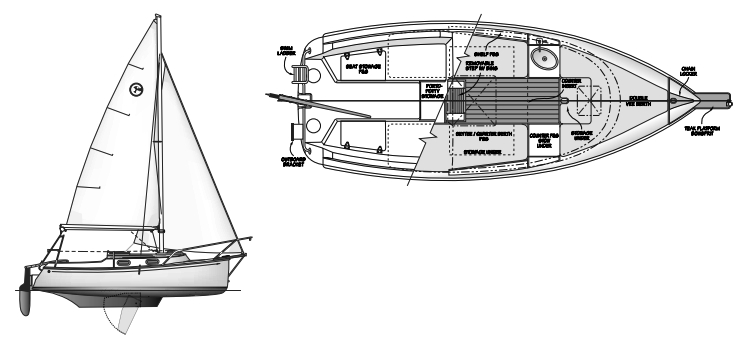
The latest Com-Pac, introduced last year, is the long-awaited replacement for the discontinued Com-Pac 16 and 19. The 20-foot-10-inch Eclipse is Hutchins’ first new sloop in years, utilizing both the centerboard and Mastendr rig pioneered in the catboats. It is being offered at an introductory price of about $23,000, or about the price of a new medium-sized car.
Richard Hutchins says that all existing models will remain in production for the foreseeable future. Interestingly, he says that the introduction of the new line of catboats has seemed to rekindle customer interest in the company’s older designs. As for the future, does the Hutchins Company have anything new and exciting in the works? When I asked Gerry and Richard about this, they only smiled and replied, “Wait and see.”
Thank you to Sailrite Enterprises, Inc., for providing free access to back issues of Good Old Boat through intellectual property rights. Sailrite.com