A remote control for short-handed sailors
Issue 41 : Mar/Apr 2005
Among the myriad of knots available to the sailor, one is most conspicuous by its absence. I cannot recall seeing a toggle hitch in use on any boat other than our own. This hitch has so many uses, where no other knot can be substituted, that a review might be in order.
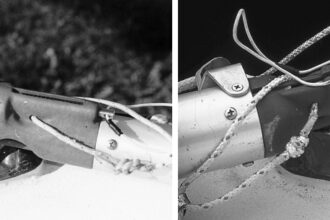
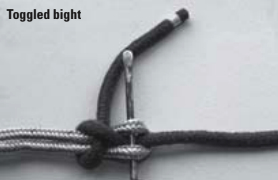
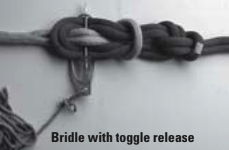
The toggle hitch is basically a means of joining two lines with eyes in the end. These eyes can be formed by having splices or knots. The photo above illustrates the basic hitch. If the lines are different sizes, the eye in the larger line is passed through the eye in the smaller one. A bight of the smaller one is then pulled up through the eye in the larger, and the toggle inserted. A toggled bight is shown on Page 74. It uses one line with an eye and one line without an eye. (Note: It would be tempting to try two straight lines, but you really need at least one loop to have a stable hitch –Ed.)
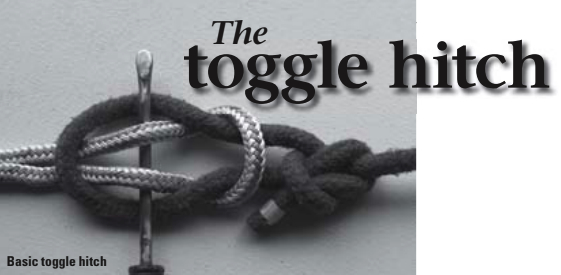
What is the toggle? Almost anything, from a tree branch on up. I use a 12-inch round-shanked screwdriver with the tip smoothed and a 1⁄2-inch hole drilled in the handle. The strain on the toggle is a very small fraction of the strain on the line. The hole in the handle allows for a loop of bungee cord and for a toggle line, which is used when you need to undo the hitch from a distance.
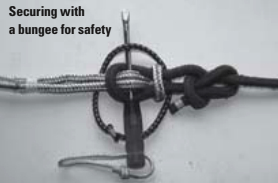
While the hitch is very secure, belt-and-suspenders types may wish to add to the security. A loop of bungee cord, fastened through the hole in the handle, can be pulled over the end of the toggle. The length of a loop should be a few inches short of the end of the toggle so the toggle cannot self-withdraw but can be withdrawn by tugging firmly on the toggle line. The bungee cord should be pulled around the back of the hitch so it bears on the outer line, not the inner one (see bottom photo).
The benefits of the toggle hitch are in its ability to be instantly disengaged and to be disengaged from a distance.
Laying out an anchor
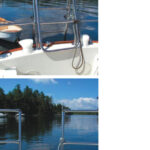
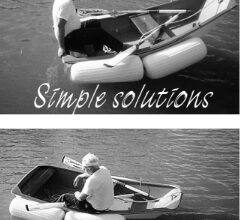
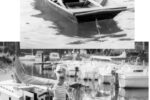
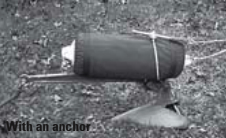
When it is necessary to lay out a second anchor or to put out a breast anchor from any pier mooring, the toggle hitch really shines (see anchor photo on facing page, top). An appropriately sized line with eyes in each end — spliced or knotted or a loop of line — is passed through the head of the anchor and around an appropriately sized fender. On top, a toggle hitch is fastened. The anchor/fender is lowered over the side by the rode, with a line from the fender and a toggle line led to the dinghy. The anchor is then rowed or motored out to its chosen location and the toggle pulled out of the hitch. The anchor drops in place, and the fender is recovered into the dinghy. No scratches, dings, or dents. In fact, using the fender and a toggle hitch, the anchor can be swum out without difficulty.
Towing
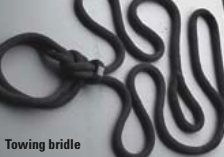
When your boat is towing or being towed, immediate disengagement can be critical. You may have only a few seconds to cast off a towed boat or to free yourself from a tow. The use of the toggle hitch provides you with the ability to react instantaneously. Towing is best done with a bridle. One way to make a bridle suitable for towing or being towed involves splicing an eye in each end of a line appropriate to the size of your boat and in finished length twice the distance between your stern cleats. If you don’t have a line made up with eye splices, bowlines will do.
Make the eyes large enough to go over your stern cleats and over your bow cleat or cleats. Hook them together over a post or cleat, pull out the tension, and mark with tape the exact center of the bridle. An error here will cause towing to be offset and will place the entire towing load on only one line. Once you have your bridle ready, tie a bowline on a bight in the bridle with the tape exactly centered as illustrated. Make the bowline eyes 12 inches long.
When towing – If yours is the towing vessel, place the spliced eyes over your stern cleats, clear of all rigging and stanchions, and rig the toggle hitch with a bungee for safety in the bowline in your towing bridle. If the towed vessel gives you a plain line, put a bowline in it. Take the end of the toggle release line and fasten it loosely to the backstay, where you can reach it. With the bungee wrapped around the hitch, the toggle will not come out by accident, but a firm pull on the toggle line will immediately disengage it and the tow.
When being towed – Use the same bridle when under tow. Lead each end on opposite sides of the headstay, through the chocks, if so equipped, and to the bow cleats. Or lead both to the midships cleat, if your boat is rigged that way. Using a bowline or spliced eye on your end of the towing bridle, fasten the toggle hitch and lead the toggle release line to the headstay, high enough to keep it clear but within reach. If you should notice the towing vessel is a shallower draft vessel and about to go over a shoal which is fine for his boat but not for yours (or need to disengage for any other reason), a quick tug on the toggle will allow you to choose your own place to go aground. He would have your towrope, but you would have your keel.
Other uses
You can use the toggle hitch to quickly release a boat moored near shore with a line to a rock or tree and an anchor off the bow. Other uses will present themselves once you add this knot to your repertoire.
We have used the toggle hitch for years, and consider it an important part of our knot inventory. All our crew-members learn it. I would not recommend that the toggle hitch be taught to sailors before the bowline, clove hitch, or buntline hitch, but it is a worthwhile hitch to have in your repertoire.
Thank you to Sailrite Enterprises, Inc., for providing free access to back issues of Good Old Boat through intellectual property rights. Sailrite.com