The patented hull gives this boat “space appeal”
Issue 41 : Mar/Apr 2005
Reinell Boat Works of Marysville, Washington, specialized in fine lapstrake and carvel-planked fishing and pleasure boats from the company’s inception in 1928. In 1957 they started using fiberglass as a boatbuilding material, replacing the cedar, mahogany, white oak, and other woods they had been using. Not long after that the company expanded its product line to include sailboats. One of the first offerings was a 26-foot pocket cruiser called the RSC2600.
The hulls used by Reinell Boats for their sailboats were designed and patented by Arthur S. Henry. To achieve more headroom, he patented the concept of extending the sailboat’s cabin sole into the keel. This provided Reinell Boats with what they must have thought was a breakthrough marketing edge.
Production of both power- and sailboats continued into the mid-1960s. In 1967, the owner, Nick Reinell, sold the company. Around this same time, or soon after, one of two events took place. Either Reinell decided to quit producing sailboats and sold the molds to the newly formed American Mariner Industries, or Reinell employees purchased the molds, left the company, and formed AMI. No one knows for sure. In 1980, following a series of disruptive management changes, Reinell Boat Works ceased operation and all its assets were auctioned off. This effectively wiped out all documentation of the company’s 52-year history.
In 1975 American Mariner Industries of Costa Mesa, California, using the patented Henry molds, introduced its first two sailboats: the American 26 and the American 23. The 26 had a three-year production run; the 23 was manufactured for only two years. However, upgrades and revisions, including name changes, of both models occurred in subsequent years. Eventually the line included sailboats from 20 to 30 feet. After eight years and 14 sailboat models, AMI declared bankruptcy in 1983, and the assets were sold. This bankruptcy case, it should be noted, set a legal precedent. Also interesting to note is that, of the 14 models produced by AMI in its short eight-year history, only three had production runs longer than three years. Most were produced for only one or two years.
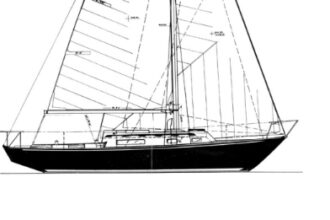
While there is much that we don’t know about American Mariner Industries, we do know that the American 23 is a first-offering sailboat from AMI sporting the patented Henry keel. It has an overall length of 23 feet, a waterline length of 21 feet, a beam of 7 feet 11 3⁄4 inches, and it displaces 3,000 pounds with 900 pounds ballast.
Design and construction
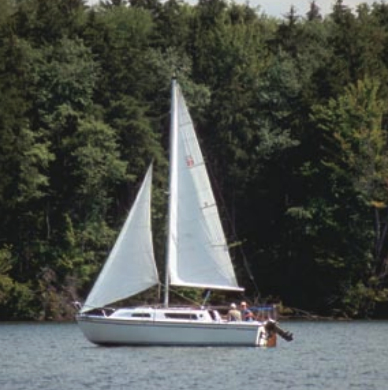
At a glance, the American 23 with its fl at sheer, straight bow, plumb stern and long deckhouse looks much bigger than a typical 23-footer. When looking a little closer, Arthur Henry’s patented design begins to stand out in several areas. The maximum beam of 7 feet 11 3⁄4 inches starts at a point 9 feet from the bow of the boat and extends almost all the way aft, ending at a transom which is 7 feet 6 inches wide. There is also significant freeboard (42 inches at the bow and slowly tapering to 36 inches at the transom). The sides of the hull have a relatively vertical relationship to the bottom of the boat, thus creating a somewhat hard chine with its associated stiffness. The bottom of the boat is flat except for a flat-bottomed, shoal-draft keel approximately half the length of the boat. True to the patent, this angular relationship between the sides and hull is maintained along a substantial portion of the hull’s length. Discounting the rigging and keel, the hull is similar to that of a flat-bottomed motorboat.
Stoutly built, the American 23 is constructed of a handlaid, solid fiberglass hull with plywood-reinforced laminates in the cabintop, deck, cockpit, and transom. The hull-to-deck joint is bonded with adhesive, mechanically fastened, and covered with a two-piece (aluminum and vinyl) rubrail. The patented stabilizer keel is molded as an integral part of the hull and incorporates 900 pounds of lead ballast bonded in place. This gives the boat a maximum draft of 28 inches, which is great for trailer launching/retrieval and shallow-water cruising. The transom-mounted spade rudder is built entirely of wood and does not kick up. The tiller is varnished ash. Also located on the transom are an outboard motor bracket to port and a stainless-steel swim ladder to starboard.
On deck
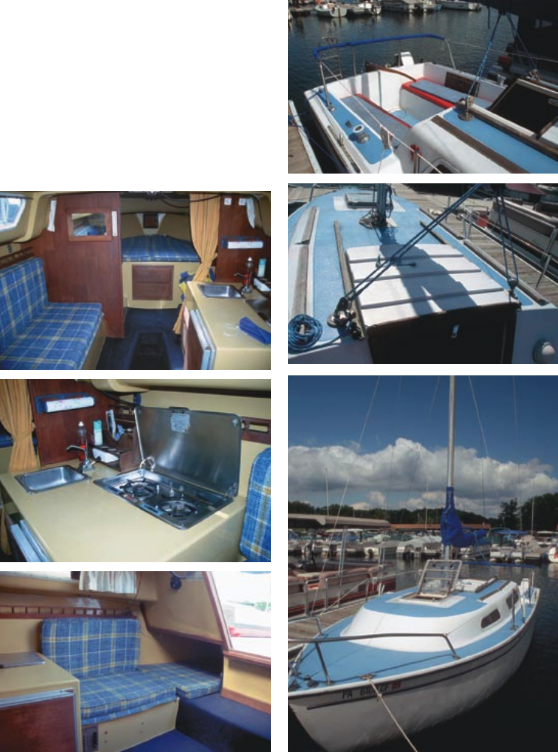
With the exception of port and starboard mooring cleats, the foredeck is completely free from clutter, providing a good work platform. Also, the deck, cabintop, cockpit seats, and sole have molded-in non-skid surfaces. The shrouds are outboard of the 9-inch-wide sidedecks, and there is an unusual and somewhat awkward two-piece grabrail along each side of the cabintop. Completing the “on deck safety package” are stainless-steel bow and stern pulpits, 20-inch stanchions, and single lifelines.
Since the boat’s beam is so extensive and the sidedecks narrow, forward and aft movement can more easily be accomplished via the broad cabintop. On the cabintop and forward of the mast is a 22-inch-square reinforced hatch, which is strong enough to step on.
The cockpit is 67 inches long, comfortably wide, and surrounded by 13-inch high coamings. What appear to be 6-inch by 22-inch hand bins (one in each coaming) are really the access to long, narrow stowage areas which run the entire length of the coamings. The cockpit is self-bailing but could benefit from a larger-diameter drain.
The boat lacks a bridge deck to help prevent water from a pooped cockpit from cascading into the cabin. Also there is no dedicated space for a remote gas tank. Placing the tank on the cockpit sole beneath the tiller is not the best stowage option, but this is a common practice. Even though there is considerable stowage space beneath the starboard cockpit seat, as well as under the cockpit sole, there is no access to it from the cockpit. No cockpit lockers! One has to enter the main cabin to reach these stowage areas. Brightwork is kept to a minimum and is limited to the companionway, cockpit storage-bin doors, grabrail, and the tiller/rudder.
Belowdecks
Belowdecks is where Arthur Henry’s handiwork is most evident in terms of space, most notably headroom. By recessing the inside of the shoal-draft keel and bonding the ballast along its bottom and side surfaces, a 16-inch-deep x 16-inch-wide x 7-foot-long keel sump is created. What would ordinarily be 54 inches of headroom, without the sump, has now become 70 inches of headroom. In addition to the two steps required to enter the cabin’s first level from the cockpit, an additional two steps are required to enter the keel sump and achieve this maximum headroom.
AMI used a one-piece, hand-laid molded pan and a similar overhead liner in the construction of all of their boats, including the American 23. While this construction technique adds considerable strength, and at the same time specifies the location of built-in furniture, it makes it very difficult to add or repair any deck or hull fittings without cutting into the liner.
Forward, the V-berth measures 6 feet in length by 6 feet 6 inches maximum width. This area is separated from the rest of the boat by a teak bulkhead. The opening through the bulkhead has no door but could easily be fitted with a curtain for privacy. Just aft and to port is the head, a Porta Potti connected to a deck pumpout. Opposite the head is a hanging locker and stowage. Over this area, providing light and ventilation, is the reinforced 22-inch-square forward hatch.
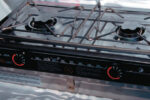
Another teak bulkhead, this time with a curtain, sepa rates the main cabin from the forward portion of the boat and provides support for the deck-stepped mast. It is at this area that the forward portion of the keel sump begins with two steps down. Immediately to starboard is a 41-inch by 30-inch fiberglass galley unit complete with a stainless-steel single sink with hand pump, two-burner alcohol stove, side-opening icebox, teak dishrack, food preparation area, and plenty of stowage beneath.
The 20-gallon deck-filled water tank is located forward, under the V-berth. Just aft of the galley is a 32-inch-wide by 36-inch-long settee. Beneath the settee is the battery and additional storage space. The 12-volt electric panel is also conveniently located here next to the icebox. Immediately aft of the starboard settee is access to the cavernous stowage areas beneath the starboard cockpit seat and under the cockpit sole.
Opposite the galley, on the port side, is a 32-inch-wide by 6-foot-long settee/berth. This is immediately followed aft by a quarter berth of similar dimensions. A 4-foot-long by 1-foot-wide rectangular pedestal table can be set-up in front of the port settee, facilitating access to the galley directly across from it. When not in use, the table is stowed beneath the settee. Additional stowage is located under all berths/ settees, except the quarter berth.
There are also 6-inch-deep shelves outboard of both set tees. Although you stand in the keel sump to use the galley, all the settee/berths are located two steps up, on the cabin’s higher level. This arrangement provides for 40 inches of sitting headroom. Natural illumination for the main cabin is provided by four long, oval, non-opening portlights. Two 12-volt fluorescent overhead lights adequately light up the main cabin, with two incandescents brightening up the V-berth and head areas. The overhead and sides of the boat’s interior are gelcoated, and the entire cabin sole is carpeted.
The rig
The American 23 is a sloop with a deck-stepped mast. Mast and boom are both anodized aluminum. The standing rigging is stainless steel and consists of a headstay, a single spreader, upper and lower shrouds, and a single backstay. It’s a fractional rig, with a total sail area of 220 square feet, consisting of a 100-square-foot mainsail and a 120-square-foot working jib. The mainsail comes standard with four battens and a single reef point.
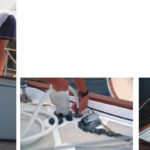
Both the external mainsail and jib halyards are wire-to-rope and are cleated at the base of the mast. The 9-foot boom is controlled via mid-boom sheeting, located on the aft portion of the cabintop. This is a triangular affair running from port to the boom, then to starboard and back. It is cleated off on the port side of the cabintop. While this setup keeps the cockpit clear of main sheet, it’s a bit awkward in actual operation. Twenty-four-inch headsail tracks with jib leads are located on the sidedecks outboard of the cockpit coamings. On the coamings are Barlow #16 winches and cleats to handle the jib sheets.
Under way
The boat’s maximum beam starts well forward and continues virtually all the way aft. This is not the shape of speed. It is most definitely a cruising boat. Add its hard chine to this, and you have a very stable sailing platform. The high freeboard and lack of a centerboard contribute to the boat’s tendency to make noticeable leeway. The sheeting angles are too wide to enable the boat to be very close winded. For its weight and amount of wetted surface, the boat might be considered just adequately canvassed, if not a bit underpowered. The American 23 responds well to its rudder. However, the boat tends to oversteer when tacking. With a little practice, this condition can be easily dealt with.
Things to check out
Sound out the deck, cabintop, cockpit, and transom for signs of water migration through the plywood core. Deterioration of this core material will sound like a dull thud when struck with a plastic hammer or the handle of a screwdriver. Even though the bulkhead separating the main cabin from the forward portion of the boat provides some support for the mast, it is not located directly under the mast, but rather a foot or so forward. Look for signs of mast compression including cracks in the fiberglass or a noticeable depression beneath the mast.
Since the rudder is made entirely of wood, examine it carefully. The boat originally came with wire-to-rope halyards. If they have been replaced with all-rope halyards, make sure that the sheaves were also replaced. Like many boats that utilize an overhead liner, access to deck fittings is impossible without cutting holes in the liner. Ask about any holes that have been cut.
Summing up
The overall construction of the American 23 is above average, and its rigging and sail controls are adequate. It’s perfectfor inland lakes and reservoirs. It’s not a bluewater sailer and was not intended to be used for crossing oceans. The patented hull gives the boat space appeal, especially the standing headroom, and makes it most definitely a cruiser.
Problems with a used American 23 will most likely be attributed to age and/or neglect. Other than those areas noted previously, there are no known major flaws.
Like many trailerable boats of this vintage, its manufacturer is no longer in business. However, there is a dedicated owners association happy to answer questions and provide support. It can be reached at http://www.amiyachts.com.
The American 23 was only produced for two years. The extent of the production run is unknown, but suspected to be small, hence there aren’t many boats on the market at any one time. Expect to pay between $2,500 and $4,000 for an American 23 in average condition.
Thank you to Sailrite Enterprises, Inc., for providing free access to back issues of Good Old Boat through intellectual property rights. Sailrite.com