A classic performance cruiser, with the emphasis on performance
Issue 41 : Mar/Apr 2005
The year was 1961 when George Cuthbertson, a mechanical engineer, and George Cassian, an aircraft designer, got together and formed a partnership with the express intention of building performance sailboats. George Cuthbertson managed the business and developed the preliminary lines and calculations, while George Cassian handled interior plans and details. The two worked together in a true collaboration. However, it wasn’t until George Hinterhoeller’s company and a stockbroker were added to the mix that C&C Yachts Ltd. was born. The date was September 26, 1969.
For almost three decades the story of C&C Yachts runs deep and varied with the ups of numerous technical innovations and successes, both commercially and on the race circuit, and the downs of the turbulent 1980s and finally a “fire sale” to Fairport Marine in 1998. (For more on the company’s history, see Dan Spurr’s “The History of C&C Yachts,” September 2002.)
Throughout its history, C&C’s bread and butter was the racer/cruiser, with emphasis on the racer. Of the more than 50 designs, all but a handful fall into this category.
Like several of C&C’s successes, the C&C 33 MK I began in the custom shop. However, after building just three boats, the company responded to market demand and started producing these hulls at its Niagara-on-the-Lake plant. Over a three-year period between 1975 and 1977, they built 165 C&C 33s. These were Mark I models, of course, since no further modifications had yet been made which would lead to Mark II or III versions.
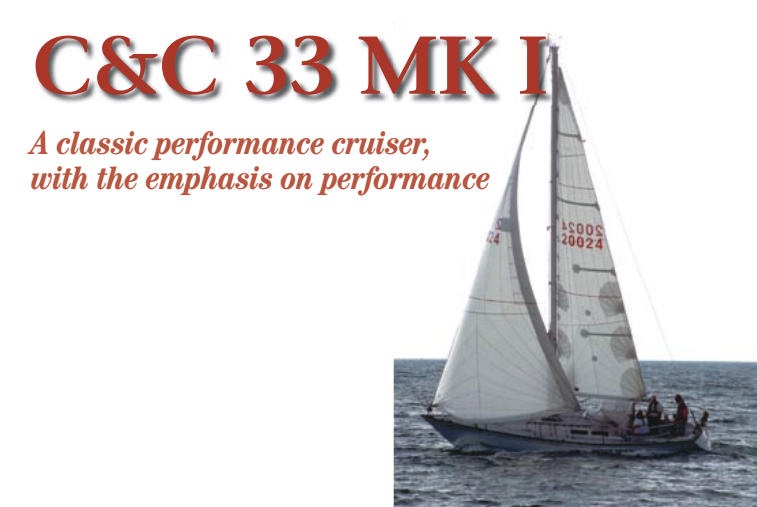
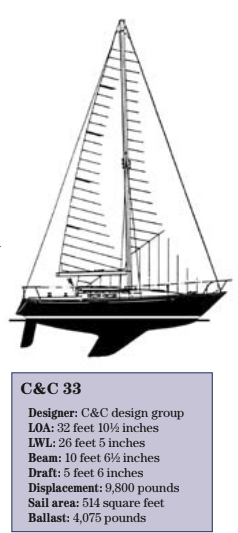
The C&C 33 MK I is a classic example of why C&C Yachts achieved a reputation for building high-performance sailboats. It has an overall length of 32 feet 10 1⁄2 inches and a waterline length of 26 feet 5 inches. The beam is 10 feet 6 1⁄2 inches, draft 5 feet 6 inches, and displacement 9,800 pounds with 4,075 pounds of ballast.
Design and construction
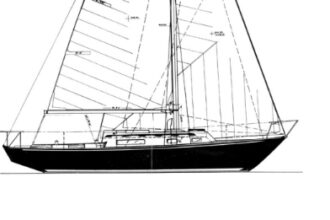
Created in-house by the original C&C design group, the C&C 33 MK I exhibits the somewhat flat sheer common in the late 1970s. The sharp entry of its bow gives way to a deep-chested hull shape with a noticeable tumblehome at its beamiest point. Aft, there is a reverse transom with a short overhang. All of these elements were designed to favor the handicap rule of the day, the International Offshore Rule (IOR). Completing the picture underwater is a swept-back fin keel and spade rudder.
The C&C 33 MK I was built as a solid fiberglass-laminate hull with a balsa-cored deck. Rather than being fabricated with the traditional square mat and roving that was employed by the majority of boatbuilders at that time, the C&C 33 MK I was one of the first boats to be built with unidirectional roving. This method of construction produces optimum weight/strength characteristics, strong yet lightweight for performance sailing.
Another innovation is the hull-to-deck joint, which is well thought-out and practical. Sandwiched between the inward-facing hull flange and deck is a layer of butyl tape, followed by a vinyl rubrail and more butyl tape. This system is capped with a full-length anodized aluminum slotted toerail and fastened together with closely spaced 1⁄4 x 20 stainless-steel bolts. C&C Yachts was one of the first builders to employ this novel design.
The deck hardware is of good quality and strength and is properly installed. The cleats, winches, and deck fittings are all through-bolted and secured to glassed-in backing plates. There’s nothing like having the job done right.

On deck
Except for the cast-aluminum stemhead fitting and the two 10 1⁄2-inch cleats, the boat’s foredeck is clutter-free. Add to this a stainless-steel bow pulpit, dual lifelines on 25-inch stanchions, and a non-skid surface, and one has a good platform on which to make sail changes or move about safely. Just aft is a 21-inch square aluminum-framed hatch with an acrylic insert. This is the source of the boat’s forward ventilation. Sidedecks are a wide 21 inches only slightly obstructed by the chainplates centered there. The coachroof is cambered and, like all the deck surfaces, is non-skid.
The C&C 33 MK I was designed to have all the halyards controlled from the base of the mast. Therefore, clustered around the base are four Barient winches (two #16s and two #10s) and their associated 7-inch cleats. Handholds in the form of two 9-foot 4-inch teak handrails are located along each side of the cabintop. Completing the picture aft is the full-length black aluminum slotted toerail, which is something of a C&C trademark. (We have heard the slotted toerail on our own C&C 30 MK I referred to with affection — we hope — as a “Canadian picket fence.” –Ed.)
The T-shaped cockpit is a generous 7 feet long and more than 5 feet wide. Its coamings are 11 inches tall, straight and, in addition to keeping water out, offer good back support. The tops of the coamings are around 8 inches wide and were the original sites for Barient #26 sheet winches. The cockpit incorporates an excellent bridge deck to prevent water from cascading down below, should a wave fill the cockpit. The cockpit is self-bailing and has four drains. To starboard is a deep sail/equipment seat locker and to port a shallow seat locker, suitable for docklines, winch handle, emergency gear, and other small items. Even though the standard C&C 33 MK I was originally designed with a tiller, the T-shaped cockpit is well suited for wheel steering. The vast majority of boats were ordered with this $850 option. This frees up the forward cockpit space and also positions the helmsman close to the engine controls and instrument panel. Completing the ondeck package is a stainless-steel stern pulpit and incorporated centerline swim ladder. Noticeably absent is a pair of stern mooring cleats. In order to tie off, one must use the sheet cleats — that is, if they haven’t been removed through upgrading — or the sheet winches themselves.
Belowdecks
Starting at the boat’s stem, just aft of a small rope locker, is the V-berth that measures 6 feet 4 inches at its longest point. With the filler cushion in place, it can comfortably accommodate two adults. In addition to stowage beneath, there are port and starboard shelves running the length, just above the V-berth. Overhead is the forward hatch, providing illumination and ventilation, and a folding teak door for privacy.
Directly abaft the V-berth and to starboard is the head, which consists of a small sink, a locker and shelves, and a marine toilet. Above is a mushroom vent. The toilet was available with direct discharge or a holding tank. As is the case with our review boat, most were delivered with holding tanks. Opposite the head is an 18-inch-wide hanging locker and three open-faced bins that provide quite a bit of usable stowage. A sliding door provides privacy and separation from the main cabin.
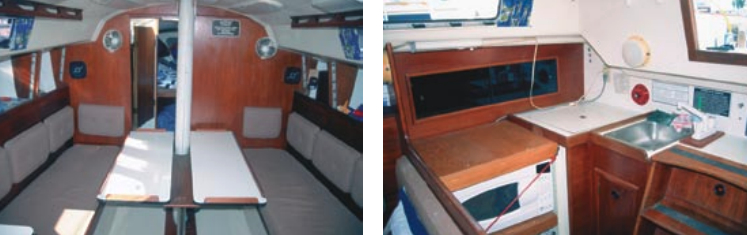
The centerline drop-leaf table measures 47 inches by 40 inches when open and is flanked by an L-shaped settee to starboard and a straight settee to port. Both measure 6 feet 6 inches. With the table lowered and the insert cushion in place, the starboard settee converts into a double, while the port settee remains a 21-inch-wide single. Shelves with 4-inch coamings incorporating bins and small cupboards run outboard of each settee.
There are stowage lockers behind the port and starboard settees’ back cushions and beneath the starboard settee. The 30-gallon potable water tank is located beneath the port settee.
Adequate stowage
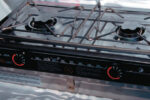
The L-shaped galley is directly behind the starboard settee and includes a three-burner pressurized alcohol stove and oven, an icebox that drains into a sump, and a small stainless-steel sink with a hand pump for water. Galley stowage space is adequate and counter space above average. The DC power panel is located beneath the companionway steps. Speaking of the companionway, it incorporates a 24-inch-square translucent sliding hatch, a sea hood, and a one-piece teak hatchboard (much more convenient than multipart boards) to close out the elements. It also provides the sole source of ventilation for the main cabin if the fixed ports have not been upgraded.
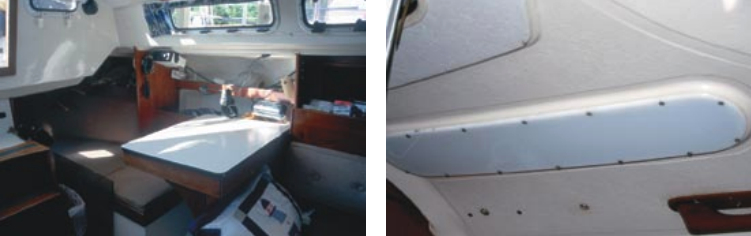
Just across from the galley on the port side is the forward-facing navigation station. The 31-inch by 24-inch tabletop is hinged to provide chart storage below. In addition to an outboard stowage bin and drawer, there is additional storage space beneath the chart table as well as the dedicated navigator’s seat. Aft of the navigation station is a 6-foot-long single quarterberth. Even though there is quite a bit of headroom, getting in and out of the quarterberth involves the traditional gymnastics. A fiddled shelf runs above and outboard of the berth, and there is stowage beneath. A port that opens into the cockpit footwell provides the quarterberth with illumination and ventilation.
With the exception of the fiberglass pan and overhead liner, the bulkheads and trim are oiled teak. All deck fittings can be reached from below through access panels in the overhead liner or from behind concealing flanges (well thought-out). Access to the bilge is by means of a wooden insert in the fiberglass sole. There is three-sided access to the engine from beneath the companionway steps as well as from the cockpit sail locker. Accessibility to the vital components of the engine rates better than average, but changing packing in the stuffing box would be a challenge.
There’s 6 feet of teak grabrail on both sides of the cabin overhead for good bracing in a seaway. And there is 6 feet 1 inch of headroom for ease of moving around below. Illumination is provided by four 23-inch-long fixed ports, in addition to the half dozen 12-volt dome lights. Overall, the accommodations of the C&C 33 MK I are roomy, offer good stowage, and are nicely finished.
The rig
The C&C 33 MK I has a bridge clearance of 46 feet 11 inches. The rig incorporates single foil-type spreaders, an aluminum diamond-shaped mast, and an aluminum boom. The standing rigging consists of a headstay, single backstay, single upper shroud, and dual lowers. The original standing rigging was Navtec #8 stainless-steel rod, rather than 7 x 19 stainless-steel wire. The C&C 33 MK I is a masthead-sloop with 514 square feet of sail area. The wire/rope halyards are internal and the sheets double-braided Dacron. A ball-bearing traveler, with stops, is located on the bridge deck. Originally, snatch blocks attached to the slotted toerail allowed for adjustment of the sheeting angle. Our review boat, Night Train, owned by Dennis and Rose Kunc, has had 10 feet of genoa track added to each sidedeck. Upon leaving the factory, the boat’s halyard winches and cleats were located at the base of the mast, and the sheet winches and cleats were located on the cockpit coamings. The review boat has been upgraded with two additional winches on the cabintop. This allows for some lines to be run aft to the cockpit.
For auxiliary power, the C&C 33 MK I has the Universal Atomic 4. This venerable 30-hp gasoline power plant is raw-water-cooled and uses a 2:1 reduction gear V-drive. With its two-bladed propeller, it pushes the boat along at a tad over 6 knots. Fuel is supplied from a 20-gallon Monel fuel tank.
Under way
This boat is a good example of C&C’s legendary performance reputation. It is quite stiff and seems to be balanced and very responsive. It points exceptionally well. In heavy air, the boat develops weather helm, but nothing that can’t be overcome. She’s a great spinnaker boat. On a reach she really performs. Downwind sailing may require some attention to maintain course and speed. It’s been noted that the C&C 33 MK I tends to yaw a bit in a choppy following sea. Her pinched ends are the suspect contributors to this phenomenon. Overall, her bad manners are few and her attributes many.
Things to check out
As is the case with all boats with balsa-cored decks, check them carefully to determine if water intrusion and delamination have taken place. This is easily accomplished by tapping the area with the handle of a screwdriver or plastic hammer and listening for that telltale dull, hollow sound. Pay particular attention to areas under and around deck fittings, especially stanchions. It has been reported that the bases of the stainless-steel chainplates have sometimes separated from the hull due to stress. Carefully inspect this area to determine if they need to be reglassed. The T-shaped deck ties, used to attach the bulkheads to the deck, often precipitated deck cracks. This is due to the movement of the deck relative to the hull and bulkheads. These cracks in the deck can allow for water intrusion and subsequent delamination.
The boat was originally delivered from the factory with rod rigging. Over the years, most owners have had this replaced. Have any rod rigging that is still in place professionally examined. As with any boat of this vintage, be prepared for possible breakdowns in the wiring, sail-handling gear, pressurized alcohol stove, and the Atomic 4. All of these are pushing 30 years of use and may be getting tired.
Summing up
The C&C 33 MK I lives up to its performance pedigree. Its accommodations are roomy, stowage is ample, and it’s nicely finished. When new in 1975, the C&C 33 MK I had a base price of $33,500. Nicely equipped boats retailed for about $36,500. In today’s marketplace you can pick one up for between $22,000 and $33,000, depending upon year and condition.
Thank you to Sailrite Enterprises, Inc., for providing free access to back issues of Good Old Boat through intellectual property rights. Sailrite.com