After a belated refit, sailing starts in earnest
Issue 42 : May/Jun 2005
It has been a glorious summer, the best since 1727 they say . . . the stuff of memories, a summer to tell tales of, a summer that truly is how summers used to be but never were. For those of us who are fortunate to live on the coast of Wales, the sea breezes have brought some respite from the heat, while all around has become a pastel postcard world of blue sea, blue sky, and golden sand.
The sailing season was late starting for me, with my boat not coming to the end of a belated refi t until July. There were dozens of repairs and restorations on board, and a new auxiliary outboard and sails were ordered.
We were having tea in the garden when the sails arrived. They were delivered from the sailmaker in Chichester, their arrival announced by stumbling and crashing noises in the undergrowth on either side of the narrow lane leading to the beach house. Two young men hove into view, one carrying a large box and the other poor fellow struggling with a long, a really long, tube containing the foresail reefing foil.
It took a few more days to get everything rigged, a few more again to finish off the work on the boat. They say no ship is ever ready for sea. Then the day came.
It was not my first sail since beginning the refit; there had been the dinghy, to keep my hand in, and I had crewed on a friend’s Wayfarer. My friend is a natural helmsman but with only a few seasons’ experience. Once, when we put to sea, a porpoise surprised him by leaping out of the water inches from the boat. Like most people seeing this for the first time from a small craft, he was startled but soon came to see, as everyone does, that these harmless creatures are a delight. Then there were a dozen or more leaping and playing around us, turning in the air and water with their smiling faces. After a while, with regret, it was time for us to bid farewell to our cheerful friends and turn back but, in perfect unison, so did they . . . like soldiers on parade escorting us home. Real showoffs!
Hoisted sail
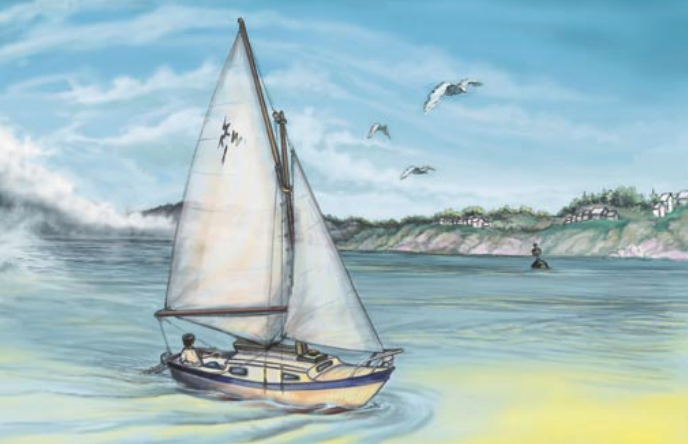
The new auxiliary started easily. I motored out into the bay and turned my ship into the light breeze to hoist the mainsail. The foresail unfurled; we were sailing at last.
The foresail set perfectly, drawing well, but try as I might I could not trim the mainsail to a perfect set. I reckoned the peak halyard was not pulling quite sufficiently through the masthead sheave, leaving the yard at just a little too great an angle from the mast. That evening I rowed back out to the boat and spliced a new eye to the halyard, gaining a couple of inches of hoist in the process.
The next morning was virtually a dead calm, one of those mornings where sounds carry across the water: boats getting ready for sea, the clunk of an oar in its crutch, a voice, the rattle of a chain. With the morning haze clearing from the surface of the water, we motored out and once again hoisted sail. There was barely a breath — less even than the previous day — but the mainsail set without flaw. Literally the last wrinkle was ironed out.
This was more like it! How can such a minute imperfection have such an effect on something so massive? With both sails drawing, even in what was a much lighter breeze, that wondrous creation that is a sailing boat was gliding along handsomely. I lowered a mackerel line over the stern, cruised along the edge of the rocks for a while then turned seaward. About four miles out, by my guess, the wind dropped to nothing. I had caught no fish.
It hardly mattered. Alone on a mirror sea, with the land now little more than a haze astern, I had found contentment. One or two cables to seaward a fin broke the surface, then a glistening back and horizontal tail. One of our porpoise friends had arrived. It is said that when they leap out of the water, bad weather is in the offing. The old seamen say: “When the seahorse jumps, stand to the pumps!” But this fellow looked too lazy to jump.
Seeking a breeze
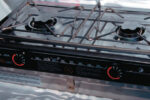
It was a good time for thinking. Inshore, I could just see some motorboats putting out, toy boats and one or two impossibly tiny white triangles optimistically seeking a breeze. Going below, I boiled up a kettle, the gimbaled Primus hissing and squeaking with the gentle scend of the deep.
I took stock then. A boat, in her way, may be a work of art, like a book or a painting, but also a crafted blend of the aesthetic and the functional. The polished brass cabin lamps, the gleaming brass galley and bilge pumps, varnished lockers and the new L shaped chart table. I have a stainless-steel Charlie Noble venting on deck, serving a cabin heater. The heater is a splendid sculpture in black cast iron with a deep fiddle rail for pots. Made in the United States, it is cozy and practical. Burning driftwood to warm the cabin in chilly anchorages, it is a great expression of the American perspective of the outdoors, highly practical, extending the vessel’s independence from civilization. Reading my log, I saw that I once spent 10 days aboard when it worked so efficiently with just a fistful of twigs gleaned from the tideline, to cook or brew up, that on only one occasion did I find it necessary to use the Primus.
Back in the cockpit, I noted that the scenery had changed. At sea, one’s eyes are ever shifting around the horizon, scanning for signs of change in the weather or sea. To the north, the long curve to the mountains of North Wales was no longer visible, while to the south the Strumble Head Light, with its spark of light flashing group four every 15 seconds day and night, was as sharp as a pin. A quick position fix with the hand-bearing compass gave a respectably condensed cocked hat on the chart some three miles off the coast. I had thought it further.
As I had put to sea early, crossing the shallows of the bar on the very first of the flood tide, time was not wanting and if, as I suspected, a sea mist was coming in, then something of a breeze must be propelling it.
Water sail
I wanted to get inshore to where big ships cannot go before visibility closed in and, as my eyes turned to the auxiliary, I felt a coolness on my arms as the first outriders of the coming breeze rippled the water. The storm jib was quickly rigged as a water sail beneath the boom to catch every scrap of wind, and I sat as far out as I could on the lee rail to try and careen the vessel into a sailing attitude, the way the wind does. That way, I reckoned, the sails would be prepared, set to the right curve under gravity, so the first of the breeze is not wasted swinging spars and filling sails. I shaped a course for home.
Soon the familiar landmarks came into view, marks I have sailed past in different vessels a thousand times since boyhood. We had won, boat and skipper, a race against the mist that had snapped at our heels. Then, finally triumphant, running goose-winged up the estuary against the ebb, the mooring buoy in sight, heaving to in order to strike the water sail and lower the main, running on under the smaller sail before that too was furled, the boat gliding on under her momentum and the slight pressure of the wind on the rigging, the skipper braced on the foredeck, boathook on its lanyard held like a harpoon. Finally, rowing in the pram back up the creek with tendrils of mist closing in. All is well.
She is at her mooring now, a pool of moonlight showing off her strong, purposeful lines against the sparkling water of another ebb. We have known a few hours of perfect freedom. We have been to sea and returned. The floor of my study feels as if it is moving — freedom is intoxicating. The first real sail but not the last.
I hear there is a breeze promised for tomorrow.
Thank you to Sailrite Enterprises, Inc., for providing free access to back issues of Good Old Boat through intellectual property rights. Sailrite.com