Fast way to make a seagoing pillow/blanket
Issue 43 : Jul/Aug 2005
Whoever came up with the idea for the first quillow deserves some sort of award for ingenuity. But the name of that individual is probably long forgotten. It’s an idea well known to the quilting crowd and appears to be rather widespread among “the rest of us” as well. (I was amazed at how many people knew about quillows when I raved about this concept that was new to me.) What revolutionized the traditional quillow and made it perfect for boaters was the introduction of fleece fabric. By “fleece,” I mean the fuzzy synthetic stuff that essentially comes from recycled plastic bags and is warm and about as easy to care for as it gets.
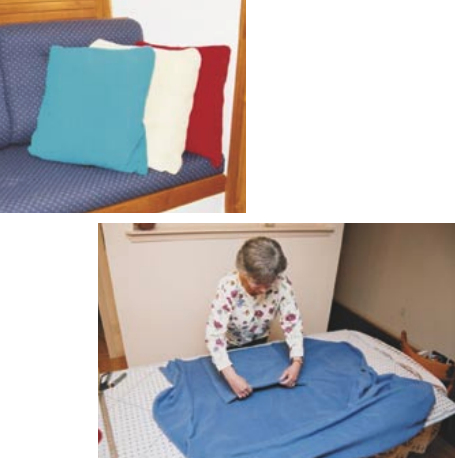
A quillow is a quilt with a pocket. If you fold the quilt into the pocket, it becomes a pillow. It’s that simple. The creation of a quillow is ridiculously simple with fleece. You don’t have to hem the stuff. You cut a blanket. You cut a pocket flap. You sew the pocket flap doubled over on the blanket on three sides. The folded fourth side makes the opening. Fold the blanket so that it can be stuffed into the pocket (this part is a bit tricky, see Page 79 for instructions). By Jove, you’ve got it! You don’t have to handstitch a fancy quilt and pocket flaps as quilters are wont to do. And you can give this sort of quillow the rough treatment that may befall nice things aboard a boat.
I learned about quillows from Mary Jeanne Richards, one who enjoys all kinds of sewing and craft hobbies, when we went sailing in Washington state’s San Juans with her one December. She and husband, Durkee, have several bright primary-colored quillows aboard, which came in handy as extra blankets and pillows.
Plain-colored fleece
Mary Jeanne cautions that plain-colored fleece is easier to work with than fleece with patterns (if having the pattern on your pocket line up with that on the blanket matters to you, that is). Her directions follow:
- Purchase 3 yards of polar fleece. Fold it in half lengthwise and square up the ends.
- Cut from one end a strip 17 inches all the way across the width of the fleece. Then cut this strip into a piece that is 17 x 36 inches. Fold this piece in half, wrong sides together. This will become your pocket. Since fleece does not ravel, there is no need to finish any edges or trim any seam allowances. The seam allowances will all be inside when it is a pillow. And when it is being used as a blanket, the seam allowances do not detract.
- If you would like to embellish your pocket or you have a one-way design on your fleece, note that “up” is toward the cut edges, not the folded edge. Place the embellished side of the pocket face down on the blanket before pinning and sewing.
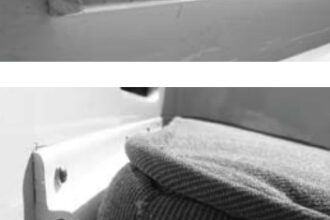
- Position the pocket at the end of the blanket, centered side to side (see photo on Page 77). The cut edges at the bottom of the pocket will be at the bottom of the blanket. The folded side will be the opening. Pin and sew the three cut sides of the pocket down. You can use the edge of the presser foot as the seam allowance guide. This is all the sewing there is to it. Your project is complete.
Mary Jeanne notes, “If you want more ideas or information, go online and do a search on the word ‘quillow.’ You will be amazed at how many variations there are.”
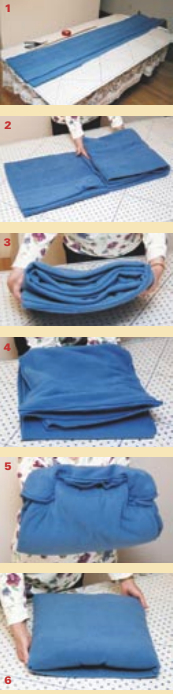
Folding quillows
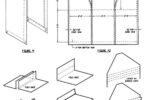
Place the fleece, pocket side down, on a flat surface. Fold the long edge of the fleece back just to the pocket edge. Make this fold the full length of the fleece. Accordion fold any material that is wider than the pocket back out of the way. Do the same to the other long side. Now you have a bundle that is the width of the pocket and 2 1⁄2 yards long. (1)
(2) Fold the end without the pocket over until it just meets where the top of the pocket is. (3) Fold this section again. Now fold all layers over the pocket. (4) Run your hands down into the pocket corners and grab all layers by the ears. (5) Turn the whole bundle right-side out by pulling the pocket over the bundle. You may need help turning it right-side out the first time. Let someone else pull the pocket right-side out while you hang on. (6) You have a quillow!
Thank you to Sailrite Enterprises, Inc., for providing free access to back issues of Good Old Boat through intellectual property rights. Sailrite.com