Upholstering for those who hate to sew
Issue 46 : Jan/Feb 2006
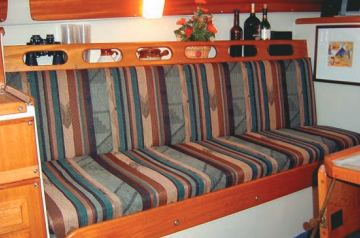
My husband, Chris, and I have been sailing in the Pacific Northwest for 15 years on a variety of sailboats. We look for older sailboats to purchase, upgrade, and eventually sell after enjoying them. We buy when the price is right and the potential exists for improvements we can do on our own and ultimately realize a profit when we sell. The one enhancement I can be sure of with each boat is that new cabin cushion covers will be needed. Having them done professionally is expensive; making them myself is the only alternative. Nothing makes an older sailboat appear uncared for more than ratty, faded, and dated upholstery.
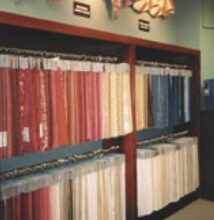
Armed only with an ancient Kenmore sewing machine, circa 1960, I have made more than 80 cushions to date. By shopping in fabric outlet stores, it is possible to cover five to six cushions for about $60 to $70.
I agonized over the first set: first taking off the old upholstery and using it as a pattern; then tracing to the new material, cutting and sewing strips for the cording and boxing; and eventually sewing all the pieces together. Then I learned that, by using a piece of 1⁄4-inch plywood for the bottom to which the material could be stapled, sewing was simplified and used less material.
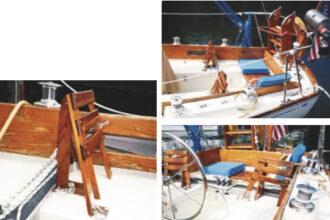
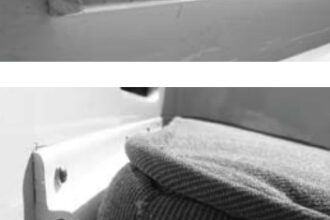
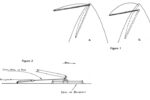
The cushions can’t be reversed, so the only part showing is the cushion top and the front boxing. I have further simplified the process by omitting the cording and sometimes use a method which eliminates the boxing (as shown in the photo, above right). Because the top cushion and the boxing are held in place firmly by the stapling, they maintain their form and don’t creep out of shape.
(Note: Use outdoor plywood. Seal it with epoxy. Use galvanized or stainless-steel staples. These are available from Sailrite. –Ed.)
Simplified procedure
The procedure has been simplified over the years. Here is my simple system for recovering cushions for those who hate to sew:
- Measure the cushions and purchase material compatible with your boat interior.
- Remove the old upholstery (or cover over it).
- Place the cushion on the material top-side down, and trace around it, leaving a 1⁄2-inch allowance.
- Measure the depth of the cushion (the boxing) and cut and sew strips together long enough to go all the way around the cushion. Leave at least a 6-inch-wide allowance for sewing the boxing to the top piece and 4 extra inches to wrap under and be stapled to a plywood board.
- Using a heavy-duty needle and upholstery thread, sew the top and boxing together.
- Clip the corners of the material for a smooth fit.
- Cut a piece of 1⁄4-inch plywood to the exact size of the cushion.
- Arrange the cushion in its new cover on this plywood form.
- Invert the whole thing so the plywood is on top.
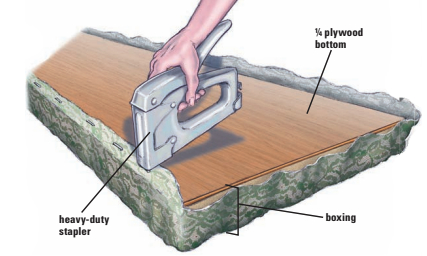
- Stretch the material taut and, using heavy-duty staples, attach it to the plywood (as shown in the illustration).
If you choose to use cording between the top piece and the boxing, cut a strip 4 1⁄2 inches wide the same length as the boxing. Wrap the material around a similar length of cotton cording and, using a special cording (or zipper) foot on the sewing machine, stitch as close to the cording as possible. Sew the finished cording strips to the top and then to the boxing strips. This process gives a first-class look to the finished product. The rest of the process is the same.
I have just completed cushions for our 1972 Erickson 27. After we refinish some brightwork and freshen up her painted areas, we will explore Puget Sound in Avatar. After that she will go on the market to be followed by another boat needing our TLC.
Thank you to Sailrite Enterprises, Inc., for providing free access to back issues of Good Old Boat through intellectual property rights. Sailrite.com