This beamy, home-built 12-footer is still going strong

Issue 48 : May/Jun 2006
All during the long, clear california summer, the rising sun heats the rich black soils of the Golden State’s vast central valley. As the day progresses, the air in the basin absorbs this warmth and rises. Surrounded by mountains, it can only be replenished through the Sacramento River Delta that empties into the northern part of San Francisco Bay. Blocked by the coastal ranges, the only replacement source is the Northern Pacific, from which cold, dense sea air, driven by the eternal northwesterly trades, rushes into the North Bay through the only path available — the Golden Gate.
This combination of circumstances creates a venturi effect, giving the bay the powerful afternoon winds that bless and torment sailors there. Added to the mariner’s challenge are the extreme tides and currents complicated by islands, rocks, steep swells, bridges, heavy commercial traffic, and sudden fogs. The locals like to say, “If you can sail the bay, you can sail anywhere.” It is like no other place in the world.
Built for the bay
Captain William H. Short knew the bay well. He commanded a steam tug, pushing heavy barges around San Francisco’s inland sea for 28 years and was an avid sailor and student of boat design. His own boat, therefore, was based on a list of personal requirements and detailed knowledge of the waters he worked on. The result was the San Francisco Pelican daysailer.
The Pelican demonstrated that an unballasted centerboarder, suitable for children and families and easy to build in a home workshop with minimal skills and basic materials, could handle the waters of the North Bay and still be trailerable behind a compact car. Captain Short’s design incorporated elements of the Banks fishing dory, an oriental sampan, and Joshua Slocum’s Liberdade.
The hull was constructed of 3⁄8-inch plywood with 3⁄4-inch stock for the bow and stern transoms. Monocoque design concepts were applied to give a shape that was strong, light and roomy with a minimum of internal bracing. Pelican #1, Chloe Maru, was launched in 1959.
News of the Pelican spread quickly; numerous inquiries from admirers and an article published in a local paper generated requests for plans. Bill and his wife, Muriel, began providing building instructions to the public, and further publicity from boating magazines stimulated additional interest. Local boatbuilders began building Pelicans to meet the demand. By the early 1960s, the boat was registered as a one-design class with owner associations and racing fleets in the bay area and the Pacific Northwest. To date, some 10,000 sets of plans have been sold worldwide.
Over the years, the basic design has remained essentially unchanged, although some minor modifications and improvements have been incorporated into the plans. A scaled-up cabin version, the Great Pelican 16, was introduced in 1969, and the Super Pelican 18, also based on Captain Short’s design, joined the fleet in 1991, five years after his death.
Other variants also exist, including the independently developed Pacific Pelican 14 and numerous one-shot variations on the basic theme. Within the specifications called for in the plans, there is wide possibility for customization; most home-built boats, even those adhering to racing rules, often have personal touches added by their owners, such as outboard auxiliaries, oarlocks, boom tents, and other amenities.
Although some of the boats are professionally constructed, the bulk of the fleet is built from plans still sold by Muriel to hobbyists and amateurs; many are the first boats built by their owners. Detailed instructions for constructing a jig come with the plans. When completed, it is the form on which the hull takes shape. After the boat is finished, the jig is then available to make additional hulls, making the Pelican well-suited for fleet operations and clubs.
World’s biggest 12-footer
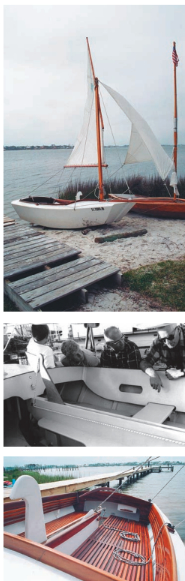
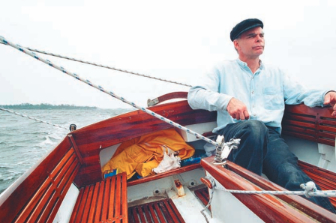
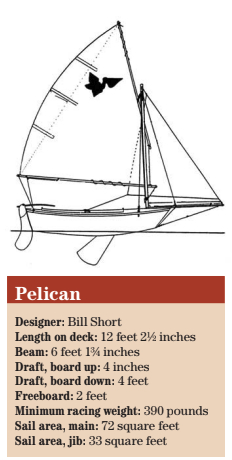
The most obvious features of the boat are its size and shape. The Pelican is only 12 feet long but it sports an enormous 6-foot beam at the deck level. The sides flare out from the modest 4-foot waterline beam. The pram bow is flat like the stern, giving it the appearance of a great bathtub. This allows for easy plywood construction and unprecedented interior space for such a small hull, but it also provides broach-proof buoyancy in the big bay rollers. A generous 2 feet of freeboard keeps the water out, while the flared hull and flat bottom gives the Pelican the high initial stability it requires to sail its home waters.
The Pelican is small, but it’s big enough to be sailed standing up; you can easily move about while underway. There is plenty of room for storage and crew; it will safely carry four adults and camping gear for a weekend, a full half-ton of cargo and crew, and still float in 6 inches of water. Its lightness and flat bottom make it easily manhandled on and off a beach, yet if you run into some weather, the boat will take it in stride.
A closer look reveals more features designed to keep the crew dry and the water out. The forward third is completely decked over. The decking extends along both sides of the cockpit to flare out at the stern and completely enclose it. A coaming, several inches high and inboard of the decking, adds further protection from the water and completely surrounds the cockpit. Numerous stowage compartments are scattered along the sides with additional stowage available under the forward deck and lazarette. A large kick-up rudder and an equally generous centerboard provide control and stability. The sides, bilge, transoms, centerboard housing, and decking are all stout plywood sheets. This is a boat that, despite its size, will let you go somewhere and do something when you get there.
Box on water
From a distance, the Pelican may at first resemble a box in the water but even a cursory inspection reveals that there is considerable subtlety in the design. There is scarcely a straight line in the hull; the sides curve gracefully toward bow and stern in long arcs, the deck has a very slight camber, and the chines appear as sections of great circles. The sides enter the water at a constant angle all around while the bottom has a small amount of rocker. The sheer is classic, with the grace of a sampan or junk, upon which the design is partly based. The result is a beautiful, well-proportioned form, whether lying at anchor, under sail, or tied to a dock. Only the transom and bow are flat; the rest of the hull rolls and flows through the water. It is no accident — a lot of thought went into this design.
The Pelican’s construction is strong and rigid but structural integrity is achieved without the use of transverse frames. All internal braces are longitudinal and the marine plywood sides and decking form the exoskeleton that serves as the main structure. The bottom planking is also specified to be no less than 3⁄8-inch plywood. The centerboard trunk, resting on a stout (1-inch thick) laminated keelson and braced by thwarts at the beam and attachment to the forward deck, is an integral part of the hull’s structure and contributes to its overall rigidity. Wooden slats in the bilge add to the stiffness of the bottom planking while providing footholds for sail handling. The result is a phenomenally strong hull with plenty of room for gear and a clear and open surface with few obstructions to trip on or to stub a bare toe.
Traditional rig
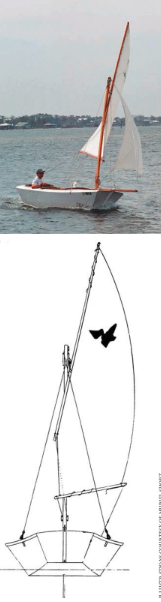
In keeping with the philosophy of old ideas combined in novel ways, the rig also borrows heavily on traditional concepts. The Pelican is a standing lug catboat; the mast is well forward and fits in a reinforced step in the bilge through a hole in the foredeck. Standing rigging consists of three 3⁄8-inch low-stretch Dacron lines with eyes spliced over wooden hounds at the masthead and thimbles laced to shackles on the chainplates, one on each side and one on the stem post. Four massive cleats at the base of the square wooden mast secure the main and jib halyards as well as the boom outhaul and gaff downhaul. These last two lines are attached to the forward ends of the spars and control the position of the boom and the angle of the gaff, respectively.
The rig is a bit more complex than the standard Marconi, but allows infinite adjustment in the mainsail’s shape on any point of sail and is remarkably resilient and forgiving. Control of the main is through a traveler arrangement with five blocks, two strapped on the boom, two bolted on the aft deck, and one on the aft end of the centerboard housing equipped with a cam cleat on a spring-loaded swivel. Except for the blocks and the chainplates, there is no metal in the running rigging; the mainsheet and halyard are bent to the spars with simple clove hitches while the gaff downhaul and boom downhaul pass through holes in the spars, kept from pulling out by figure-eight knots. Traditionally, both gaff and boom are rigged to the port side of the mast with the battened trapezoidal sail laced to both spars.
Reaching jib
The Pelican sails well with one large sail but Bill Short added a reaching jib for sailing with the wind on the beam. It is set on a 4-foot bowsprit, which is locked at the aft end by a notch that fits over the stem post and at the tip by a bobstay. The jib tack is run out to the end of the bowsprit with an outhaul rove through a small block. Like the rest of the running rigging, the foresail can be handled from the forward end of the cockpit. Jibsheets are rigged outboard of the shrouds and are cleated on elevated stations on the decking at the widest part of the hull, just outside and above the coaming.
The rig is simplicity itself, and very, very 18th century. For the benefit of singlehanders, some of the newer Pelicans are even equipped with roller furling.
The rig is simple, but it is a bit more involved than the typical daysailer. For the weekend skipper, preparing the Pelican for a sail takes a few minutes, and the drill should be rehearsed several times in the comfort and security of your driveway prior to tying up at a busy launch ramp. Still, if conditions allow, much of the rigging can be done with the boat on the trailer — a courtesy you owe to others using the ramp. Prior to stepping the mast, the running and standing rigging should be checked to make certain there are no tangles aloft and that the stays are properly looped over the masthead hounds. If you stand on the foredeck, you can lower the mast through the opening and place its lower end in the mast step. The bowsprit is put in place and the bobstay secured, after which the forestay and shrouds are tied off to the chainplates.
Lots of slack
The next step is to run out the jib tack, raise the sail, and properly position the sheets for sailing. Leave plenty of slack in them but tie stopper knots to keep them from pulling clear of the fairleads and getting lost in the bilge. Once you are satisfied the foresail is free and clear, lower it and get it out of the way, preferably into its sail bag. It will be ready to deploy once you’re underway.
Next, hitch the main halyard to the gaff and run it up the side of the mast, cleat it off, and cleat off the gaff and boom downhauls. This may take a few tries to get it right (another good reason to do it first at home) since the luff should be parallel to the mast. It may be necessary to experiment with this until you find the precise spot on the gaff to hitch the halyard and the correct tension to put on the mainsail outhaul and downhaul so that the main hangs fair; every sail and rig is unique. Hitch the mainsheet to the aft end of the boom and reeve it through the traveler blocks, again making sure that there is plenty of slack and that it is properly stoppered. Finally, hang the rudder and shove off. Oh, and don’t forget to install the drain plugs.
Sailing the Pelican is pretty straightforward, as the standing lug rig behaves pretty much the way a Marconi rig does and is handled the same way. In spite of its asymmetry you should notice no difference in performance between port and starboard tacks. The jib is not necessary to sail the boat effectively; indeed, it adds little advantage when beating or running, but on a beam reach it can make all the difference in the world and is a great help in balancing the helm.
Strong weather helm
The Pelican can develop strong weather helm, particularly when sailing as a catboat, but this can be dealt with by experimenting with the centerboard and moving weight about. The boat is properly trimmed when the bottom edge of the transom is clear of the water. A tiller extension allows the helmsman to steer from the midship thwarts, which helps keep the boat level. Because of the flare of the hull, it is possible to sail a Pelican on its side, with the water at the lee coaming and the centerboard clearly visible to a windward observer.
The chine acts as a keel of sorts and it can make for an exciting ride in high winds, but excessive heel does not give optimal performance. It sails best on an even keel, and it is rarely necessary to hike out. In light air, a bit of heel can help, but don’t overdo it. While under way, it may be necessary to tweak the main outhauls and downhauls and to adjust halyard tension as the running rigging takes the strain. Until you are used to the boat, it is a good idea to have crew available to do this for you while you tend tiller and mainsheet.
After you get used to the Pelican, you’ll be able to round up and quickly make the adjustments yourself and still get back to the helm in plenty of time. The same goes for raising and lowering the jib; it can be done without help, but you have to be completely at home in the boat. Sailing the Pelican is good training for a larger boat because the sailor is not dependent on human ballast to keep it upright, except under the most extreme conditions; consequently, it teaches good habits in sail balance and trim.
Necessary concessions
The North Bay, especially the killing zone between the Golden Gate and Alcatraz (which is, incidentally, Spanish for pelican), is characterized by cold water, steep seas, and strong winds blowing in one direction. The weaknesses of the boat — its relatively sluggish windward performance and slow progress in light air — are the necessary concessions made to optimize its other virtues.
Although designed for the bay, the concept is versatile and adapts well to other environments. My Pelican was sailed in Florida where I was often frustrated by light and variable winds and the jarring pounding of trying to make headway against a shallow water chop. But the inevitable dramas that occur when cruising far from home in a small boat — the sudden thunderstorm after being becalmed, the shoal water mangrove mazes, and the desperate midnight battles with flogging sails — all make you glad you are in a Pelican.
My experience with this remarkable craft began more than 30 years ago. I purchased a used Pelican from a close friend who had built his from plans. For four years I sailed the waters of the central Florida Gulf Coast, particularly Tampa Bay, St. Joseph’s Sound, and Anclote Anchorage. The Pelican’s shallow draft and massive storage capacity made it ideal for long coastal cruises and wilderness camping, while its strength and seaworthiness gave this novice sailor the reserve capacity needed to sail these normally placid, but sometimes treacherous, waters. The Pelican taught me to sail and it saved my life more than once. She was my first love, and I will never forget her.
Most out West
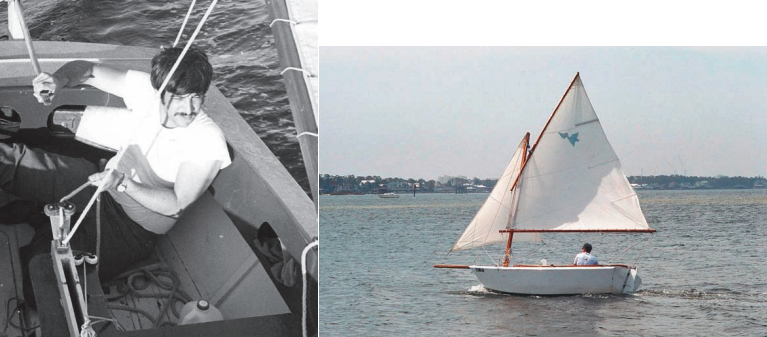
Pelicans are found throughout the world but are mostly concentrated on the U.S. West Coast. Though I sold mine many years ago, I was able to locate one near my home in Florida for a refresher course. I am indebted to the hospitality and generosity of Pat Pulaski for allowing me to sail and photograph his Pelican. Pat is a skilled sailor, boatbuilder, and owner of The Furniture Repairman in Pensacola. He rescued his boat from years of neglect and abuse and restored it to peak condition.
As do many owners who have no plans to race, he made numerous modifications from the original plans and specifications to suit his own taste. When I sailed with him, his boat had just received some minor cosmetic damage due to recent hurricanes, but it performed flawlessly. Pat graciously gave me permission to solo. After almost three decades it was all exactly as I remembered it.
Sailing the San Francisco Pelican transports one into a working boat of another century: the textures of wood and line and the almost total absence of metal and plastic fittings. There is ample room aboard to move about and operate the controls in comfort, and everywhere are the icons of the mariner’s craft: varnished spars, coiled lines, functional knots — and lots of them.
Underway, the boat is stable. The Pelican is not a child’s toy, although it is suitable for children to sail; it is not a temperamental thoroughbred, even though it is frequently raced competitively. Neither is it a trainer for novices, although it is a forgiving boat and easily managed.
Evocative of a fishing boat or a small cargo vessel, the San Francisco Pelican has the feel of a little ship, inspiring confidence and seamanship in its crew. It is easily handled by a lone sailor but responds best to seasoned crew used to working together. On a long cruise you will find it perfectly suited for two although there is ample room for one or even two others. Owning a Pelican will tempt you to go on long cruises.
Thank you to Sailrite Enterprises, Inc., for providing free access to back issues of Good Old Boat through intellectual property rights. Sailrite.com