This respected company continues to move with the times
Issue 48 : May/Jun 2006
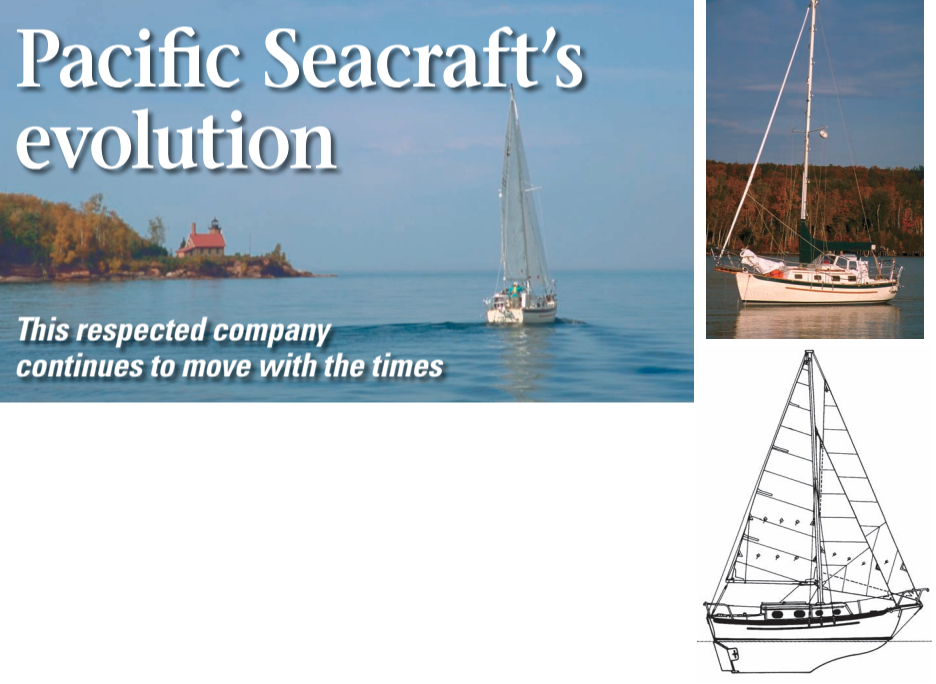
Aa any marketing whiz will tell you, brand recognition is key to sales. And among sailboat builders, Pacific Seacraft has it in spades. Cape Dory had it, too, thanks to the lean, flat-sheer, traditional CCA designs of Carl Alberg. With Pacific Seacraft, it’s the nicely proportioned profiles of designer W. I. B. (Bill) Crealock: round bronze portlights and, more notably, the canoe sterns of the Pacific Seacraft 34, 37, and 44.
But not all Pacific Seacrafts had canoe sterns. What they did have in common was a certain freshness, traditional yet not clunky. Lean and spirited, each model looked ready to cruise the South Pacific. And many have.
Pacific Seacraft was founded by two Southern California boat enthusiasts following separate stars. Mike Howarth, now 55, grew up in Anaheim. Academic subjects didn’t interest him, but he took a strong liking to wood- and metal-shop classes. He says he always liked working with his hands and won a woodworking competition in high school.
Following graduation, his first job was at a boatbuilding company. “I didn’t want to get into mass production,” he says. Assigned to the wood shop, he was paid $2 an hour to make parts for a 43-foot, twin-engined, fiberglass motor cruiser. His skills, both technical and interpersonal, led to his being promoted to foreman.
After a few years, Mike moved on to Islander Yachts in Costa Mesa, the epicenter of West Coast fiberglass boatbuilding in the 1960s and ’70s. His job there was to build the tooling — male plugs and female molds. It is in the molds that the major components such as the hull, deck, and liners are laminated. He apprenticed under a master patternmaker, Marty Novak, and the experience was etched deeply in him. To this day, Mike believes fiberglass molded parts are preferable to wooden ones.
Rose in rank
When it came time to move again, Mike went to an outfit called Pacific Trawler, where he installed engines and electrical systems, did some carpentry, and rose in rank once again.
It was at Pacific Trawler that Mike met his future partner, Henry Mohrschladt, who was six years his senior. Though employed at Pacific Trawler as an engineer, Henry’s background was in economics. After graduating from the University of California/Irvine, he applied to graduate programs and was going to accept a fellowship and research assistantship at the University of Pennsylvania’s Wharton School of Business.
But the lure of boats was a stronger call. Just why, he can’t say. His father never owned a boat, though in an effort to assuage his son’s surging interest, he did buy Henry a radio-controlled model boat — this for the kid who in his spare time went to the library to read yachting magazines.
Boats won the career tug of war, and in 1971 Henry went to work for Westsail, a young company owned by Lynn and Snyder Vick, who were building double-ended cruising sailboats. Not particularly well qualified for anything in boatbuilding, Henry was assigned practically everything, from polishing and waxing molds and grinding fiberglass to laying up laminate in the molds. But he was hardly your ordinary glass guy.
Henry’s intelligence and organizational skills prompted him to begin documenting all shop practices to create a record of what was done and how. And he could draw, thanks to some drafting experience during high school. Recognizing Henry as a self-starter, Snyder made him the company “engineer.” After a year and a half, Henry left for a job as project engineer with Columbia Yachts, then perhaps the largest builder of fiberglass sailboats in the world. Their model line ran from the Columbia 22 to the flush-deck bubble-top Columbia 50 and 57, many designed by the late Bill Tripp. (For more on Columbia Yachts, see Good Old Boat, May 2002.)
Those heady days
Moving on, Henry next went to work at Pacific Trawler, meeting Mike Howarth for the first time. That was in the mid- 1970s. In those heady days of Flower Power and Earth Day celebrations of environmental consciousness, not to mention the OPEC oil embargo, a lot of young people dreamed of sailing over the horizon in their own small, fossil fuel-free cruising sailboats.
While Henry was the engineer at Pacific Trawler, as well as the purchasing and sales guy, he liked to draw boats and was always thinking about boats he’d like to build and own himself. So he already had a small, double-ended, pilot-type boat design completed when Mike approached him one day and said, “I’d like to ‘tool me up’ a little boat. You design boats, don’t you?”
Henry replied, “I have something designed. Would you like to see it?”
The two talked about the project at some length, and Mike eventually built the 25-footer in his garage. He tooled it alone, building the hull and deck molds in his back yard. But he didn’t want the boat for himself. It was to be the boat with which he’d launch his own company. And now he had Henry as his partner. “This was when people dreamed about cruising to the ends of the earth,” Mike says. “Cruising sailboats were really big.”
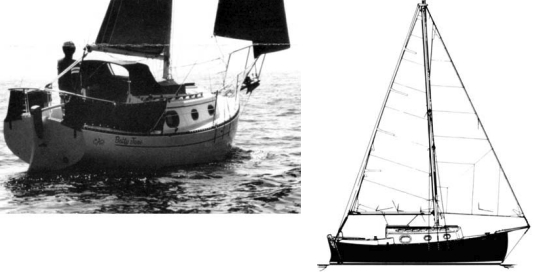
Their plan was to exhibit the boat at the 1975 Newport Boat Show and, as is so often the case with startup operations, it was a race against time. They were still working on the boat at the dock when the show opened. The show manager had to tell them to get their band saw off the dock. Their funds were exhausted, yet the boat had no cushions. Henry was forced to sell his car. Fortunately, the boat sold. Full of confidence, Mike and Henry quit their jobs, formed a company, and began building the second hull of what came to be known as the Pacific Seacraft 25 (shown on Page 57).
Newport workboats
Other stout little cruising boats followed, notably the Flicka. Small Craft Advisor tells the story: “While in the Navy in the fifties, [Bruce] Bingham stumbled onto a couple of these [Newport workboats] derelict on a riverbank near North Kingstown, Rhode Island. Fascinated by their design, he made sketches and took some rough measurements. He learned that these rugged craft were sailed year-round by fishermen in the harsh conditions off the Rhode Island coast. In the early 1970s, Bingham opened his own design office. By 1972 he was offering plans for a stout, plumb-bowed 20-footer called the Flicka (shown on Page 56), based on the Newport boats.”
At first he sold Flicka plans, eventually numbering more than 400 sets. They were built in a variety of materials: ferroconcrete, wood, and fiberglass; and with a variety of rigs: masthead sloop, cutter, yawl, schooner, and Chinese lug, most of them with a gaff rig. Like the Westsail 32 of that era, it was a “cult boat.”
Building a boat yourself is a big undertaking and some plans, of course, resulted in no boat at all. Anxious for a boat of his own, as well as a production fiberglass version, Bruce Bingham built a plug but had to sell it.
An outfit called Nor’star Marine in Santa Barbara, California, picked it up and built the hulls for a few years. Westerly Marine of Costa Mesa finished some of the hulls under contract to Nor’star. The venture ended in 1977, and a year later Pacific Seacraft purchased the molds and resumed production.
After hull number 434, the run ended in 1998. One reason for discontinuing production was the cost of the boat, which had increased from around $45,000 in 1989 to nearly $100,000. A company spokesman explained that the boat wasn’t particularly efficient to build because it was so small only one person at a time could work on it.
In came Crealock
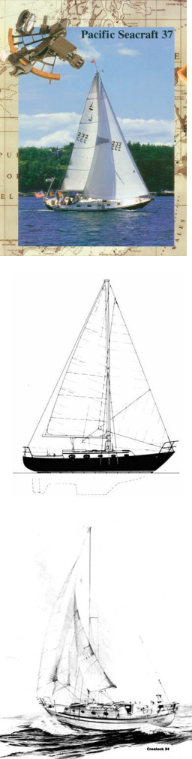
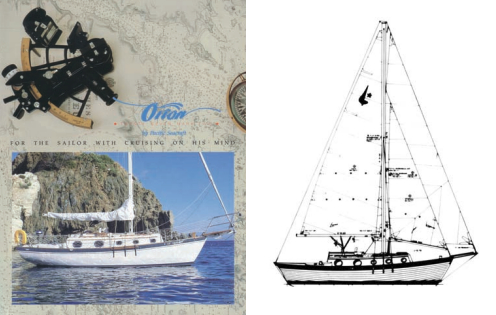
Henry designed the next two boats, the Mariah 31 (1979) and Orion 27 (1980, shown on facing page) before bringing in Bill Crealock to do the Crealock 34 (1984), Dana 24 (1985), and Crealock 31 (1987). (For more on Bill Crealock, refer to Good Old Boat, July 2003.)
Henry’s magazine ads often depicted their boats in a beautiful tropical anchorage, like Bora Bora, making buy- ers feel like they, too, could cruise the South Pacific on one of these heavy-duty little Pacific Seacraft boats. And many did, crossing oceans in safety.
The Pacific Seacraft 37 (at left), the first Crealock-designed boat in the model line, originally was built by Cruising Consultants of Newport Beach, California, as a kit or partially completed. A total of just 16 were sold between 1978 and 1979. Pacific Seacraft bought the molds and rights in 1980, offering it with sloop, cutter, and yawl rigs.
In 1988, Fortune magazine named Pacific Seacraft one of the top 100 U.S.-made products, a distinction again conferred in 2000. The first time this occurred, the company attracted a lot of attention around the world, even out- side the marine industry. As a result, later in 1988 Mike and Henry sold the company to Singmarine, a Singapore-based shipping company owned by the Keppel Group.
They signed a no-compete contract, promising not to build sailboats for five years. “We retired for about a month,” Henry laughs. Not two to sit around on their hands, Henry and Mike started a new company, Cabo Yachts, building sportfishing boats in the high desert west of Los Angeles.
More recently, Mike and Henry’s Cabo Yachts was sold and now is a member of the Brunswick Boat Group and its Hatteras Collection.
Don Kohlmann, co-founder of Ericson Yachts with his brother Gene, came on board as sales manager in 1991, when Pacific Seacraft bought some of Ericson’s molds, the Ericson 34 and 38, designed by Bruce King. That line was expanded to the Ericson 333, 350, and 380 before being discontinued. The flagship of the fleet, the Crealock 44, was introduced in 1990, a year before Don joined the firm.
Singmarine sold Pacific Seacraft to a Southern California businessman in September 1998, and Don became president. His brother, Gene, joined the firm in a consulting role. According to Don, Gene was “the operations guy.” Both left in 2005.
Distinctive boats
The Crealock-designed boats are distinctive in several ways. Most obvious is the canoe stern, whose advantage is alleged to be the parting of following seas, thus preventing the cockpit from being pooped. While a broad, beamy transom can get pushed around by overtaking waves that also break at the propitious moment, it seems doubtful that a canoe stern offers any real advantage over, say, a modest CCA-type counter transom. A disadvantage is that there is no afterdeck to stand or sit on or to lash gear to. It’s convenient to be able to walk around a cockpit without having to step down into it.
The underbodies of Crealock’s boats are classic cruising fin keels with separate skeg-mounted rudders. The skegs add some directional stability and offer some protection to the rudder. Many designers would drop the skeg on boats bigger than the Pacific Seacraft 44 because, as size increases, so do loads on the helm, and the best way to offset those loads is to balance the rudder. This means that the leading edge must be forward of the pivot point or rudderstock, and that is only possible with a so-called spade-type rudder.
Like Carl Alberg, Bill Crealock is not a sucker for the marketing guys who demand great beam to enhance interior volume. Bill knows that boats with moderate beam and freeboard are more comfortable, handle better, and enjoy higher stability ratings. The 40, for example, has a limit of positive stability of 141 degrees; 120 is considered by many as the threshold for safe offshore passagemaking.
These days, Pacific Seacrafts are built in an old soft-drink factory in Fullerton, California, (having moved from Santa Ana) and enjoy a reputation for above-average quality. The hulls are molded in one piece.
Gone by the board
As with many builders, 24-ounce woven roving, the industry standard for decades to quickly bulk up the laminate, has gone by the board at Pacific Seacraft. Since 1993 the company has used biaxial stitched reinforcements, a savings of 500 pounds in the 37. Skin coats are vinylester resin, which has been proved in independent laboratory tests to resist blistering better than other resins. The remainder of the Pacific Seacraft laminate is polyester.
The smaller boats, up to the 37, have solid glass hulls. The 40 and 44 are balsa cored, the 40 in the topsides only and in the 44 to within 2 feet of the centerline. There’s so much glass on the centerline itself that there’s nothing to be gained in the way of stiffness by adding coring in that area. Plus, in the event of a grounding and puncture, cored hulls are much more difficult to repair. These are, after all, world cruising boats.
Balsa and plywood have been used to core the decks; the latter is heavier and doesn’t need to be removed where hardware is through-bolted, as does balsa, but if it gets saturated with water, it’s a mess. Rudders are mostly hung on steel-reinforced skegs, and have generous webbing welded to the rudder stock.
Ballast now is external lead castings, except for the Dana 24, which has a full keel and cutaway forefoot. Among the fin-keelers, the company reports that most buyers opt for the shoal-draft Scheel keel. Named after designer Henry Scheel who developed it, this keel has a bulb at the bottom to concentrate weight as low as possible, but is cupped to generate lift. Think of it as a forerunner of the wing keel, not as efficient but less vulnerable to damage. The company says the Scheel and standard keels provide the same righting moment, so while the shoal option may give up a few degrees of pointing ability, it doesn’t give up stability.
Interior liners
True to Mike Howarth’s early training and approach to boatbuilding, Pacific Seacraft still uses a lot of interior liners or pans in its boats. These have advantages and disadvantages. First, the downside: fiberglass liners are poor acoustic and thermal insulators when compared to wood; access to all parts of the hull (requirement of any boat, especially an offshore one) may be difficult if the pan hasn’t been carefully designed; bonding of complicated liners to the hull and/or deck may be difficult; and, perhaps most importantly, liners severely limit customization of the interior later.
On the positive side, properly executed liners can stiffen the hull (though not necessarily any better than glass-over-foam longitudinals in a plywood-interior boat), do not rot or delaminate, and, most importantly, save the builder money. Once the cost of the tooling is amortized, there is great savings, thanks to reduced man-hours.
Pacific Seacraft finishes all fiberglass surfaces so there are no rough or fibrous surfaces behind the liners or elsewhere. A copper bonding strip is laminated into the hull for use as a single-sideband (SSB) radio ground.
The hull-to-deck joint is through-bolted, as it should be, and incorporates a nice bulwark for safer footing on deck. In recent years, Pacific Seacraft has followed the industry trend of removing exterior wood; gone are the teak toerails, in favor of metal.
Shrouds are bolted outboard through the topsides. This can make walking the sidedecks easier and eliminates the pesky through-deck fittings, which often leak. On the other hand, this widens the staying base. That means the rig is more secure, but you can’t sheet in headsails as tightly as you might wish, so you give up some windward ability.
Better engine access
Other features include rack-and-pinion steering on many boats, rather than the usual cable-quadrant system. Cockpit soles are removable for better engine access. Interior teak joinerwork is acceptable but not as nicely finished as some similarly priced boats.
Pacific Seacraft has joined numerous other sailboat builders in offering powerboats to its customers. It builds and markets the 38T Twin Engine Fast Trawler and 38T Coastal Voyager.
And, scheduled for release this summer, is the newly designed Pacific Seacraft 377, which will be resin-infused with all vinylester resin. Infusion captures more volatile organic compounds (VOCs) in the laminate, making the workplace safer, and helps achieve a more consistent glass-to-resin ratio. Vinylester resin also has better secondary bonding properties, which are important when glassing in engine beds and tabbing bulkheads.
Pacific Seacraft enjoys strong brand recognition today, as it has for many years. The company has earned this by building some of the most admired boats afloat.
Thank you to Sailrite Enterprises, Inc., for providing free access to back issues of Good Old Boat through intellectual property rights. Sailrite.com