Ted Brewer compares three well-known circumnavigators
Issue 49 : Jul/Aug 2006
It will be the rare reader of Good Old Boat who has not heard of Captain Joshua Slocum and his famous yacht, Spray. However, for those who are new to sailing, I will say that the good captain, a craggy Nova Scotian skipper of three-masted ships, and his rugged 37-foot yacht were the very first to circumnavigate the globe singlehanded. Joshua Slocum left Boston in April 1895 and arrived home in June 1898 after a three-year voyage that was leisurely and adventurous and also extremely dangerous and arduous in turn.
To research this article I took the hull lines shown in Slocum’s book, Sailing Alone Around the World, and enlarged them to a workable size. From that I was able to calculate Spray’s displacement, along with the other factors that I needed in order to relate her characteristics to those of other yachts that have successfully circumnavigated. It was an eye opener. I’d never thought of Spray in yachting terms but more as a sailing legend. Also, I never felt that she was the ideal bluewater cruiser either, and my investigations tended to reinforce this opinion.
Unintended circumnavigator
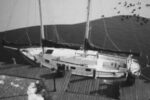
Certainly, Spray was never intended for offshore cruising, defi nitely not for extended ocean voyages. She was built in Delaware in the early 1800s as an oyster sloop. Over the ensuing years, Spray migrated to New England where she was used for inshore fishing and oystering in the waters of Connecticut and around Cape Cod and Boston. As Joshua Slocum was born in Nova Scotia in 1844, it is quite possible that he and Spray started life about the same time. In that case she would have been about 48 years old in 1892, a ripe old age for a wooden boat in those days. But it is also possible that she was much older. In any case, the tired old fishing boat was propped up in a field in Fairhaven, Massachusetts, and covered with tarpaulins when Slocum first set eyes on her.
Indeed, Spray was virtually a derelict when she was given to Slocum by a friend, more or less as a practical joke. However, the captain turned the tables on his joker friend by taking the gift seriously and spending the next two years completely rebuilding the old boat, timber by timber, until there was hardly a piece of the original left.
Unfortunately, we have no idea of Spray’s configuration before he began work on her. It is probable that the area of her aftercabin was an open cockpit and fish hold when she was a commercial fishing boat. By closing in this space with a trunk cabin, Slocum greatly increased the boat’s livability as well as her survivability in extreme conditions.
New all over
The law says that a vessel that is repaired piecemeal and never completely broken up for salvage is still the original vessel. That is exactly what Slocum did to his “gift.” He restored her from the keel up, replacing every one of her rotted timbers with good sound wood. Thus, the newborn Spray was sound as a nut from her new oak keel to her new oak frames, her new Georgia pine planking, her new white pine deck, and her new spruce spars. If any of her original timbers remained in the Spray after this “repair” work, the captain does not mention them.
Slocum fished the boat for a season after restoring her but readily admits he was not the world’s most successful fisherman. It must have been about that time that the idea of a singlehanded circumnavigation took hold. So, in April 1895, Slocum departed Boston and sailed to New Gloucester to stock up on supplies. In May he voyaged to Nova Scotia, to the town of Westport where he met some of his old schoolmates, and finally, on July 1st, he set sail for Gibraltar. The rest is yachting history and a wonderfully interesting book that has inspired many followers.
After the completion of his epic three-year circumnavigation, Captain Slocum and the Spray became famous and quite justly so. However, over the years this fascinating tale of his travels has deluded many yachtsmen into assuming that the Spray is the ideal vessel for such a voyage and that they are every bit as capable as Joshua Slocum in handling the many dangers that can and will arise. Unfortunately, neither assumption is necessarily true.
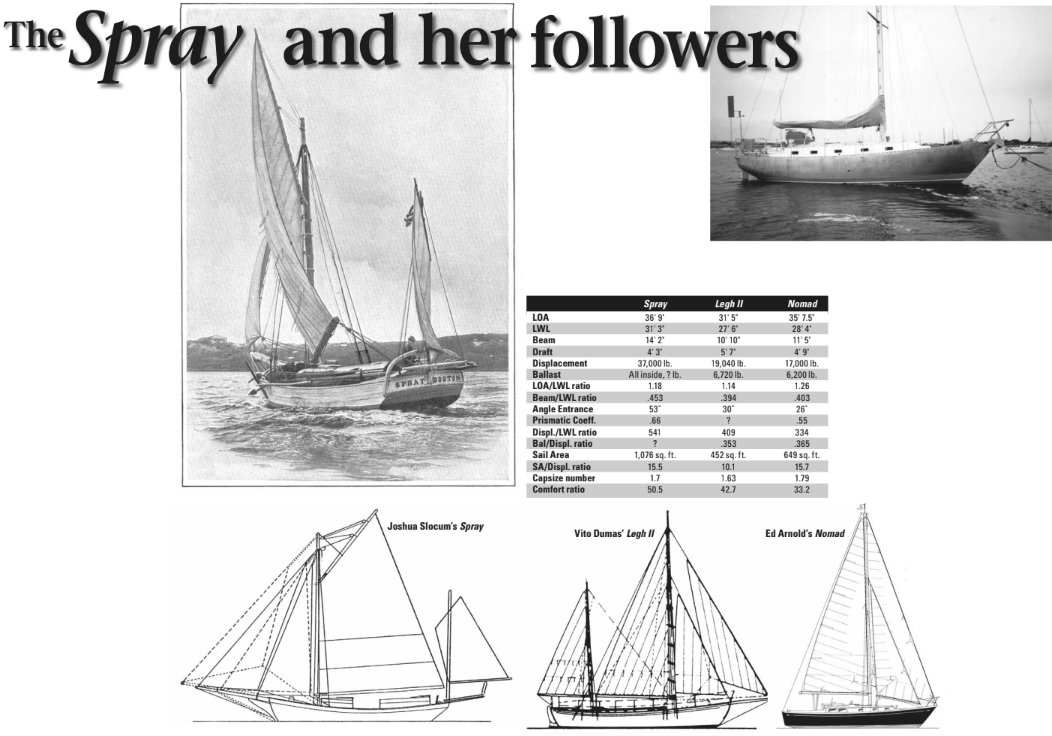
The table on Page 20 shows Spray’s particulars, along with those of Vito Dumas’ Legh II and Ed Arnold’s Nomad, two other yachts that circumnavigated. I selected those two boats for comparison with Spray because both boats made solo circumnavigations and — like Slocum — their skippers took the southern route rounding
Cape Horn and Cape of Good Hope. I must emphasize that in saying “rounding Cape Horn,” I include making the passage via the Strait of Magellan, as that was Slocum’s route. Unfortunately, I have been unable to discover if Dumas actually rounded Cape Horn but Arnold did . . . in both directions!
Dumas and Legh II
Aboard Legh II, Dumas circumnavigated from west to east in 15 months, from June 1942 to September 1943, with stops at Cape Town, Sydney, and Valparaiso, Chile. This was during World War II so Dumas, an Argentinian, wisely stayed well south to avoid being caught in the war at sea. This greatly shortened the mileage he covered but also meant that Dumas was sailing in some of the world’s windiest and roughest waters. Legh II’s sail area/displacement ratio seems extremely low when compared with the other two, but it is well suited to a solo skipper sailing through the gales and high seas of those far southern oceans where Dumas laid his course.
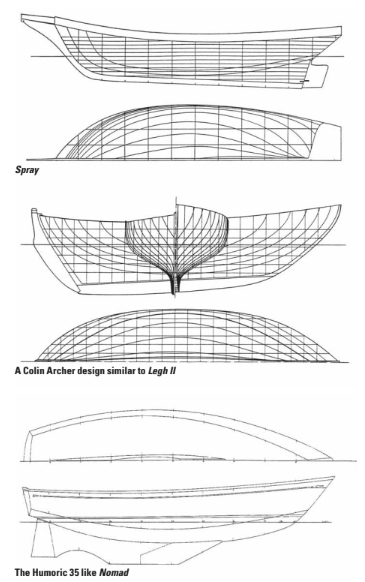
Legh II’s hull was that of a double-ended Colin Archer type and, although I do not have her actual lines drawing, the lines of a typical Colin Archer are shown at left for comparison with the others. Note the deep dead rise of her sections, so very different from Spray’s shoal and beamy hull.
Arnold aboard Nomad
Ed Arnold, aboard Nomad, actually singlehanded the Horn twice. He had already cruised to the Azores when he decided to tackle the Horn, so he kept on from the Azores to Alaska, via Cape Horn, and he enjoyed it! Indeed, Arnold enjoyed it so much that he decided to solo Sitka-to-Sitka via the Capes. He rounded the Horn again, west to east this time, and returned to Sitka in September 2002, after taking just 11 months for the remarkable 27,000-mile voyage. His only stops were in Cape Town for repairs to Nomad’s bowsprit after striking a bergy bit and in Australia for repairs to the radar. Interestingly, Nomad is an aluminum version of the steel Huromic 35 cutter, one of which, the Globe Star, also rounded the Horn west to east in the early 1980s. Globe Star was skippered by Marvin Creamer on a very unusual circumnavigation made without the use of navigation instruments.
The reader will note Spray’s incredibly heavy displacement. It’s the heaviest I’ve ever run across in a sailing yacht of her size, well over twice that of the average modern 37-footer. Spray’s displacement/length ratio of 541 almost makes the husky Colin Archer seem like a lightweight racer. With her 14-foot beam and that heavy displacement, Spray would have tremendous initial stability and would be a difficult boat to capsize. Indeed, I have been aboard an authentic replica, the Joshua, owned by my friend Bill Harpster. It’s like walking on a city sidewalk; the boat simply does not seem to move as you walk around her decks. That very heavy displacement also contributes greatly to motion comfort since a heavy boat will not scend, or rise, as quickly as a lighter, corkier craft when a large sea passes beneath it
Ballast questions
Spray’s ultimate stability is questionable, though, as little is known about her ballast except that it was all inside. But was it lead (unlikely), iron (possibly), or stone (probably)? And was it strongly fastened in place to prevent shifting (probably)? Unfortunately, Spray was lost at sea in 1909, so these questions must remain unanswered. Her great initial stability made it unlikely she would be capsized, especially given the skills of her skipper. However, if Spray were capsized by a freak wave or that ultimate storm, she would not right herself in a hurry and, if her ballast shifted, it is highly unlikely she would recover at all. Marvin Creamer’s Globe Star was capsized in huge seas off Tasmania but recovered, thanks to fixed ballast, a reasonably low center of gravity, and more moderate beam. She went on to successfully complete the circumnavigation.
Spray’s performance under sail has also been the subject of much speculation. She has a very reasonable sail area/displacement ratio, quite ample for ocean voyaging, but there are a number of factors that work strongly against her windward ability. Bill Harpster has cruised the west coast aboard his Spray replica from Mexico to Alaska numerous times. Bill told me that Joshua would point to windward at 45 degrees, but I think Bill was exaggerating slightly as proud owners tend to do. He did admit that she was slow when pinched that hard and admitted that Joshua was much happier at 55 degrees when beating to windward. That I can believe.
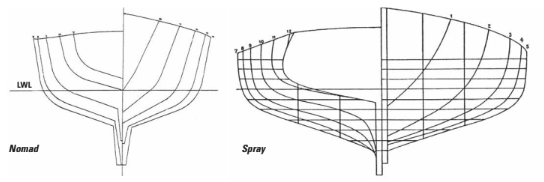
Spray’s very blunt bows, her shoal draft, the lack of an efficient lateral plane, and her low-aspect-ratio gaff rig all combine to reduce her speed and weatherliness. Her 53-degree half angle of entrance (the angle formed at the waterline by the hull and the centerline) is incredibly large. I have never seen a waterline that bluff on a sailing yacht before and can only imagine something like it on, perhaps, a chunky Dutch Boeier (see Good Old Boat, September 2000) plowing through the steep waves of the Zuider Zee. Such a full bow certainly would not be conducive to speed to windward in a choppy sea. Too, Spray’s very shoal draft, along with her lack of a salient keel or centerboard, would do little to reduce leeway.
Pointing ability
Finally, the low gaff rig simply would not provide the drive to windward of a tall and efficient Bermudan sloop or cutter. So Spray would be a slow boat, pointing up barely 55 degrees and making lots of leeway when hard pressed to windward. Nomad, on the other hand, with her more effective lateral plane and taller Bermudan rig, would sail circles around Spray in a decent breeze. The biggest difference is that Nomad would be heeled down, having an exciting sail, while Spray would be almost upright, with her crew relaxed in deck chairs, sipping rum and enjoying the scenery. Super-heavy displacement combined with great form stability does have its merits!
Slocum reported making some excellent day’s runs while sailing off the wind in the Indian Ocean, covering 2,700 miles in just 23 days, an average of more than 117 miles per day. I believe that Spray’s unusually high prismatic coefficient (Cp) largely contributed to this good passage (for more on yacht design formulas by Ted Brewer, see Good Old Boat, July 1999 and November 1999). The Cp is an indication of the fullness of the ends of a vessel.
In less technical terms, Spray’s ends were very full for a sailing yacht. The average auxiliary cruiser has a Cp of from .53 to .56 or thereabouts whereas Spray’s Cp of .66 is more akin to that of a displacement motorboat. This high Cp indicates that the maximum speed for her waterline length was about 8.5 knots, quite in line for a husky motor boat and a full knot faster than the usual sailing cruiser of her waterline length. However, it’s unlikely that Spray ever achieved that 8.5 knots, except down the face of a wave perhaps, due to her bluff bows plus the limiting factors of her sail area and stability. Still, the high Cp would help to reduce resistance when she was being pushed by a spanking breeze. So when the wind was free, the Slocum/Spray team was able to make some passage times that would be the envy of many a modern sailor.
Hands-free steering
Spray had one feature that would endear her to any cruising sailor. That was her ability to sail herself for long
periods with no attention to the helm. The reason for this lies partly in her long keel but primarily in her balanced ends. Her bluff bow is matched by an equally bluff stern so that her hull would not change shape greatly as she heeled and, with her high initial stability, Spray would not heel to any degree in average breezes, especially with the wind astern. Slocum stated that she sailed her truest with the wind two points on the quarter and that she had very little weather helm even when beating to weather, a sure sign of balanced ends. A Colin Archer, such as Legh II, has balanced ends also and would be similarly steady on the helm, while a more contemporary yacht, with a much finer bow and full stern, such as Nomad, will not fare so well; thus, the need for autopilots and windvanes today.
So, is a replica of Spray the ultimate yacht for offshore voyaging or a circumnavigation? Not in my opinion. She has neither the ultimate stability nor the weatherliness that I would want to see in an oceangoing vessel. There are simply too many other yachts her size that can provide adequate comfort, better performance, and greater safety when you meet that ultimate storm.
Is Spray a fine coastal cruiser? Absolutely! She combines family accommodations with the stability of a city sidewalk and a very easy motion in rough weather. She also provides sedate but quite adequate performance, provided you have a husky diesel engine ready to haul you off a lee shore in a gale or push you along when the breeze fails. And when you drop the hook in a new harbor, what other vessel Spray’s size could possibly attract as much interest?
Thank you to Sailrite Enterprises, Inc., for providing free access to back issues of Good Old Boat through intellectual property rights. Sailrite.com