A floating test-bed for cruising equipment
Issue 51 : Nov/Dec 2006
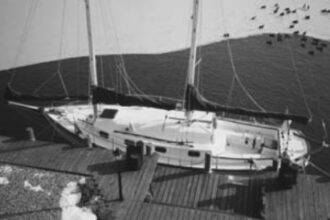
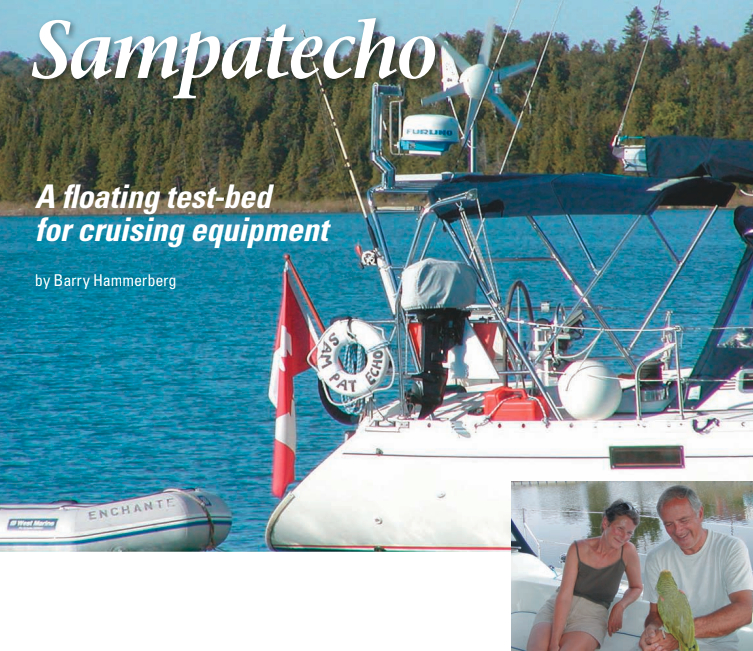
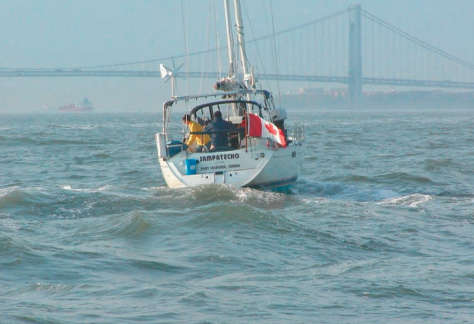
We first saw Sampatecho, A 15- year-old Beneteau 390, lying at anchor at Solomon Landing on Chesapeake Bay. Her custom aft arch — supporting radar, a solar panel, and a wind generator — identified her as a serious cruising boat. The Canadian flag at her transom reinforced the image. It was not until we arrived in Cape
May a week later that we met Sampatecho’s owners, Bradd and Maeve Wilson. We talked and exchanged stories that ultimately led to friendship. We cruised together for what began as a couple of days and turned into three months of exploration and shared good times. We parted at Mackinac Island — they were to journey back to Caribbean waters and we were to return to Wisconsin.
They left with us the story of a couple with a passion for sailing, their experiences in outfitting two boats for a cruising lifestyle, and how they formed their company, Cruising Solutions, to help others find economical answers for their equipment needs.
As a youth, Bradd began sailing in small boats. As an adult, he had owned a 15-foot gaff-rigged catboat, a Venture 22, and a Viking 28. He’d raced the last two extensively. He had chartered in the British Virgin Islands and Florida. Along the way, he had qualified for his captain’s license and made delivery trips. In order to be near boats, he’d left the automotive industry to manage Sugarloaf Marina in Port Colborne, Ontario. Sailing was in his blood.
Charter experience
Maeve was introduced to sailing later in life. She had gained Laser and charter experience in the Thousand Island area of the St. Lawrence River before she met Bradd. Their mutual affinity for water and interest in a lifestyle of exploration, meeting people, and coexisting with nature made cruising on a sailboat a natural choice. They’d had a taste of it while on charter vacations; they wanted more.
The Viking 28 wasn’t adequate for extended family cruising. They needed a boat with room for three teenagers and themselves. The next boat had to have easy access for swimmers, as their kids loved the water. Bradd wanted speed to reduce the time necessary to cover long distances and to open up more weather options. The boat also had to be easily handled by a couple.
Bradd researched boats, finally deciding that a C&C Landfall 38 would meet their needs. It was designed as a cruiser/racer, had good tank capacity, and was seakindly. They went to Ft. Lauderdale in 1995 to search for a Landfall. After being ignored for 20 minutes by a broker who had a few Landfalls to show, they walked over to the nearby Moorings docks . . . just to look around. Bradd had already discounted the Moorings offerings as too new, too expensive, too much boat for their needs, and too worn from chartering. They were just looking for ideas.
Needs analysis
But Bob Ross of the Moorings was everything the prevous broker was not. He asked about their plans and past experiences. When he had a good picture of what they were looking for, he suggested a boat that had just arrived and had not yet been cleaned. It was a 1990 Beneteau Oceanis 390 just in from four years of charter service. It was one of six a French owner had bought. Planning to use it himself, he’d squirreled this one away in Guadaloupe where it didn’t get a lot of use. He didn’t have time, however, and it wasn’t being chartered enough, so he had instructed the Moorings to sell it.
The original owner had replaced the 27-hp Volvo with a 50-hp Perkins. The boat also had new lines and a bonus: spinnaker gear. Unfortunately, it didn’t have shorepower, holding tanks, or instruments beyond basic speed and depth. The boat was clean, although it was anyone’s guess what it had suffered at the hands of charterers.
Maeve liked the swim platform, three-cabin layout, two heads, and big saloon. Bradd liked its construction and speed. They hadn’t intended to commit to a boat during their trip, but they made an offer that was accepted. The franc-to-Canadian-dollar exchange rate saved them $4,000; it was meant to be.
Three changes
Not long afterward, Bradd returned for a survey and sea trial. The 390 performed well in light air and was very responsive to the helm and trim. His surveyor required three changes. The most major of these was some re-tabbing on the floor grid. Bradd completed the purchase and brought back a little mermaid statue for Maeve. He taped the key to their new boat on the bottom of the mermaid, as a signal that the boat was theirs.
The name Sampatecho is a combination of the children’s names, Sam, Pat, and Echo. The Spanish word simpatico means congenial; something that is in sympathy with its surroundings; at peace with nature. Since it was a similar word, they felt that Sampatecho reflected their life philosophies.
Bradd believed they had acquired a basic hull, interior, and rig at $30,000 below market value. They spent almost $4,000 to ship her to Buffalo, New York, where they launched and sailed her home to Port Colborne, Ontario. It would have cost another $5,000 if they’d shipped her to Canada over the Peace Bridge: the cost of permits, escorts, and closing one lane of traffic.
It was time to find out if they could live aboard. They rented out their home and moved aboard with their children for the summer. The 390 needed a few modifications. They added a holding tank (one head still has only bluewater discharge), added a macerator (for offshore use), installed shorepower, and converted the engine-driven refrigerator holding plate to a 12-volt holding plate. They added cupboards and shelves. Bradd moved the water heater from under a settee to an aft locker and used the space for storage. New instruments and an autopilot finished the initial conversion to a family cruiser.
The adventure begins
In 1997, they qualified for homestudy tutoring, took the children out of school, and went south for four months. The children were aged 10, 14, and 16. One lesson that Bradd and Maeve learned all too soon is that extended cruising doesn’t work for teenagers who prefer to be home with their friends. So, their cruising dream was put on hold. They brought the Beneteau home to Port Colborne for family summer cruises.
In order to live aboard for part of each winter season, at least, Bradd and Maeve purchased a second boat in 1998. This one, named Enchanté, was a 1978 Endeavor 32. She was based in Florida, and from there they spent a month cruising each spring and fall. Enchanté became something of a test boat for their cruising lifestyle. Bradd researched systems, installed them, and tested them in the real world of Caribbean cruising. He soon realized that they were slaves to refrigeration. They also needed electricity for instruments and lighting. Power consumption dictated that they be able to generate and store electricity and find ways to reduce demand.
Bradd installed a bank of AGM batteries, shorepower, a charger, and a wind generator. He reduced demand by changing interior lights to compact fluorescent lighting. The Endeavor had the icebox to die for: 12 cubic feet. They mounted an efficient 12-volt cold plate under the cover to reduce the demand for ice. A propane oven upgraded the galley.
He next addressed peace-of-mind issues. He upgraded instruments and ground tackle. He installed dual anchor rollers to support a primary 30-pound CQR anchor with 66 feet of chain and 200 feet of rode and a 35- pound Danforth anchor with 20 feet of chain and 150 feet of nylon.
Comparing notes
About this time John Van Blois and Bradd formed Cruising Solutions, although John has since left the company to Bradd and Maeve and serves as an advisor. Their big idea started when the two men sat together at John’s kitchen table comparing notes on equipping a cruising boat. Both had done a lot of research and sought a way to share this knowledge with others. They envisioned starting a company selling cruising gear they had tested and could recommend without hesitation.
Bradd and Maeve continued sailing the Bahamas, Florida Keys, and Cuba, learning during their month-long cruises that the Endeavor was adequate for two people but crowded with more. Now that the kids were older, they wanted to be aboard for a couple of weeks at a time. Eventually, Bradd and Maeve decided to keep the Beneteau and sell the Endeavor.
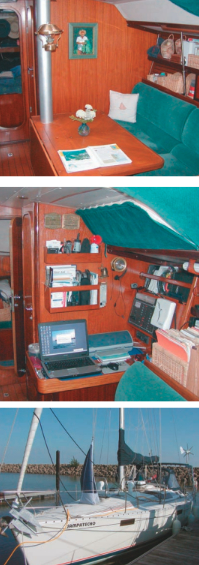
It was time to prepare the Beneteau for extended living aboard, based on lessons learned on the Endeavor. The list of additions to the Beneteau grew as they incorporated their wish list. First, Bradd addressed their basic electrical systems. He added a 110-volt AC distribution system, 12-volt DC outlets for accessories like the hand-held radio, cabin fans, and compact fluorescent lights in the cabins. Next, he added a radar system with an arch that incorporates seats, a motor hoist, motor mount, rod holders, and anchor light. He also added a swim ladder, offshore life raft, and watermaker.
Adding equipment
Crew needs were addressed by adding a microwave oven, larger winches (Lewmar 58s), an electric windlass, Bimini, dodger, and a propane barbecue.
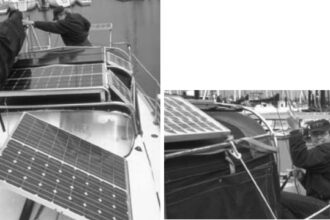
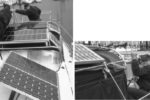
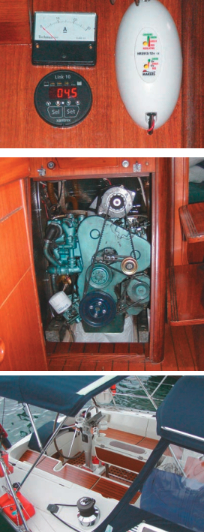
Bradd realized they’d need to be energy self-sufficient. His system for energy production and management is well researched. He used Nigel Calder’s formulas to figure demand, planning to run the engine about two hours every fourth day to replenish the batteries. He knew he’d need a respectable house bank and passive generation to extend amp-hours by keeping ahead of the demands of refrigeration. With this in mind, the following items were added to the boat: a 660-amp-hour house battery bank plus a starting battery, a 100-amp alternator to supplement the original 55-amp unit, one 55-watt solar panel, and a Rutland 913 wind generator.
Bradd figures their solar panel puts out daily about 3 amps for four hours and 1.5 amps for another four hours. He chose the Rutland 913 because he wanted a unit capable of generating in less than 10 knots of wind in the calmer areas they seek for shelter and anchoring. Bradd calculates the Rutland quietly averages a continuous 2 amps.
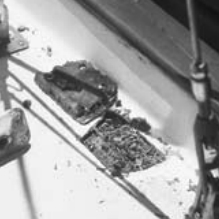
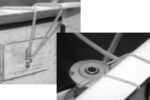
The 100-amp alternator is engaged only when he needs to replenish the house bank. He designed a system for easily mounting or removing the drive belt on the 100-amp alternator (see photo on Page 30). The 55-amp unit is always engaged. A nice feature of this arrangement is that both alternators are self-regulating and serve as backups.
His system proved itself in the Bahamas. As hoped, they ran their diesel only two hours every fourth day to maintain their batteries.
Upgraded anchors
The original ground tackle was upgraded to include a 40-pound CQR with 150 feet of 3⁄8-inch chain and as their secondary, a 35-pound West Performance (Danforth style) with 66 feet of 3⁄8-inch chain and 150 feet of 3⁄4-inch nylon. Bradd acknowledges that he sleeps better with all-chain rode. This was reinforced one night on the Bahamas Bank when they chafed through a 1-inch nylon snubber line in eight hours.
Finally, Sampatecho was ready. Bradd and Maeve sold their house, disposed of the cars, stored heirlooms, and headed down the East Coast.
Meanwhile, Cruising Solutions had continued to grow, adding customers and products. Bradd and Maeve’s business had morphed into something more than simply serving as the representative for chosen products, as existing suppliers closed and Bradd and Maeve began developing their own new products. They now had contract manufacturers, inventory, shipping, and product development to contend with.
Does it work?
So how do they run a business while cruising? Bradd and Maeve exhibit at boat shows, test gear, and run their business as a virtual company. They handle questions, issues, product development, and acquisition. Until recently, their son, Pat, processed orders each day and cleared the spam from their email account back at home. But Pat, age 23, is crewing on a 165-foot yacht now and his younger brother, Crawford (Sam), has the job. Shipping is handled by a contractor in Florida.
They liken their business to a wind generator: it doesn’t provide enough income to fully support their cruising, but it does help extend the life of the battery bank. It also puts demands on their liveaboard lifestyle.
Maeve notes, “Five years ago we couldn’t be sailing and run the business.” She points out that efficient communication wasn’t possible. Cellular phones and the Internet make it possible today, possible but not simple.
Bradd adds, “The Internet has changed people’s expectations. Once, you clipped a bingo card from a magazine, waited a few weeks for literature, then called or sent in an order. Today, you research the info on the Internet, enter your order, and expect shipment the same day. We have to be accessible, always, 24/7.”
High-tech headaches
They have learned that cell phones are a blessing and a curse. They promise mobile communication but fall short on connection reliability. The places where sailors are found — rivers, lakes, and oceans — don’t have enough potential users to support nearby service providers and cell towers. Emerging technologies such as tower signal-strength modulation, directional signals, and traffic-flow control diminish a boater’s ability to connect.
Simple things, such as changing your coverage plan, can result in weeks without service. Costs can escalate out of control when roaming charges kick in, especially offshore, or when you’re traveling along a border where direct and roaming towers compete for your signal. In other areas, days would pass without a reliable connection.
After many months of communication frustrations, Bradd and Maeve purchased a SkyMate satellite communicator, which provides affordable and reliable global weather forecasts, secure email, position reporting to friends and family, voice messaging, and fax capabilities. They also switched their cell phone provider from Sprint to Cingular, which offers superior coverage in Canada and the Bahamas. A Black-Berry (a small wireless email and web accessing device) is on the wish list, they say, but they’re on a cruising budget like everybody else. Maybe that technology will be tested later.
As they face communication complications and changes, they are backed up by their “virtual infrastructure.” Crawford, age 20, does much of the communications and office work. Payments are processed via telephone from orders placed on their website or called in to their toll-free number. Maeve handles the accounting with the help of their accountant. Artwork for advertising and promotion is developed by their daughter, Echo, age 26. Crawford also assists with product evaluation and data entry.
All the elements of a small business are in place; it’s just not all in one place. Cruising Solutions has become a model for a small virtual business.
Thank you to Sailrite Enterprises, Inc., for providing free access to back issues of Good Old Boat through intellectual property rights. Sailrite.com