Triton served as home for two for seven years
Issue 51 : Nov/Dec 2006
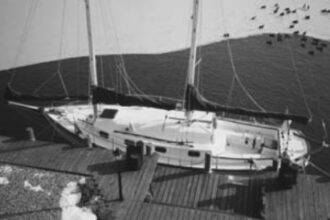
The new old boat at the marina caught my eye. Boats like that always do. Wow! A real cruiser. A 1960s boat. A Triton? An Alberg 30? Heavy-duty dodger, windvane on the transom, mounts for storm boards on the ports, big CQR in a bow roller, and another hanging on the pushpit. Everything about her said she’d been somewhere and done something. She looked out of place, tucked into the crowd of weekend toys and dock potatoes. Her registration numbers said California. Since we’re in North Carolina, that was a start.
I recalled my next-door neighbor, Dave Hause, telling me, after finding out I sailed, that a co-worker of his had sailed his boat from California through the Caribbean and up the Intracoastal Waterway to Wilmington. A couple of email messages established the match — the boat was indeed a Pearson Triton. Before any time went by, I was a guest crew for a summer evening sail with her owner, Jack James, along with Dave and a guy who taught in the same department as I did and whose wife worked with Jack. That was four years ago.
Since then, Dave has moved away, but Jack and his wife, Beth, and the other guy, Tom Massey, along with his wife, Meg, have become our close friends. I’ve spent many an evening and weekend afternoon sailing Ariadne. She is the boat that showed me in real life what I’d only seen in books and magazines — how a small long-distance liveaboard cruiser really works.
The Triton is in many ways the Elvis of fiberglass sailboats and, as such, her history’s been recounted plenty of times already — Sailboat Hall of Fame and the first really successful production fiberglass racer/cruiser. The Triton, launched in 1959, put Pearson Yachts on the road to becoming the world’s biggest sailboat builder. More than 700 Tritons were built. Dan Spurr once said it was probably the cheapest, smallest true bluewater-cruising-capable boat (properly modified and equipped, of course) out there. She’s a proven circumnavigator and is still raced as a one-design.
Bullet-proof hull
Cruising traditionalists praise her modified full keel, bullet-proof hull, barn-door rudder, and low freeboard. You don’t have to be Ted Brewer or sail this boat halfway around the world to appreciate her qualities; she’s dry despite her low freeboard, she sails like nobody’s business, and she rides like a Cadillac — no mean set of feats for a boat just over 20 feet on the waterline.
But if you want to tackle what Jack did, and turn a tired stock Triton into a seaworthy liveaboard cruiser, you’ve got your work cut out for you. Scan the big online boat listings, and you’ll rarely find a fully restored, tricked-out Triton for sale. What you will find are major projects going cheap. There’s a world of difference between what the original owner got from Pearson in 1963 and what Ariadne is now, 43 years later.
Jack was a teenager when his father bought his first sailboat — a Pearson Electra — so he got familiar with the boatyard early in life. After the Electra, Jack Sr. bought a 35-foot wooden boat, and Jack learned the ins and outs of marine woodwork while helping to restore her. When he was 19, Jack and his father sailed her from California to Hawaii in March . . . a little early in the season. Jack says he was soaking wet for three straight weeks. Several years later he crewed on a 40-footer for a whale research expedition down the Baja coast. After living aboard a smaller boat for a while after college, Jack bought Ariadne in 1985, in southern California, even though she’s an East Coast Triton. He paid $10,000 for her. He thought that was a great deal at the time. (Her original price was $9,700.) Then the bottom fell out of the sailboat market.
DIY paradise
Jack was living in Los Angeles, which was a do-it-yourself sailor’s paradise. All the production builders in and around Costa Mesa had spawned a thriving sailboat-parts economy. Jack wandered through scrap yards and found stainless steel to make his anchor roller, beefed-up mast tabernacle, and storm-shutters.
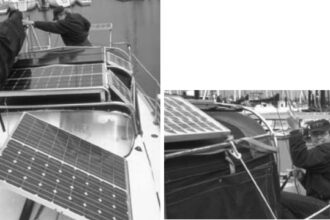
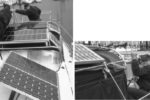
His two 40-watt solar panels were NASA surplus, and he made his own wind generator which hangs from the backstay and has a wooden propeller like the ones on World War I fighter planes. If he couldn’t make it or salvage it, there was Minney’s Yacht Surplus. Some of Ariadne’s blocks and hardware came from a sunken wreck that Jack and a friend dove on in Mexico before they were chased off by the Mexican coast guard.
He needed plenty of stuff. The builder’s definition of “basic” in 1963 is what we would call “not done yet” today, and while Jack knows little about her past, he does know she was already a veteran of Baja cruises and showing her age and mileage when he got her. He needed a full set of stanchions, lifelines, a pulpit and pushpit, and an interior that didn’t have raw fiberglass surfaces. One cool thing he did get from the previous owner was a homemade windvane self-steering system — the type of auxiliary rudder with a trim tab. It still works.
Tritons have deck-stepped masts supported by an oak deck beam just in front of the break in the split-level cabin trunk. Ariadne’s was cracked when Jack came along — a common problem on hard-sailed aging Tritons — and he replaced it with a steel I-beam. He added a second set of lower shrouds to stop mast pumping. However, he says if the rig is stout, and the mast doesn’t pump, leave it alone.
Rotten core
Most of the deck core on one side, forward of amidships, was rotten. Jack drilled six million tiny holes in the outer skin, poured acetone in them, and squeegeed epoxy into them. No problems since. When he went to a boatyard parts counter and asked for non-skid paint additive and they tried to sell him a can of sand for $13, he found some crushed walnut shells (plentiful in California) and used those instead. Concerned about flex in the uncored, thin sterndeck, he glassed-in wood reinforcements underneath it and made a watertight, beefy door for the stern lazarette.
The original Triton rudder was mahogany. Ariadne’s wasn’t in good shape, so Jack made her an exact copy out of solid fiberglass. While he had the engine out, he replaced the shaft log.
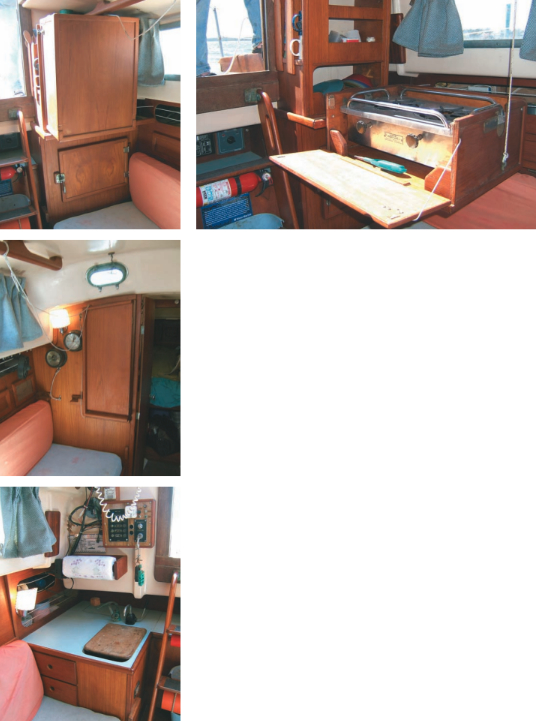
As frugal as Jack is, he does have a weakness for teak. Ariadne is a teak showcase. Jack reckons he spent around $2,000 on teak 20 years ago. He’s a capable finish carpenter, and her hatches, sea hood, propane locker, coamings, and interior trim are works of art. He built the athwartships cockpit locker abaft the bridge deck. The swing-down teak stovebox with the flip-down front and gimbaled Luke stove is very well done. He was living aboard while he did the interior, and he made almost everything with a jigsaw on the dock and a bench sander he kept in the cockpit.
Jack met Beth in 1987. A farm girl from New Hampshire finishing college in California, she warned him before their first weekender to the Channel Islands that she got seasick, but that didn’t stop him. Beth was getting out of school and needed a job, and Jack encouraged her to work at West Marine, where they proceeded to score gear — inverter, regulator, the Luke stove, and an early hand-held GPS — at the employee discount as they got ready for the trip down south.
Two luxuries
Still, they kept it simple. The two mechanical luxuries on Ariadne are a manual windlass (not a luxury on a larger boat, but counts as one on a 28-footer with a chain/rope rode) and refrigeration (an Adler Barbour Cold Machine for which Jack added a third battery). Jack confirms what’s generally reported: the stock front-loading Triton icebox is poorly insulated. But he was pleased with the refrigerator as they cruised the tropics and reports that the wind generator and solar panels were able to keep up with it.
On their way down the Baja Peninsula, there were enough windless days that they found themselves hand-
steering far more than they wanted to, so when they got to Nuevo Vallarta on the Mexican mainland, they bought a used autopilot at a cruisers’ second-hand sale on the beach for $30. It worked. Their “hand-held VHF,” which is the size of a World War II walkie-talkie, cost $1. It works too. Their inflatable dinghy, which they finally replaced last year when it just couldn’t be patched anymore, was bought used, as was the outboard.
But as inspiring as Jack’s improvements and upgrade list is, it should be noted that what wasn’t broken on Ariadne didn’t get fixed. The most valuable lesson I learned from Ariadne was not what I needed, but what I didn’t need on my own project boat.
Her original, raw-water-cooled Atomic 4, which Jack pulled and had rebuilt in the ’80s, still starts every time and runs like a champ after 42 years and some serious cruising, all in salt water. (He’s religious about flushing and tightening the grease cup on the water pump.) The original alternator lasted until last year, and the original starter still works. Her DC panel is original, as is much of her house wiring, main battery switch, galley sink, icebox, ports, spars, and interior lights.
Headed south
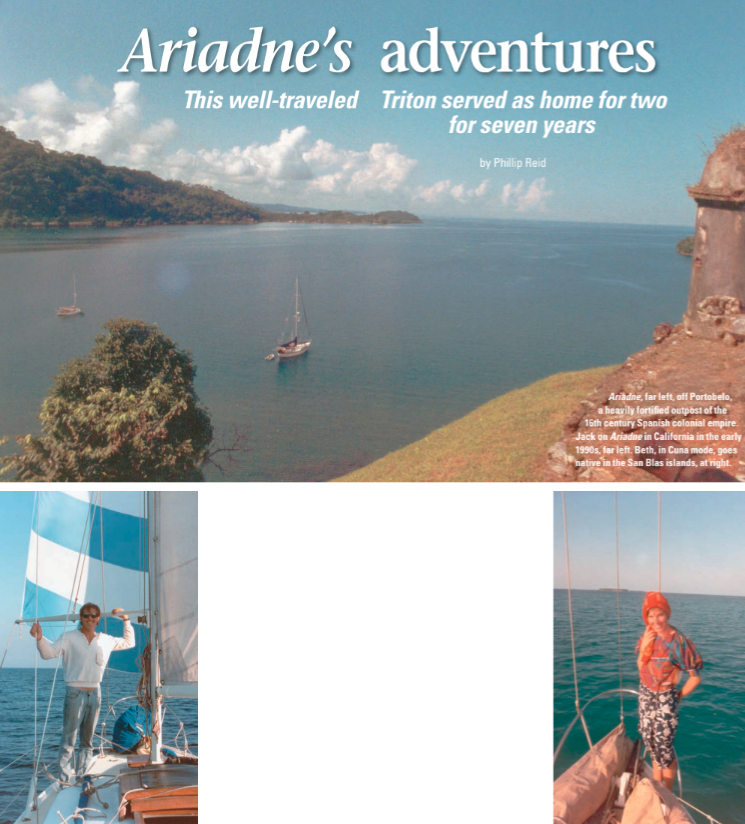
Jack, a chemist, sold his one-man garage business making orthodontic parts. With that as their kitty, he and Beth sailed Ariadne from San Diego in November 1993, heading down the Baja Peninsula to the Mexican Pacific coast. They explored Baja and Mexico, then jumped to Costa Rica, where they lingered for months.
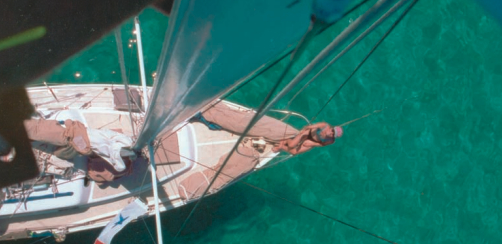
Moving on to Panama, they knocked around the Pacific side for a month or so, did the Panama Canal, helped some other cruisers through the canal and, once on the Caribbean side, proceeded to fall in love with the San Blas islands, which at the time weren’t well-known. Picture a tropical island paradise, they say, and you’ve got the San Blas Islands.
Ariadne’s V-berth is still graced with molas, colorful appliquéd panels made by the Cuna, the last indigenous Caribbeans. Framed molas also hang in their log house in the woods. They found the Cuna fascinating, and the Cuna were well-disposed toward Americans, whose government had once helped them in their knock-down-drag-out fight for autonomy against the Panamanian government. Panama was finally forced to recognize a treaty that set aside the San Blas islands as an autonomous reservation for the Cuna. Jack and Beth never wanted to leave, but the Cuna, while friendly and hospitable, do not allow outsiders to swallow the anchor in their unique world.
So they sailed over to Cartagena and spent some time exploring coastal Colombia, went back to the San Blas, explored the Bay Islands of Honduras, and poked around Guatemala and Belize before heading up the Yucatán coast. From Isla Mujeres, two years after they left San Diego, they crossed the Gulf of Mexico to Florida. The cruising kitty was nearly empty. They made their way up the ICW all the way to New Bern, North Carolina, and then to Wilmington for Jack to take a job with a pharmaceutical development company.
Custom trailer
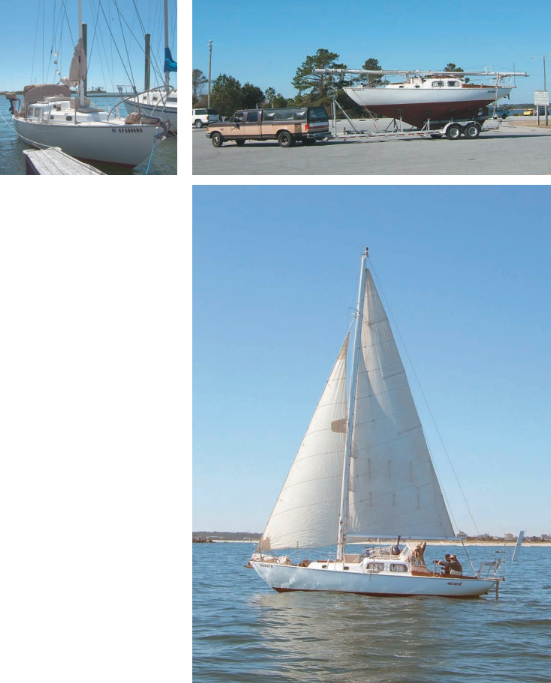
He and Beth bought a house two years after they got to North Carolina, and Ariadne was no longer the permanent home she’d been for seven years. Jack had a custom trailer made for her, bought a used dual rear wheel pickup (which together cost far more than the boat), and hoped to use that rig for short-term cruises much more than he actually has so far since he went back to the 9-to-5. He hauls the boat for hurricanes and trucks her inland. He and Beth spent one hurricane living aboard on the trailer in a Wal-Mart parking lot, cozy and comfortable and, most importantly, not worried about the boat. The only trailersailing trip he’s had time for so far has been to the Bahamas with his father. They trucked the boat to Florida to make the shortest possible Gulf Stream crossing.
How does the Triton measure up as a liveaboard home for two? “It’s pretty cramped,” Jack says, “It’s about as small as you can really get and make it work.” (He’s 6 foot 2 inches and Beth is 5 foot 10 inches. They hit their heads a lot.) But they made it work for years. They emphasize that making a small boat work as a home is much easier in the tropics and subtropics where you spend most of your time on deck and in the cockpit, which is why good canvas is so important. You don’t need insulation or artificial climate control; you can dive overboard to cool off and clean up.
When they got to the East Coast, they experienced their first real winter aboard. Condensation dripped off the overhead, and Jack found himself improvising interior insulation out of the foam-cloth used on car overheads, with limited success and lots of mildew. The extra clothes you need, blankets, stove fuel, being stuck below . . . cold weather completely changed the equation, they say.
Many fans
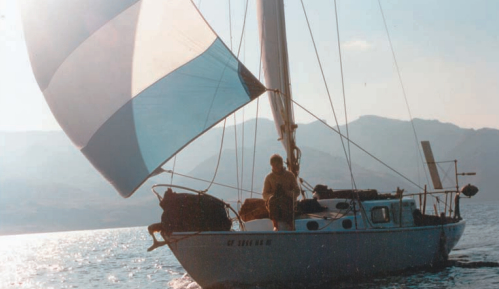
When it comes to her performance at sea, Jack joins the chorus of the Triton’s many fans. “I’d trust the boat anywhere but in ice,” he says. (He’d only take a steel boat into ice.) During their travels, they ran into one bad storm off Colombia. They set the windvane, went below, and lay down, popping up every so often to take a look around. Beth rested on the low settee berth; Jack made himself comfortable on the cabin sole on some cushions. The waves were huge; they filled the cockpit constantly, but they rode through it.
Jack’s not a fan of slow boats or of unweatherly hulls and rigs. “A cruising boat needs to be reasonably fast and able to beat off a lee shore,” he says. When they crossed the Gulf of Mexico to Florida they found themselves outrunning an unexpected hurricane. According to Jack, the first priority should be to get a good sailing boat. Then make that boat as livable as you can without compromising her sailing performance more than you have to.
Beth says she wouldn’t trade the cruise for anything but wouldn’t want to do it again. She spent pretty much the entire time underway on seasickness drugs, and she hasn’t been sailing on open water again since their return to the U.S. She was ready to have a house, a garden, and to settle down.
Jack hopes to persuade her to do sheltered-water cruises on the East Coast, using the truck and trailer to minimize time in transit to intended cruising grounds. But for now Ariadne is a daysailer and overnighter (they like to anchor out overnight once in a while in the sound behind Wrightsville Beach) — though she stands far apart from the crowd of daysailers and overnighters around here. Her past life and all those tropical miles under her keel are written all over her. Her future as a cruising boat may be unclear, but one thing is certain: “I’ll die with this boat,” Jack says. After that, who knows where Ariadne will go and what she will do?
Thank you to Sailrite Enterprises, Inc., for providing free access to back issues of Good Old Boat through intellectual property rights. Sailrite.com