A fine racer/cruiser for a small family
Issue 54 : May/Jun 2007
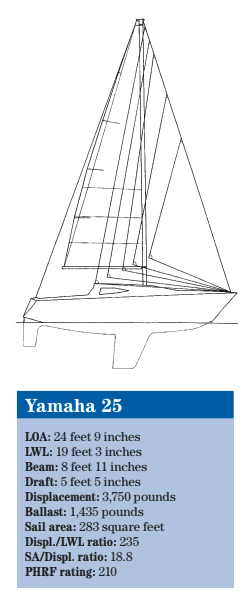
Yamaha is a well-known name in musical instruments and motorcycles. But sailboats? Perhaps one in a hundred sailors knows that during the late 1970s and ’80s Yamaha built a fine line of sailboats, with distribution throughout North America and Europe. They ranged in length from 21 to 37 feet. Most were cruiser/racer designs. One of the smaller models, the Yamaha 25, was available in two versions: a standard rig and the Mark II with a taller mast, more sail area, and spinnaker gear (spinnaker halyard and a turning block for the foreguy on the foredeck).
Yamaha developed an in-house engineering and design team to support its sailboat business. Product literature describes how the design process for the hull moved from preliminary lines drawings to tank testing using the company’s own test facility.
At the same time, other members of the design team made mockups of the cockpit, deck, and interior to assure good ergonomics. Prototypes were built and tested and then refined before moving into production. Yamaha product literature from the 1970s touts its success on the race-course. Magician V, a modified production 24-footer, won the 1978 Quarter-Ton World Championship. Earlier, Yamaha Motors had followed a similar strategy with motorcycles: gain visibility with success in competition and then follow up with a full product line for a broader consumer market.
Specialty Yachts in Vancouver, British Columbia, was the primary dealer for Yamaha yachts in the Pacific Northwest. I spoke with a member of their staff, Lawrence Fronczek, who recalled the Yamaha yachts with obvious fondness. He had sailed extensively on models from 25 feet (the smallest his dealership imported) to 36 feet. He characterized them as “extremely robust and well built” with “well-thought-out interior layouts.” Specialty Yachts had very few warranty problems to deal with. He could recall no incidence of osmotic blistering or delamination, even on older boats that came in for routine maintenance.
First impression
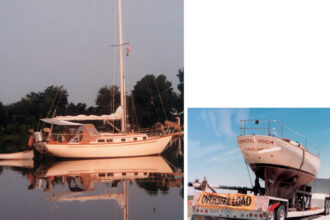
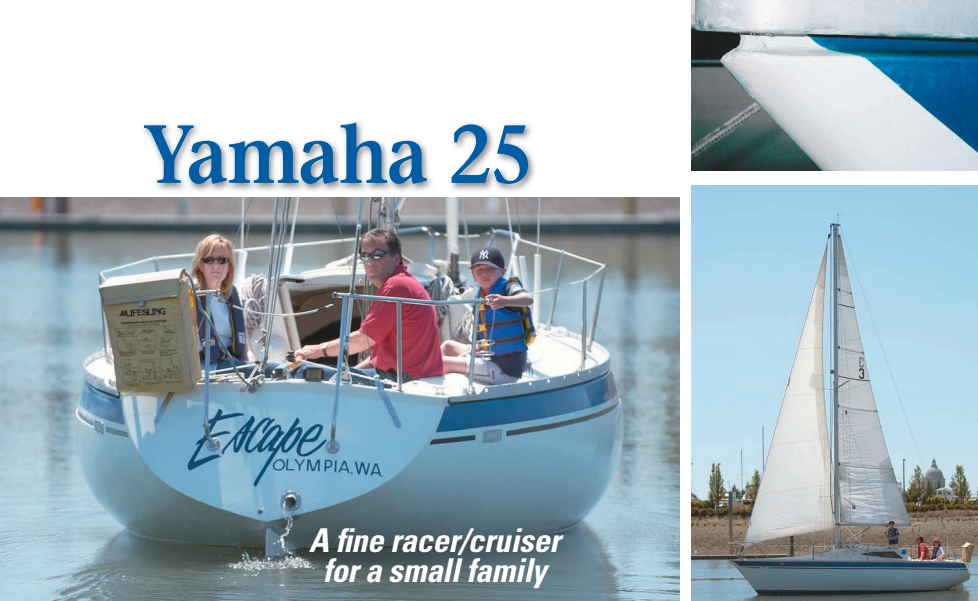
When you approach a Yamaha 25, the first impression will be of a lithe and lively vessel that was designed to sail well. The influence of the International Offshore Rule (IOR) is evident, as this model was designed to compete in the Quarter-Ton class. Whether you see her from bow or stern, you’ll notice the trademark tumblehome. Because beam increases wetted surface area, and therefore friction that slows a boat, the IOR gave credit to beamy designs, but designers attempted to thwart the intent by adding beam only above the waterline.
Maximum beam in the IOR designs is not carried well aft as is currently in fashion. Rather, the hull typically tapers to a rather slender transom with pinched ends. The moderate bow and stern overhangs result in a fairly short waterline by today’s standards. However, the buttock lines at the stern flow smoothly upward so that the effective waterline lengthens quickly as the vessel heels.
As with any rating rule, designers exploited whatever part of the IOR they could to gain even a small advantage on the racecourse. Sometimes this resulted in peculiar bumps on the hulls. Sometimes a portion of the ballast ended up in the bilge rather than in the keel where one would normally expect it. When that was the case, the boats were prone to “death rolling” when pushed hard downwind. Fortunately, the Yamaha 25 seems free from these excesses. The hull has a smooth, fair shape, and all the ballast is in the deep cast-iron keel.
Straight sheer
The sheer is nearly straight, and the coachroof is smoothly contoured with tapered portlights port and starboard. The masthead sloop rig is conservative. The mast is deck-stepped with single spreaders, cap shrouds, and fore-and-aft lowers. The backstay is split and incorporates a block-and-tackle tension adjuster. The mast is stepped relatively far aft, so the jib and genoa are important in generating power. On larger boats, this design choice can lead to genoas that require a strong crew to sheet home. On a 25-foot boat, however, this should not be a concern. All halyards are run internally with nicely detailed sheaves where the lines exit the mast. The rudder is hung on a skeg, which gives added protection against the drift logs too often encountered in the Pacific Northwest.
The cockpit provides sufficient working space for a race crew, yet the boat should be easy to singlehand. The halyards are led aft to coachroof-mounted winches and linestoppers. The mainsheet traveler is close at hand, and the mainsail is sheeted to the boom end, which helps keep sheeting forces low. The engine controls also are close at hand on the starboard side of the cockpit. These controls are a clue to an unusual feature in a 25- foot sailboat: an inboard diesel engine.
On deck there are stoutly built and well-mounted stainless-steel bow and stern pulpits. A single vinyl-coated stainless-steel lifeline runs along each sidedeck. The stanchions feel quite secure. The foredeck is solid underfoot with a nice camber. A small anchor locker is molded into the starboard side of the foredeck and drains overboard. A translucent hatch provides ventilation for the V-berth and could be used for hoisting or dousing a spinnaker.
Easy access
The sidedecks provide easy access fore and aft, with the chainplates set inboard. An unusual feature is a molded gutter just inside the aluminum toerail. Just aft of the shrouds, the sidedeck has a molded-in ridge to deflect water away from the cockpit. Farther aft, the sidedecks feature a concave profile, which makes for comfortable seating when sailing to weather.
When stepping into the cockpit,you’ll notice the bridge deck and locker below the companionway. The Yamaha 25 brochure suggests this would be a good place to store a life raft. Clearly, the design team intended these boats to be used for more than daysailing. There is another, larger locker running athwartships at the stern.
At the end of the cabin bulkhead, port and starboard, are clever recesses adjacent to each of the winches on the coachroof for storing coiled-up halyards. A seahood provides protection for the companionway hatch and extends outboard far enough to enclose the lines running aft from the mast. Two Dorade vents are mounted near the forward end of the seahood.
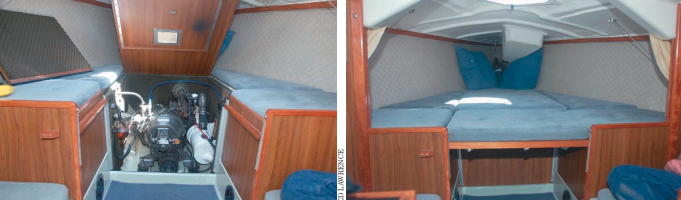
Going below, you’ll find a surprisingly spacious interior with several clever touches. The V-berth is large, in part because the mast is stepped well aft and thus the main bulkhead is well aft too. The cabin also seems roomy because there is no compression post to impede movement. This is a plus.
A potential negative is that a strong deck support of some kind is required to carry the mast compression loads. In the case of the Yamaha 25, the molded fiberglass arch looks positively massive and effectively carries rigging stresses to each side of the hull. This arch is integrated into the main bulkhead, which also supports the chainplates for the cap shrouds. The overall engineering of this system leaves a very favorable impression.
Privacy curtain
A standard marine head is hidden away behind panels at the aft end of the V-berth on the starboard side. The privacy curtain that closes off the V-berth also shields the head when in use. A holding tank for the head was not standard equipment. Most owners in the United States have opted to install flexible holding tanks in the bow.
No coachroof liner is used in the V-berth area. Instead, one can see the nicely finished underside of the deck. The contours of the deck help provide stiffness, and molded-in stringers provide more stiffness where needed. Additional reinforcement is visible around the hatch.
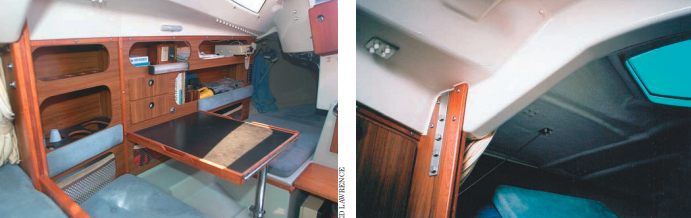
The main cabin features a compact galley to port. Lifting a panel reveals a gimbaled single-burner alcohol stove and a stainless-steel sink. A foot pump provides water to the sink from the 9 1⁄2-gallon tank. Dish storage is built into the locker behind the sink and stove. Below the dish locker and behind the stove and sink there is a modest icebox. Standing headroom is available only for those shorter than 5 feet 7 inches.
There is seating for two on either side of an adjustable table on the starboard side across from the galley. The aft seat is actually part of the starboard quarter berth. The table also serves as the chart table. When folded out athwartships, the table aligns with the cover panel over the galley and can provide dining space for four. Again, the aft seat on the port side is part of the quarter berth on that side.
The table serves one more function. When folded up, it can be lowered and covered with a cushion. It then aligns with the quarter berth and forward seat to provide more seating space. Or it could provide sleeping space for a fifth crewmember — preferably the shortest one. The quarter berths are surprisingly spacious and make good sea berths.
Lockers behind the seats to port and starboard provide storage for small items. More storage is located underneath the quarter berths and between them. Fixed portlights to port and starboard provide for ample natural lighting. Strategically located incandescent lights provide nighttime lighting.
Construction details
The hull is built of solid fiberglass. A molded “grid-and-box” structure is incorporated below the sole to provide additional strength. The deck also is solid fiberglass with some marine plywood coring used to increase panel stiffness for flat surfaces, for example, around the companionway. As mentioned, molded-in stringers and ribs are incorporated under the foredeck to provide additional strength and stiffness.
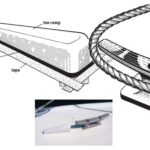
The hull-to-deck joint is unusual, even to Yamaha, I think. Product literature for the Yamaha 25 and 30 shows an outward flange. However, at least on the Yamaha 25, it is more complicated than that. The top few inches of the hull are built in a C-shape, creating a recess or channel running the length of the hull underneath the T-shaped aluminum toerail (see photo on Page 47). The deck flange bears on the top of the C.
The horizontal surfaces of the deck and hull are glued and mechanically bonded. Monel rivets are used along most of the joint, except at the bow where the toerail is through-bolted. The joint is somewhat protected by the tumblehome of the topsides, which will take the brunt of the impact from less-than-artful dockings.
The cap shrouds are secured to stainless-steel chainplates that are bolted to the main bulkhead. They seem appropriately sized for the rigging loads. The aft lower shrouds are secured to plates bolted to the sidedecks, with a stainless-steel backing plate belowdecks. The forward lowers are similarly secured but with additional support coming from a stainless-steel rod that runs diagonally back down to the main bulkhead. These supports for the lower shrouds are evidently sufficient for the rigging loads of a 25-foot boat since the deck is robustly constructed. The owners’ group does not report any associated problems. I did not note any flexing of the sidedeck when pulling vigorously on the lower shrouds.
Under way
The winds were very light the day of our test sail, but I can say the Yamaha 25 will ghost beautifully under jib alone. Though it’s a different model, a husband and wife in my local sail fleet owned and raced a Yamaha 33 for several years. They spoke highly of its performance under sail and felt it was at its best when working to windward.
The PHRF rating for the largest fleet of 25s — albeit just four boats — is 210, roughly the same as a C&C 25. A J/24 rates 171.
When you lift the center panel of the V-berth you’ll find a single-cylinder Yanmar diesel. This is a very unusual installation. The engine, a model YSB-8, has a horizontal cylinder. Yanmar produced three models of horizontal, raw-water-cooled, single-cylinder engines of 8-hp and 12-hp between 1974 and 1980. In general, raw-water-cooled diesels require a bit more maintenance than freshwater-cooled engines. So check engine condition and maintenance records during a pre-purchase survey. A blower was standard equipment to help remove engine heat and fumes. The engine in Escape, George Zimmerman’s Yamaha 25, which I test-sailed, started quickly and was surprisingly smooth for a single-cylinder engine.
The overall height of the engine is low enough that it can be easily tucked under the V-berth. Overall engine access is good. The 6.6-gallon, stainless-steel fuel tank is mounted in a wood-paneled locker on the port side just forward of the bulkhead. It is vented up through a nearby stanchion — another nice touch. Access to the fuel tank is easy. In fact, George told me of removing his tank and taking it ashore for cleaning when he encountered a problem with contaminated fuel. Motoring range is said to be at least 100 nautical miles at 5.5 knots.
Placing the engine under the V-berth frees up room elsewhere and helps balance the boat. But it does necessitate a long driveshaft with a center support bearing where the shaft passes through a frame in the bilge between the transmission and the strut and Cutless bearing. The propeller ends up just aft of the keel. This location significantly reduces prop walk when backing. Hence, these boats can be easily turned to port or starboard when backing out of a slip.
Summary
The Yamaha sailboats were well designed and constructed. The performance of the Yamaha 25 lives up to the design goal of a cruiser/racer.
The Yamaha 25 should be a good choice for anyone who wants a boat for daysailing or club racing. The creative use of space belowdecks also makes this boat a good candidate for cruising with a small family. More good news is that replacement parts are still available from Yamaha Motors. A Yamaha 25 will not be easy to find since most owners of Yamaha sailboats tend to keep them for a long time. But they are worth the hunt.
Used models of Yamaha sailboats are found mostly in the western United States and Canada. Yachtworld, the on-line sailboat brokerage , usually has six to eight Yamahas for sale. As they are not well-known, these quality boats can prove to be a good value. Yachtworld shows the average asking price for a 1977 25-foot C&C and a 1977 Yamaha 25 to be in the $8,000 to $12,000 price range. The Yamaha, however, has an inboard diesel.
Thank you to Sailrite Enterprises, Inc., for providing free access to back issues of Good Old Boat through intellectual property rights. Sailrite.com