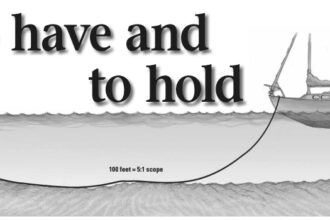
Adding staying power to your ground tackle
Issue 54 : May/Jun 2007
The anchor sentinel has been used by mariners for thousands of years. It is known by many other names throughout the world: the kellet, sentinel, chum, Sent Angel, Rode Rider, Anchor Buddy, and anchor weight. Anchor weight is probably the most descriptive term, since this object is a weight that is hung from the center, or slightly beyond the center, of the anchor rode to increase an anchor’s holding power. Nevertheless, sentinel and kellet are the two most commonly used names.
Two thousand years ago those master sailors, the Phoenicians, used this method to hold their primitive anchors more securely, and the same system is still being used today by knowledgeable sailors. The Phoenicians’ catenary stone was the genesis of today’s modern sentinel. Although nothing can correct for improper anchoring technique, the sentinel’s advantages are complementary, resulting in greater holding power and decreased arc of swing once the anchor has been properly set.
How it works
An anchor’s holding power is greatest when the pull on the rode is horizontal. As this angle is increased from the horizontal, the holding power of the anchor is reduced by a surprising and alarming percentage. Royal navy tests in Britain showed that when the anchor rode is only at the small angle of 10 degrees, the anchor’s holding power is already down to about 60 percent, compared with a horizontal pull. At an angle of only 15 degrees, the holding power is down to 40 percent, as is described in the Admiralty Manual of Seamanship.
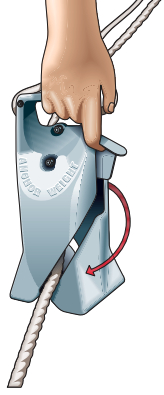
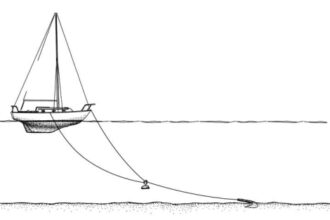
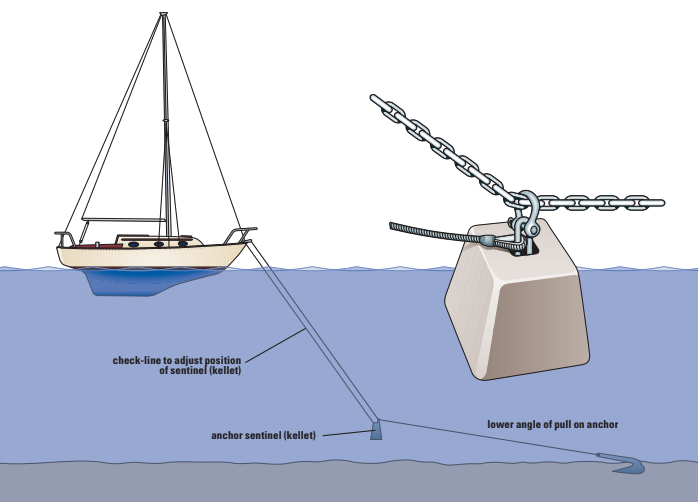
The sentinel increases the catenary (the curve) of the anchor rode and keeps the angle of pull on the anchor lower. In many cases it can nearly double the anchor’s holding power. This weight also decreases the hunting action of a boat at anchor as well as acting as a shock-absorber during sudden gusts or wave action. In these cases the weight is lifted while continuing to maintain a fairly constant pull on the anchor as well as on the boat’s cleat.
In his book, The Annapolis Book of Seamanship, John Rousmaniere recommends the sentinel be in the 20- to 50-pound range. The recommended weight depends on boat size and windage as well as the ability of the sailor to deploy it easily. Although a very heavy weight would be the ideal, leaning over the bow to attach it to the anchor line presents a limiting factor and becomes a compromise between a heavy weight and the sailor’s ability. A sailor should be able to set and retrieve an anchor sentinel easily, since time is often of the essence when weighing anchor.
Setting and retrieving
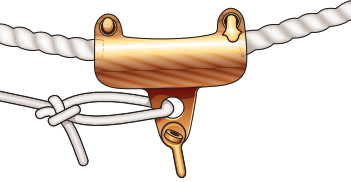
Once an anchor has been set and the proper length of rode deployed, the sentinel is sent about halfway down or a bit more, as measured between the boat’s bow and the anchor. A small-diameter warp, called a check-line or buddy-rope, usually a 1⁄4-inch line, is attached to the sentinel to control this distance. When leaving an anchorage, the sentinel is brought back on board again using this warp, before the anchor is weighed.
Sentinels can be used on anchor rodes that are allchain, rodes that use a short length of chain at the anchor end, or rodes with a rope-to-chain splice. However, it’s difficult, or sometimes impossible, to use a sentinel where (partway down the anchor rode) there is a line-to-chain connection, if this connection includes a shackle.
The sentinel itself can take many forms. Some weights are hung from a Rode Rider (usually bronze) that rides down the anchor rode. The Anchor Rode Rider from ABI Marine opens in half for easy attachment. It has no internal rollers, relying on the sentinel’s weight to let it slide down the rope anchor rode. It is not suitable for a chain rode. Other sentinels, such as Guardian Marine’s Kiwi Anchor Rider, have corkscrew slots molded into them, enabling them to be twisted on or off the rode. A handle on the top facilitates deployment and retrieval. The Kiwi Anchor Rider is manufactured for either a rope rode or chain rode and has internal nylon rollers to reduce friction.
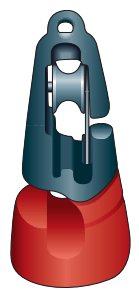
A sentinel can be a complicated patented design or simply a shackle with a weight attached (the weight I use is a cast-iron theater scenery weight coated with epoxy). Whichever type of weight is used, it must ride on the anchor rode without abrading the nylon or rubbing the galvanizing off the chain. Some commercial models have nylon rollers to eliminate chafe and make deployment and retrieving easier.
Even if you don’t use such a device every time you anchor, it is a good idea to have an anchor sentinel in your sailor’s bag of tricks.
Thank you to Sailrite Enterprises, Inc., for providing free access to back issues of Good Old Boat through intellectual property rights. Sailrite.com