Keel/centerboarder has fans on the Chesapeake and in Florida
Issue 58 : Jan/Feb 2008
In the late 1970s, Robert Deutsch decided he needed a new boat to race on the Great Lakes and approached Bruce Kirby with his ideas. Bruce was a magazine editor, racer, and designer of the immensely popular Laser. He designed a shallow-draft sloop for Robert that would do well under IOR (the favored rating rule at the time). He wanted to create a “normal boat,” meaning one without any “bumps or hollows that would be there only for measurement purposes.” The resulting boat proved reasonably fast and manageable. Robert owned at least two of them, both of which he named Shasta.
In addition, Robert formed a company, Arkady Marine in Green Bay, Wisconsin, to market the boat, which he called the Nightwind 35. He did not build the boats himself. Beginning in 1980, the first seven boats were built by the C. E. Ryder Company in Rhode Island. These were fitted with Volkswagen diesel engines. The molds were then moved to Ft. Meyers, Florida, and another six (or seven; there is some question) were built, this time with Yanmar diesels. I recently had an opportunity to sail on hull #1, Gator, in southeast Virginia.
Design and construction
The Nightwind is a moderate displacement keel/centerboarder with a fairly long waterline and generous beam. Bruce Kirby has compared the design to the famous Sparkman & Stephens yawl, Finisterre, which won the Bermuda Race an unprecedented three times but was influenced by the CCA rule, rather than the IOR. “It should be noted,” he says, “that the Nightwind is not typical of the traditional American centerboarder, such as the Finisterre relatives, which were much heavier for their length and relatively deeper with the board raised. They also had longer ballast keels with rudders hung on the after end of the keel. Nightwind is far more dinghy-like, lighter for her length, and with ballast keel and rudder widely separated.
“The Nightwind was designed in the IOR days, when I had done several boats to that rule that had lead only in the top half of the keel and with a good chunk of ballast inside the boat. This was done by a lot of designers to deal with the rule’s CGF, or center of gravity factor, which, in short, dictated that a tender boat should be slower than a stiff boat and, therefore, should rate lower. But as I was not designing the Nightwind under the IOR rule, I gave her a wide and flattish bottom for stability to make up for the high center of gravity of the ballast. Robert Deutsch wanted a shallow boat with good stability and that was how I handled the problem.”
The hull is solid fiberglass with Airex foam coring on the flat sides of the bow to prevent flexing and oil-canning there. The deck is solid fiberglass with plywood backing plates for deck hardware at the mast partners.
The fiberglass hull has a fine entry with moderate overhangs. The rudder is hung on the transom with a skeg protecting the upper two-thirds, which is built like a narrow box. The blade can be raised within this “trunk” like a daggerboard, and an emergency tiller is easily fitted to it.
The hull molding has a shoulder at the top. The deck molding fits over this shoulder and is joined to the hull by bolting the rubrail through the joint.
The inside ballast is located in the area of the mast step, but not on the centerline. It starts about a foot out from the center and fills an area of several square feet.
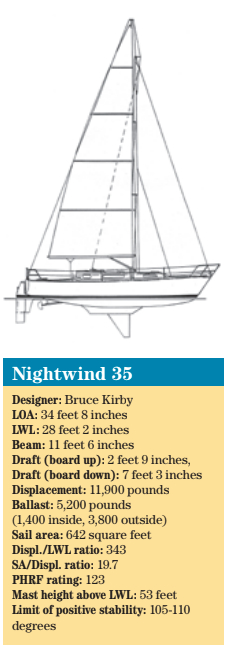
Ballast is part inside and part outside. On the outside is something Bruce describes as a foil-shaped lead shoe that is about 10 feet long and 10 inches thick and weighs 3,800 pounds. Since this is not deep enough to contain the centerboard, there is a trunk in the cabin. In addition to the stub keel, there are also 1,400 pounds of inside ballast. Total ballast is 5,200 pounds on 11,900 pounds of displacement for a ballast-to-displacement ratio of .46. The boat is reasonably stiff in normal wind ranges. The limit of positive stability (LPS) is 105–110 degrees, about standard for a centerboard boat. Draft, board up, is only 2 feet 9 inches; lowering the foil-shaped board brings the draft to 7 feet 3 inches. Beam-to-length ratio is .33.
On deck
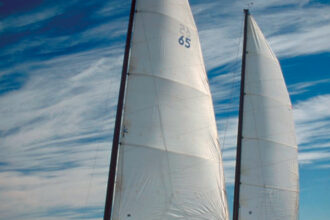
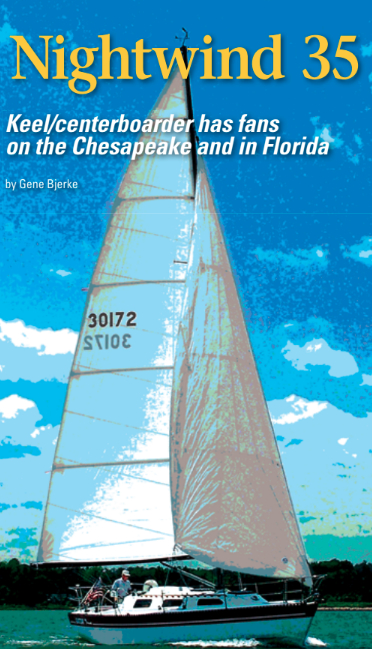
The Nightwind is a sloop with a seven-eighths rig. The sail area is 624 square feet, with most of that (359 square feet or 57 percent) in the main. The keel-stepped mast reaches to 53 feet above the water and has two spreaders. The cabintop is low and narrow with the chainplates installed against the cabin. The result is a wide deck for moving around on the boat and narrow sheeting angles for the headsails. There is ample working area on the foredeck. Gator has full-length lifelines.
Since Gator is not raced, she is normally sailed with a 110 percent working jib. All lines are led to the cockpit for shorthanded sailing. There are two two-speed winches on either side of the cockpit. The forward winches are self-tailing and are used for the headsail sheets; the after winches are available for the running backstays. We didn’t use the running backstays for casual sailing, but Dave Crossett, Gator’s owner, says that using the backstays reduces the tacking angle. There are also four winches and 11 clutches on the cabintop for everything else, from the centerboard pendant to the spinnaker pole downhaul.
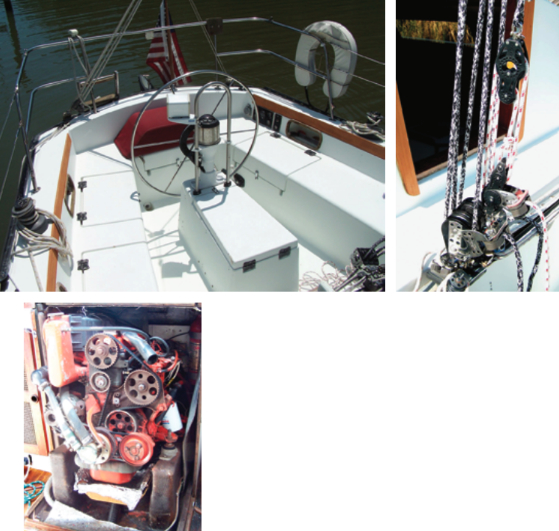
The mainsail is controlled by a mid-boom sheet taken to a traveler on the after edge of the bridge deck. Because it is a large sail, the mainsheet tackle has a hefty six-part purchase. Even that is not always enough purchase going to windward in a strong wind, so Dave has added a smaller, four-part tackle on Gator between the becket of the six-part and bitter end of the mainsheet (see photo). This allows him to make fine adjustments in strong conditions.
The Nightwind has a large cockpit for a 35-foot boat. It’s a bit over 8 feet wide forward and 5 feet wide aft on a total length of 8 feet 7 inches. This provides ample room for guests or a racing crew. The width might seem to be a disadvantage when the boat heels, but the center of the cockpit has a box the same height as the seats. This is convenient for bracing your feet and for sitting on when working the traveler on the bridge deck. It is possible to lift the bottom out of this center box to gain access to otherwise inaccessible areas below the cockpit and abaft the engine.
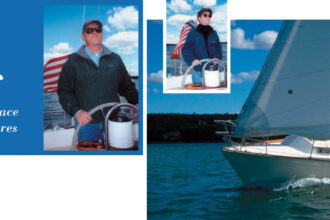
Gator is fitted with an oversize 40-inch wheel — the largest that will still allow the seat lockers to be opened. This makes it somewhat difficult to get behind the wheel when changing helmsmen, but allows the helmsman to sit up on the narrow deck outside the cockpit and reach the wheel easily. This is Dave’s favorite position because it gives him a good view of the jib. Gator also has a firm, portable, and very useful “helmsman’s seat” that sits on the stern seat and is raised about 10 inches.
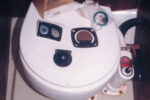
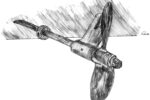
There is a self-draining propane locker under the after end of the starboard seat in the cockpit. It is fitted to take a 20-pound propane bottle. Another interesting detail is a small hatch amidships at the port rail. It opens to reveal a fitted locker that holds a Danforth anchor (about 13 pounds) vertically. It holds just the anchor, not the rode, but it does move that much weight off the bow.
Belowdecks
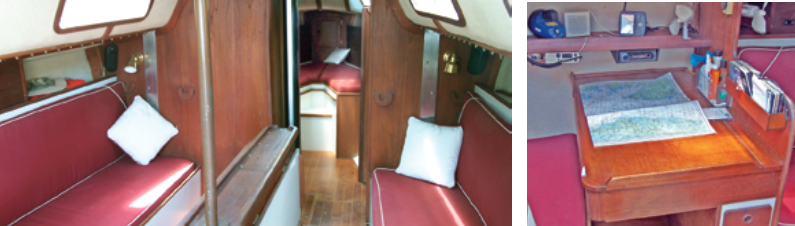
Below, the Nightwind has the typical layout of V-berths forward and settees in the main cabin. The boat also can be set up with pipe berths above the settees. This allows a sailor to race with a large crew but doesn’t clutter up the cabin with lots of berths that are unnecessary when cruising with the family.
The U-shaped galley is aft on the starboard side. There are two possible arrangements for the galley. One has the sink aft and the icebox forward; the other has those two reversed. Icebox forward seems like a better bet, because in the aft position the icebox lid, when it is opened, tends to bump against the cockpit overhang.
There are some slight variations among boats (at least on paper). One plan calls for a generous enclosed head opposite the galley. Gator has a navigation station and quarter berth in this area instead, with a small enclosed head just aft of the port V-berth (there would otherwise be hanging lockers on either side in that area). The headroom below is a generous 6 feet 2 inches, with a soft overhead.
The centerboard trunk is in the middle of the main cabin, but there is ample room to pass on either side. In addition to the overhead grab rails, it does give you something to hang on to in a seaway. And it forms the base for the drop-leaf table.
Natural light is provided by four fixed portlights and a translucent hatch in the saloon. There also are two fixed portlights and another translucent hatch in the fore cabin. In addition, there is a small translucent hatch over the head.
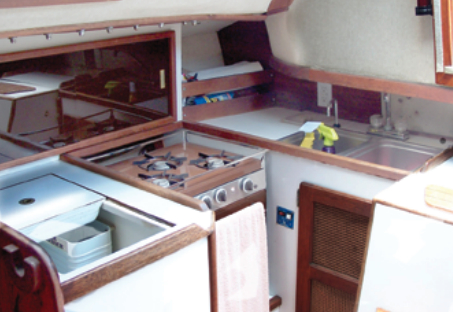
The freshwater-cooled engine is mounted under the companionway steps. This provides good access for
maintenance and repairs. Removing the steps opens up the whole front of the engine. Another cover can be removed to access the rest of the engine, mainly from the port quarter berth. This is normally enough since most components, like oil dipstick and filters, are on the port side of the engine. It is possible to get access to the entire engine if needed.
An advantage of the Nightwind models with Volkswagen diesels is that parts are usually available from a good auto parts store. In fact, Dave was able to adapt a cylinder head from a parts store and make it work on his engine. The only difference between the automobile head and the marinized head is a small vent pipe attached to the front, necessary because the engine is not installed horizontally in the boat. Dave was able to install a pipe himself on a new head and saved about $300 over a used marine cylinder head.
The propeller is on the centerline, forward of the rudder, so the boat handles well under power, including backing. In fact, Dave backs Gator into a narrow canal to get to his pier because there isn’t enough room in the canal to turn around. Gator will make about 6 3⁄4 knots under power.
Performance
The important question is how does the boat sail? The first day we went out, the wind was light and fluky to begin with but eventually settled in at about 10 knots. We set the main and 110 percent jib. Gator is not raced. Dave crews on friend Dan Smoker’s Nightwind in races) so Gator is set up for easy singlehanding.
In the process of circumnavigating an island between the creek where the boat is moored and the adjacent York River, we covered every point of sailing except a dead run (Dave prefers to tack downwind). When beating, Gator made about 7 knots and tacked through 85 to 95 degrees (without the running backstays). On a beam reach the knotmeter read about 5.5 with an indicated true wind speed of 9 knots. When broad reaching, the boat sailed at 4.3. At that wind speed, heeling was quite moderate. Set up as we were for casual sailing, it was a most pleasant and relaxing afternoon.
On the next sail the wind started at 8 to 10 knots and gradually built to about 15. We kept the boat on a beam reach for most of the afternoon, and she generally sailed about half the wind speed. We ended up hard on the wind to fetch the entrance to the creek. For a short time we furled the jib for comfort. The boat was well balanced and held her course under main only. The appearance of another Nightwind created an informal race and the jib was set again. Bruce Kirby feels that such a situation, beating in 12 to 15 knots of wind, is the boat’s best point of sailing. It was certainly a delightful sail.
The Nightwind’s PHRF rating is 123 seconds per mile, which compares favorably with a Niagara 35 at about 156, and an O’Day 35 at 150. J/Boats are the high-performance benchmark among production boats, so it’s always instructive to look at their ratings. A J/35 comes in at 89.
Bottom line
Properly set up, the Nightwind does well as a racing boat. It is the boat of choice for Dan Smoker, who is generally considered to be one of the Chesapeake’s hot racing sailors. He has won a lot of silver with his good old Nightwind. But if racing is not your thing, the accommodations are quite comfortable for cruising. It seems to be a true cruiser/racer. It is a shallow-draft boat that can perform adequately, if necessary, with the centerboard and rudder in the raised position. Thus, it’s no surprise that the boats are mainly found in Chesapeake Bay and Florida.
The Nightwind does not seem to have any inherent problems to look out for, at least none have been reported among the boats that Dave is aware of. Of course, age-related problems, such as corroded electrical wiring and leaky portlights, are common to all boats.
This was a low-volume boat. Only 13, or perhaps 14, were ever built, and at least one came to grief on some rocks. As far as I have been able to discover, there was only one Nightwind 35 available for sale as of this writing. It was listed on several websites, priced variously at $64,900 and $77,000.
It seems obvious that Nightwind owners are happy with their boats. Bruce Kirby bought one for his own personal boat. That says a lot.
In the last 45 years, Gene Bjerke has sailed on all sizes of boats, from 8 1⁄2 to 116 feet. He currently crews on a couple of reproduction 17th-century square-riggers.
Thank you to Sailrite Enterprises, Inc., for providing free access to back issues of Good Old Boat through intellectual property rights. Sailrite.com