This catboat has had nine lives — well, almost
Issue 58 : Jan/Feb 2008
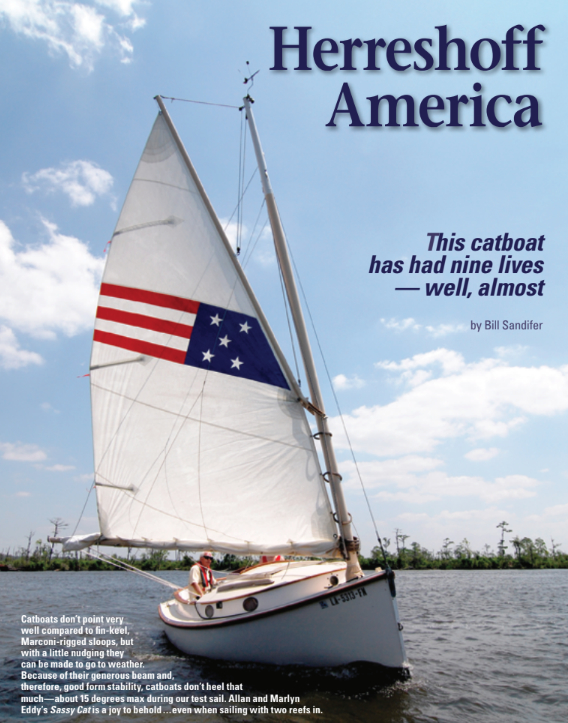
Sassy Cat, A Herreshoff America catboat was recently selected by Paramount Pictures for a supporting role in a movie. Since one would be hard pressed to find a prettier catboat of the fiberglass variety, it’s not hard to see why.
In the early 1970s, when Halsey Herreshoff was hired by Nowak & Williams to come up with a catboat design, he chose one from a number of models drawn in the early part of the 20th century by his grandfather, Nathanael Herreshoff. He copied the hull exactly from the original model, but the deck, cockpit, and cabinhouse were Halsey’s designs. The model he selected was the fastest of the group. With the addition of an outboard well in the stern, however, the boat gained added resistance and is no longer, and perhaps never was, “the fastest 18-foot catboat on the block.”
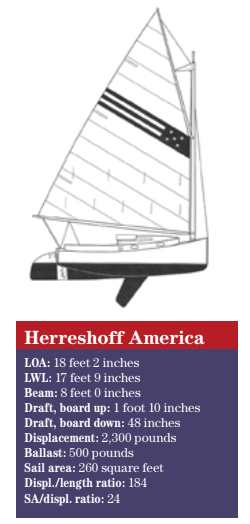
Nevertheless, its sail area/displacement ratio is a very high 24, which suggests generous power. The reason for this is that all the sail area is in one sail; when the wind goes light, you can’t set a genoa. And when the wind blows, you must reef early. Regardless, the America is still the prettiest fiberglass catboat to my mind.
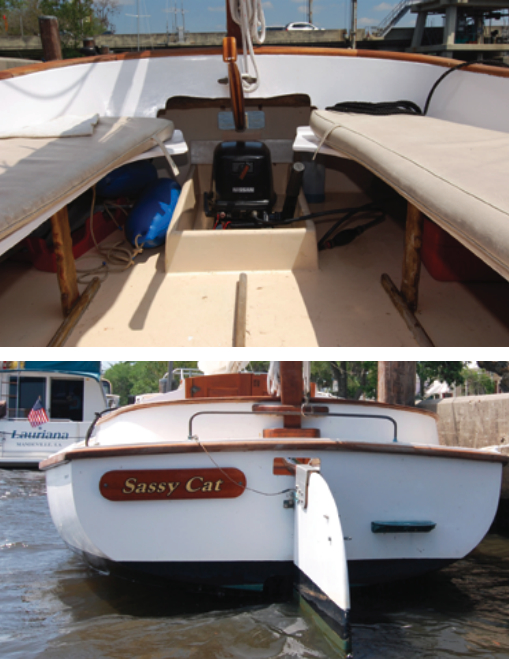
Catboats are famous or infamous, depending on your viewpoint, for weather helm. Because shoal draft, usually in the form of a centerboard, is essential to the catboat concept, many, including the original cats, have so-called barn door rudders to provide sufficient surface area for steering. To compensate for lack of draft, catboats have generous beam to give them form stability. The result is a high potential for bad manners. But not all catboats have weather helm, though most of the smaller ones do require early reefing and careful handling to point well.
Five lives, actually
The Herreshoff America design has an interesting history for a fiberglass boat. The hulls and decks were first built by Tillotson-Pearson Industries in Warren, Rhode Island. Then Nowak & Williams, just down the bay in Bristol, did the finishing work and sold the completed sailboats directly to sailors. Nowak & Williams got caught in the mid-1970s recession, and in 1977 the molds were bought by Squadron Yachts, which built a few boats before they also suffered financial reversals. Next, Nauset Marine acquired the molds. Several boats were built before the molds were acquired by NOA of St Petersburg, Florida, which did not build any boats as far as I know.
NOA held on to the molds until about 2006 when Com-Pac Yachts of nearby Clearwater bought the molds, redesigned the boat by adding a shallow fin keel, doing away with the traditional centerboard, and opening up the interior. Now named the Horizon Cat, Com-Pac also added its exclusive Mastendr mast-raising system, and a high-aspect rudder — worthy improvements for this nine-lived cat!
When it had the boat designed, Nowak & Williams had a good idea. The company offered multiple models. The most common of these was the America catboat. The second most popular model was the 22-foot Eagle. The Eagle has a bowsprit, hence the extra 4-foot length. The mast is moved aft for a sloop rig and she carries a topsail. She has a little more windward ability than the America, but she still will not go to weather like a conventional Marconi sloop. Other models include a yacht club launch; a forward cabin powerboat; the Harbor Pilot open powerboat; the Bay Fisherman; and finally, a cat ketch called the Scout, with an after cockpit, no cabin, and a comfortable forward cockpit.
Sailing performance
Catboats are not known for their windward ability and this one is no exception. The America will not point much closer than 75 degrees to the wind, but she can go to windward if you under- stand how to sail her.
The secret is to bear off the wind, get up some speed, and harden up to get closer to the wind. Then when you are almost in irons, bear off and work up speed again. Do this a number of times and you will work to windward, but slowly. If you want windward ability, get a fin-keel, masthead sloop like a J/22 or Melges 24. Catboats are fun to sail and hard to sail effectively, but that is part of their charm.
I recently had the pleasure of sailing a Herreshoff America named Sassy Cat. She was discovered in North Carolina and purchased sight unseen. She was a little rough around the edges, but this was quickly remedied by her new owners, Allan and Marlyn Eddy. Under power she is quick and stable, and under sail, a joy. We had two reefs in the sail as the wind was about 15 knots. We were sailing in a river estuary so the waves weren’t large. The board was down two thirds of the way. She did slide a little but was comfortable at about 15 degrees of heel.
Comfort
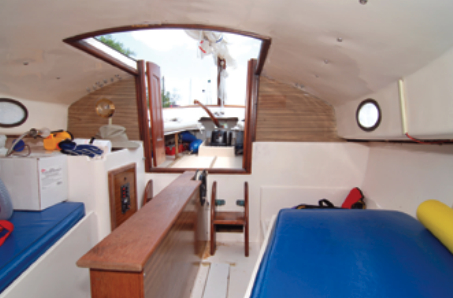
An 18-foot catboat offers a lot of accommodations for a boat of this length. This, of course, is due to its length-to-beam ratio of almost 2:1, and the fullness in the bow. The cabin is divided by the centerboard trunk but will allow two to sleep comfortably on the port and starboard bunks.
There is room for a portable toilet aft of the bunks on one side, and a minimal sink and galley flat on the other. That’s it for the belowdecks area. There is sitting headroom for anyone less than 5 feet 10 inches in height but no taller, except at the sliding companionway hatch, where you have all of God’s universe above you.
In theory, you could sleep four people on board — two belowdecks and two in the cockpit — but it would not be fun. All would have to be related as there is no good way to provide privacy for the head.
The cockpit is comfortable for two to four, though it is better with two. There is a traveler behind the aft cockpit coaming, and everyone needs to be aware of where the mainsheet is in case of an accidental jibe. It is easy to jibe a cat if one is not careful.
The traditional charm of a catboat is universal and this Herreshoff America catboat and her kin are living proof of the fun to be had, even if Sassy Cat’s appearance in the Paramount Pictures movie did end up on the cutting room floor.
Bill Sandifer is a contributing editor with Good Old Boat and a marine surveyor and boatbuilder who has been living, eating, and sleeping boats since the early ’50s. He and his wife, Genie, sail an Eastward Ho 32.
Thank you to Sailrite Enterprises, Inc., for providing free access to back issues of Good Old Boat through intellectual property rights. Sailrite.com