How collision regulations apply in real life
Issue 58 : Jan/Feb 2008
I studied the radar screen as the heavy cruiser USS Newport News crept through the night down the Lamma Channel into Hong Kong harbor. The screen showed hundreds of small craft rushing around the harbor at their various errands. This was not my problem; the captain was on the bridge, but I wondered how we would sort out the right of way in a situation like that. The answer was simple: at 717 feet on deck and 22,000 tons, we were one of the larger vessels moving about at that moment. We moved ahead at bare steerageway and let the small craft sort it out. This was not an application of the International or Inland Regulations for Preventing Collisions at Sea. This was an application of the Big Boat Rule.
A few years later, I was on the bridge of the same ship, which was then maneuvering near the beloved sea buoy 2 Charlie Bravo. We encountered a merchant vessel. She was in clear sight. CIC (Combat Information Center) reported the range and bearing, did a maneuvering board solution and advised that she was CBDR (constant bearing decreasing range). Vessels that are CBDR will collide if they both hold course and speed. I made a quick mental calculation of the applicable rules of the road and decided we had the right of way. The captain was on the bridge and, after a moment’s assessment, ordered a course change that would relieve the CBDR situation. We had the right of way, but we altered course. This was not an application of The International Regulations for Preventing Collisions at Sea. Nor was it an application of the Big Boat Rule. It was an application of the Golden Rule that supercedes all others: don’t hit anything, and don’t let anything hit you.
Frequent encounters
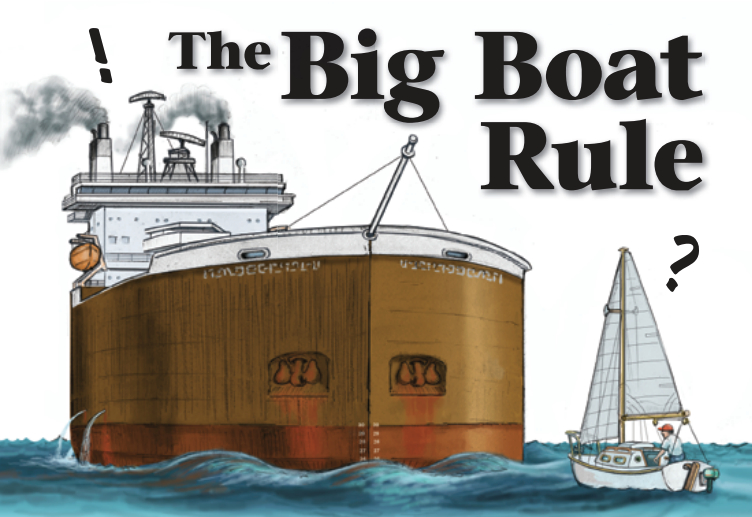
These days, Karen and I go to sea in a vessel of about four tons displacement and, because of where we sail, we frequently encounter large merchant vessels. I understand that it may be heresy to suggest this, but in such encounters, neither the Inland nor International Regulations for Preventing Collisions at Sea (Colregs) has much to do with the conduct of the vessels or the outcome of the encounter. In these cases, the Big Boat Rule applies.
The Big Boat Rule goes something like this: in situations where risk of collision exists, the vessel that can withstand the collision without significant damage will probably not yield the right of way to the vessel that will be significantly damaged if the collision occurs.
To understand all this, we need to go back to the Colregs and look at them a little more closely. The Colregs only apply to encounters between two vessels; they never address situations involving more than two vessels, so there are bound to be situations where they cannot be applied slavishly. The Colregs are actually very well thought-out and quite logical, but their original intent was to deal with encounters between ships. For example, other than in the Colregs section on lighting rules, vessels under oars are not mentioned and, therefore, by default, are only covered in the sections for all vessels. In my opinion, two principles guided the development of the Colregs: maneuverability and predictability.
In many cases in the Colregs the less-maneuverable vessel is given the right of way. This is logical, but not applied consistently. Should a rowing dinghy or kayak be required to maneuver to avoid a 45-knot powerboat holding course and speed and CBDR? Can a 5-knot sailboat motoring in a fog maneuver to avoid a merchant vessel traveling at about the speed of a WW II torpedo?
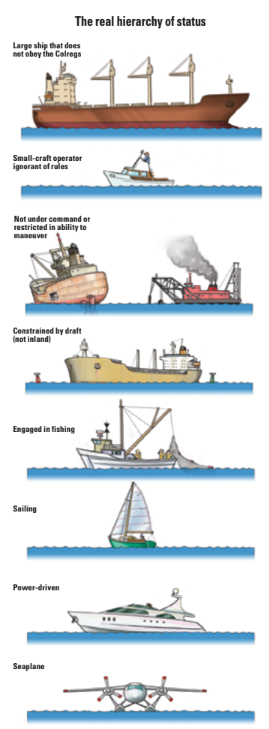
Not in Colregs
You will find no mention of predictability in the Colregs, but when the regs are working at their best, each of the two vessels in the encounter knows exactly what the other vessel is going to do and — if the prescribed behavior for the vessels does not allow for the likelihood of collision (or at least lessens it) — a collision will probably not occur.
In order to achieve predictability, the regs do not attempt to give the larger vessel the right of way since it might be difficult to quickly determine which vessel is the larger one. This leads to situations where a smaller vessel has the right of way over a larger vessel . . . at least in theory.
In actual practice today, there are three problems with this. The Colregs are not strictly enforced. Many small-craft operators do not understand the Colregs, and large merchant vessels will rarely acknowledge that a smaller craft, which cannot damage them, has the right of way. That is to say in encounters with smaller vessels, large merchant craft will almost always be guided by the Big Boat Rule.
If you press this apparent conflict between the Colregs and actual customary practice, merchant captains, instructors, Coast Guardsmen, and others will commonly offer you one or more of several half-baked waffles. They will say that the merchant vessel is in a channel and unable to maneuver. Or they will say it is in a traffic-separation zone . . . or that such large craft are simply unable to maneuver to avoid small craft. Any of these explanations may occasionally be true, but they do not explain the common behavior of large merchant vessels, which is to never accord the right of way to small craft that cannot damage them in a collision. They will apply the Big Boat Rule in channels, traffic-separation zones, and on the deep and wide blue sea. Even when they can, they won’t give the right of way to a small craft. It is simply not done. That is the real rule.
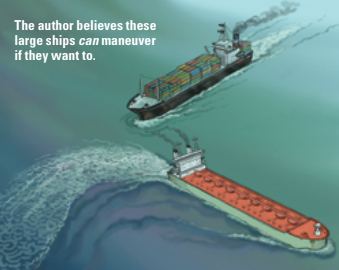
Other options
What should you do with a situation like that? The normal response is to try to explain the conduct of merchant craft by finding something in the rules that might justify this behavior. Nobody wants to say, “They are breaking the rules.” This tends to confuse helmsmen of small craft just when they need to be clear-headed. I propose a different approach that includes operating according to the Colregs as an option but does not consider them to be the only option.
Here is very different, but still simple, decision tree.
- A contact is detected and determined to be another vessel.
- Determine if the contact is CBDR.
a. If not CBDR, watch the contact but look for trouble elsewhere.
b. If the contact is CBDR, decide what rules of engagement are likely to be used in this encounter.- Remember that one authority thinks only 20 percent of small-craft operators are familiar with the rules of the road.
- Remember that large commercial craft will probably apply the Big Boat Rule.
- Remember the Golden Rule that supercedes all others: Don’t hit anything and don’t let anything hit you.
- If CBDR and yours is the give-way vessel according to the Colregs, you are in luck. Maneuver to avoid the other ves-sel while watching for the possibility that the operator will not understand his responsibility to hold course and speed. Maneuver in accordance with the Colregs if you can, but con- sider any maneuver that will alter the CBDR situation.
- If CBDR and yours is the stand-on vessel, you are not in luck; you are in danger, particularly if you are facing an adversary who is either ignorant of the Colregs or intends to apply the Big Boat Rule. Predictability is your friend here. Look at the chart for traffic separation lanes and for places in the area where the merchant vessel might be going. You need to allow for the fact that the merchant might do just about anything, but you can base your initial maneuvers on the likelihood that the ship will stay in a traffic lane if there is one and, in any case, it will hold course and speed, pretending you are not there. Or it may turn off to enter a nearby harbor.
The merchant holding to the Big Boat Rule is actually safer than the small boat operator who is not familiar with the rules of the road. Watch for the possibility that the other vessel understands its obligations and, if there is evidence that it does, attempt an encounter governed by the Colregs. Even if you take this approach, don’t completely trust the other vessel.
Finally, even if you are the stand-on vessel, it may be much safer to make an early maneuver to break the CBDR situation. This is a very attractive option because it puts you in control of the encounter. If you choose to maneuver, do it early, as soon as you conclude that there is a CBDR contact.
Reasons to cooperate
In summary, if you have strong reasons to believe that the other craft you encounter is going to maneuver according to the Colregs, by all means operate by the Colregs too. If you think you are dealing with vessels that are either ignorant of the Colregs or that will probably favor the Big Boat Rule, you must maneuver to avoid them. It is never wrong to make early maneuvers to break a CBDR situation and, no matter what other rules might be thought to apply, a merchant vessel can’t run you down if you take his stern.
There is a high-tech device that may help the small boat captain avoid collisions with large merchant craft. The AIS (automatic identification system) is a transmitter that all large civilian craft are required to carry. This device regularly transmits the name, location, course, speed, and intended destination along with many other bits of information. Simple receivers for small craft are available at a fairly reasonable price. These receivers don’t transmit, so you will not be seen by the merchants with this system, but you will see them, and in many cases their location and other critical data will show up on your chartplotter. If you know what they are doing, and what they intend to do, you can stay out of their way.
It is important to know the Colregs, but real life can be a little different. Don’t hit anything. Don’t let anything hit you.
Jerry Powlas brags that he has cruised halfway around the world twice (same half each time) courtesy of Uncle Sam’s Navy. Later he discovered sailboat racing and got into Flying Scots in a big way. He didn’t discover cruising sailboats until he met and married Karen Larson. Together, these two founded Good Old Boat magazine in 1997.
Thank you to Sailrite Enterprises, Inc., for providing free access to back issues of Good Old Boat through intellectual property rights. Sailrite.com