Dealing with potentially lethal gases
Issue 59 : Mar/Apr 2008
Aboard sailboats there are several toxic or explosive fumes that are potentially lethal and must be detected for the safety of the crew and boat. The most common dangers are from fuels, smoke, carbon monoxide, and propane or natural gas. The consequences from any of these vapors are serious enough to. warrant the small investment in a fume detector.
Fuel-vapor detectors
Fuel-vapor detectors alert boaters to the presence of combustible hydro-carbon vapors. In addition to gasoline vapors, they will also detect gaseous cooking fuels, and hydrogen, as well as some solvents and cleaning compounds. The remote detector type has a tiny detector located at a low point in the engine compartment (gasoline and propane fumes are heavier than air) and an alarm unit located where it will most easily be heard: in the cabin or on deck. Some fuel-vapor detectors have the ability to sound an alarm and also activate the bilge blower automatically.
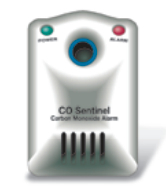
Carbon monoxide (CO) detectors
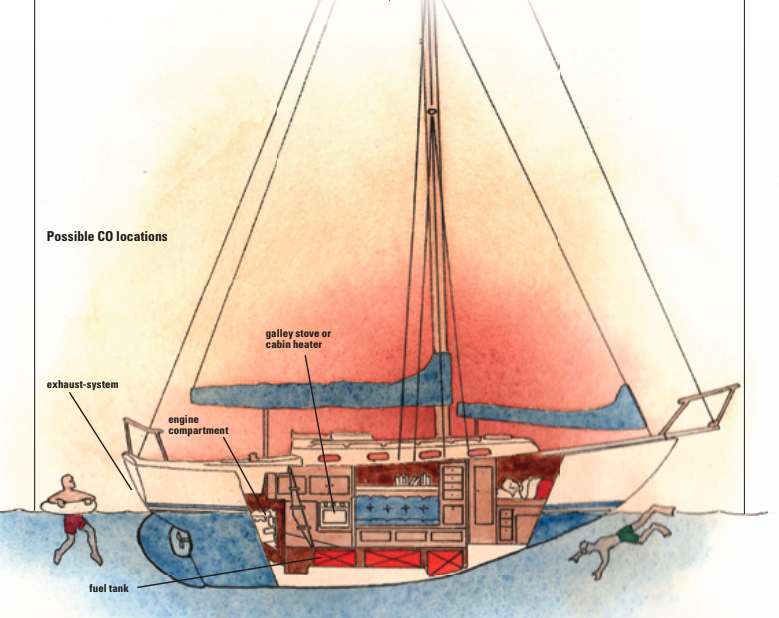
Every boat that has a cabin and potential sources of carbon monoxide should be equipped with at least one carbon monoxide detector. The American Boat and Yacht Council standards require a CO detector on every new boat with an inboard gasoline engine or generator. Most sailboats have more than one potential source of carbon monoxide. In addition to the gasoline or diesel engine or generator, most boats also have gas-burning devices for cooking and/or heating.
Carbon monoxide results from incomplete combustion and is present in the exhaust of any internal combustion engine or open flame. Carbon monoxide fumes are lighter than gasoline fumes. The inhalation of this colorless, odorless gas can overcome a person quickly. Carbon monoxide is absorbed into the bloodstream 200 times faster than oxygen. Initial symptoms of CO poisoning are dizziness and nausea, which are often mistaken for seasickness. Carbon monoxide poisoning can be fatal in just minutes; so a CO detector should be aboard all recreational boats.
Be sure that your detector is designed for marine use. The marine varieties can operate either from a self-contained battery or from the boat’s battery and are calibrated to a significantly different standard from the household variety. Your detector should also be UL-listed and able to compute the time-weighted average of the CO concentration, in order to eliminate false alarms.
Some CO detectors have the ability to shut down the generator when CO is detected.
When the engine or generator is running, there’s one place a CO monitor will be of no help. That’s when a swimmer is in the water near the exhaust when an engine or generator is running. There should never be anyone in the water next to the boat under these circumstances, especially if it is a gasoline engine.
Propane detectors
Propane is one of the most convenient and energy-efficient fuels that can be used for cooking or heating aboard. But if there is a leak, it is also one of the most hazardous. Any propane installation should also include a propane detector.
Although self-contained propane detectors are available, it is far better to have a detector of the remote-sensor type. This includes a sensor that is located at a low point within the hull, since propane fumes are heavier than air. Many remote detectors can provide more than one remote sensor and some models, in addition to the alarm, will provide an automatic shutoff at the propane fuel tank.
Natural gas detectors
A small percentage of boaters use compressed natural gas (CNG) for cooking and/or heating. Although more difficult to obtain, it has some inherent safety advantages. Natural gas is primarily methane and, since methane has no odor, an artificial “rotten eggs” odor is added to it to make detecting it easier.
Natural gas is lighter than air and a small leak may go unnoticed, since the gas will escape through hatches or deck vents. However, for those who wish to be on the safe side, and those with diminished smelling ability, a natural-gas detector makes sense.
Smoke detectors
Just as within a home, a smoke detector is an important warning device that should be located where it can most easily be heard in the sleeping area. Some marine smoke detectors operate on the boat’s batteries, while others operate on their own internal 9-volt battery.
Some other types combine more than one fume detector into a single unit, such as a combination smoke and CO detector.
Maintain your system
Just like batteries, the sensors in fume detectors wear out. Some detectors have a warning when this happens, but with others it’s up to the owner to keep a record of when the sensor should be replaced.
In case of alarm
Whenever a gasoline, propane, or natural gas detector goes off, vacate the boat immediately. Do not make calls from your belowdecks telephone or radio. Do not plug in or unplug any electrical appliances. Do not turn a light switch on or off and, of course, do not light a match.
Don Launer is a contributing editor with Good Old Boat.
Thank you to Sailrite Enterprises, Inc., for providing free access to back issues of Good Old Boat through intellectual property rights. Sailrite.com