How two sailors became publishers
Issue 61: July/Aug 2008
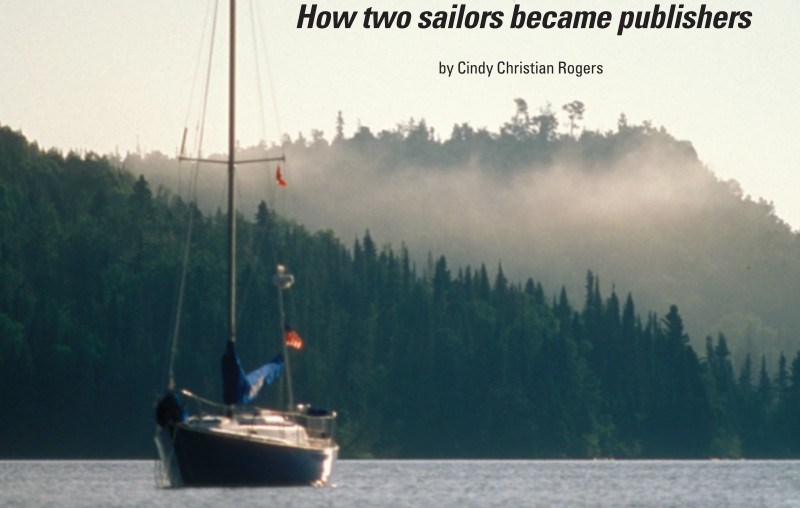
It all started at anchor, the setting that buoys so many dreams. One foggy September day in 1997, two sailors huddled aboard their 30-foot C&C among Lake Superior’s Slate Islands. They wouldn’t glimpse any caribou, but perhaps they could see the future.
“What should we do when we grow up?” the captain asked his mate. He had just left his engineering job, eager to embrace a new challenge after 29 years designing products for manufacturing companies.
Replied the mate, herself ready for a change after running a successful desktop publishing business for 10 years, “Let’s launch a sailing magazine. How hard can it be?”
Tucked away in a storm hole, Jerry Powlas and Karen Larson couldn’t imagine just how hard creating Good Old Boat would turn out to be. But they had gone there to float ideas, and they grabbed onto one that combined Jerry’s background as a naval officer and mechanical engineer with Karen’s expertise in writing, editing, and public relations. Besides, they each had a history of innovation as well as a willingness to change course.
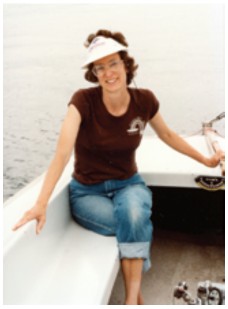
Jerry, who always had an aptitude for “technical stuff,” chose to earn a psychology degree and then pursue an engineering career, working his way up to director of engineering and acquiring six patents. Karen completed two bachelor’s degrees and a master’s in modern languages, journalism, and public relations, using her skills at a variety of companies before starting her own business, no small venture for a single mother. Each grew up in Indiana and, in search of better jobs, moved to Minnesota, where they met in midlife. And each learned to sail as an adult, compelled by curiosity rather than family heritage. They were as undaunted by the prospect of producing a magazine as children starting a lemonade stand. “Only we didn’t know anything about lemons,” as Karen now says. Or about how many resources this grown-up stand might require.
At first they thought to publish a magazine modeled after Catalina Mainsheet but directed toward owners of other fiberglass production sailboats. Familiar with DIY Boat Owner, they opted not to do another publication with solely technical content. As Karen puts it, “We decided to include editorial about the art of sailing, why we sail, and why we work on older boats.” They came up with the term “good old boat,” which they defined as a vessel 10 years or older. They would celebrate pride of ownership, enabling sailors to share maintenance, upgrade, and refit tips with fellow owners of diverse models and sizes of sailboats, including ones that have gone out of production. They wouldn’t cover powerboats and trawlers or brand-new seafaring palaces, and they would avoid an implied pecking order of sailors based on dollars invested in boats or gear. They would emphasize cruising rather than racing, featuring not circumnavigations to exotic locales but the kind of sailing weekend and vacation sailors would do — and on the budgets weekend sailors tend to have.
Getting underway
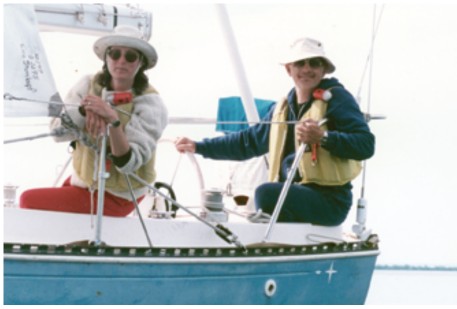
“One of the attributes of your boat has to be that you can afford to own it,” Jerry believes. “Many wonderful boats have been out there sailing for 30 or more years. Unlike cars of the same vintage, they haven’t rusted. They just keep sailing.” None of the then-existing magazines catered to this special group of boatowners, which essentially meant . . . themselves. “We are the readers and they are us,” Karen says, a theme highlighted in the tagline: The sailing magazine for the rest of us! Yes, they would launch a magazine, and while they were at it, they’d build a community of good old boaters.
Magazine professionals know that coming up with an editorial vision is daunting enough; translating the concept into a self-sustaining business is another matter altogether. By choosing to create a magazine they would want to read, Jerry and Karen created what is called a niche publication. It proved a clever move financially because it simultaneously defined their market and limited their investment demands.
Back at home in a suburb of Minneapolis, they decided to publish Good Old Boat as a bimonthly, which they would produce themselves, without advertisers, relying on subscriptions to fund the enterprise. “We were standing in the kitchen discussing what to charge per year, and Karen picked $39.95 out of the air,” Jerry recalls. “Her reasoning was that two people could go to dinner for that amount.” Surely hard-core sailors would be willing to give up one meal in a restaurant to learn new ways to save money on their boats.
They did a simple spreadsheet to see how many copies they could afford to print. The answer: 5,000. They would debut the magazine the next June and canvass subscriptions in the meantime. They didn’t waste time: the very month after their brainstorming session, they organized a phone and email campaign to conduct informational interviews with editors of boating magazines and books, and they made lists of sailing associations, charter operators, cruising guide authors, and boating friends to contact. Knowing little about what magazine marketers call audience development, they relied instead on word-of-mouth and what publicity they could garner by their own efforts. They spoke at sailing clubs and mentioned the magazine to recipients of their holiday letter. They drafted a press release and sent it to publications from Professional Boat-Builder to Caribbean Compass.
In December they began developing material for the premier issue and established a website to attract contributors; the first copy featured articles by Nigel Calder and Don Casey but also a schoolteacher and several artists cum sailors, a mix of sailing “names” and regular “folks” that has remained a hallmark of the editorial pages. They also began building a database of people who wanted to receive a copy of the magazine after it was published. “If the Internet had not been where it was in 1997-98, we wouldn’t have been able to start the same way,” Karen says. “We could not have afforded to send out subscription offers by mail.” The Internet also made it easier to assemble a list of owners’ groups, which they printed in the debut issue.
Once they had that issue in hand, they redoubled efforts to sign up subscribers. They had about 500 takers from the website, so they sent everyone two polybagged copies with a note suggesting, “Surely you have a sailing friend you can give the extra copy to.” They dropped off magazines anywhere they thought potential readers might come across them — yacht clubs, marine retail shops, the cockpits of boats bobbing in marinas. “We thought once people saw our nifty content, they’d buy it,” says Jerry. The supposition paid off. Their efforts generated 2,600 subs by the end of 1999.
Among those whose attention they attracted were cruising icons Lin and Larry Pardey. “We happened upon the first issue just after we arrived in the U.S. after spending two years in European waters,” Lin says. “It caught our attention because we’d talked on the passage about the difference between American yachting magazines and Practical Boat Owner, the biggest-selling British sailing magazine. ‘All the American mags seem to assume everyone has lots of money, always wants new boats, and can afford to pay someone else to fix things,’ I said. ‘Maybe we should start a do-it-yourself yachting magazine,’ Larry said. Well, the first edition of Jerry and Karen’s magazine looked an awful lot like what we had been thinking about, so we visited them that winter. Afterward I told Larry, ‘I owe them a thank you note for far more than a delightful stay in their home. I have to thank them for putting together the magazine because now we don’t have to do it!’ ”
Adding crew
Jerry and Karen had made headway with fellow sailors but recognized they needed help with the business end of magazines, with such intricacies as postal regulations, circulation and list management, and advertising sales, an area they saw as increasingly worthwhile for both the business and their readers. Two publishing experts showed them those ropes. “After sailing my Typhoon one day,” recalls Bill Hammond, a Minneapolis-based literary agent and author of the maritime novel, A Matter of Honor, “I wandered into the yacht club and picked up issue #1 because it had a Cape Dory on the cover. I noticed it was being published locally and I called to say I was fascinated.” With his business partner, Bill Dorn, a legendary publisher and consultant in the Twin Cities magazine industry, as well as Jack Culley, owner of Sailboats, Inc., a marina management, brokerage, and charter company based in Superior, Wisconsin, he formed Good Old Boat’s business advisory board. “We served as cheerleaders in the early days,” Hammond says. “Later we served as a sounding board for matters like newsstand distribution and ad rates.”
If a boat is a hole in the water you pour money into, then a magazine is a hole on land. Only one in 10 titles makes it to its first anniversary; few of those are publishing five years later. The reason: enormous capital outlays that are hard to recoup. Jerry and Karen took a different tack. They had no investors, preferring to build “brick by brick,” using their own savings and what they could earn from the magazine itself. “The conventional publishing path was beyond our reach, so we simply didn’t approach the magazine conventionally,” Jerry explains. “We dodged going around to banks with a hat in our hands.” Karen adds, “There are two kinds of entrepreneurs, those who follow a plan and those who follow a dream. Jerry and I are definitely in the dreamer category.”
The dreaming — and careful spending — paid off; by the third year they had developed a rhythm. “We were running on creative energy and enthusiastic feedback from readers, but the growth was steady enough to keep us going, although,” Karen smiles, “it was like buying a new car every other month — with cash.”
They never thought of giving up, even during their biggest crisis in year three when they fingered one last check and sweated out the wait for subscription renewals. (The magazine now enjoys a renewal rate of 67 percent, a figure most other publishers would covet.) Jerry and Karen had found what they would do when they grew up. And the magazine grew up too, reaching 12,000 readers by the end of 2001 and 20,000 by the end of 2002. Circulation today numbers about 30,000, including subscriptions, a sampler program offering free issues to prospective subscribers, and newsstand sales, which began in November 1999. Most readers live in the U.S. or Canada, but subscriptions are delivered to such farther-flung locales as Australia, Brazil, and Scotland.
As for advertising, “we originally thought it would be a big hassle,” Karen notes, “one more thing to manage, and we didn’t want high-powered ads anyhow because they weren’t consistent with the editorial content. Classifieds fit in right away, but then real companies called up, asking to buy ad space.” These companies, many run by sailing enthusiasts, offered a wide-ranging array of services and products of value to readers. Today the magazine boasts 125 advertisers, which accounts for the full page devoted to each issue’s ad index.
Harnessing gear
The magazine’s editorial pages also have grown in sophistication without losing their grass-roots appeal. Layouts have more variety and color, type is easier to read, graphics are engaging. Such enhancements have gone hand-in-hand with advances in the hardware and software tools that revolutionized magazine production over the last decade. Jerry and Karen became early adopters, and technology continues to play an integral role in their endeavors, notably on the recently redesigned website, which offers online book and logo merchandise sales, as well as a regularly updated marine suppliers’ directory, searchable index of articles, and perhaps the most extensive list of owners’ associations anywhere. Nowadays, the site averages more than 24,000 unique visitors a month.
As the magazine’s visibility grew, Jerry and Karen no longer could function as a do-it-yourself team. During the summer of 1999, they began pressing others into service. Good Old Boat now draws on the skills of a virtual staff that helps prepare issues, process subscriptions, sell and place ads, whatever it takes to get the magazine into readers’ hands. Additional crew members help manage the website, produce a print and electronic newsletter and CD-ROMs of back issues, mount exhibits at national boat shows, and develop spin-off products, such as audiobooks.
Navigating life
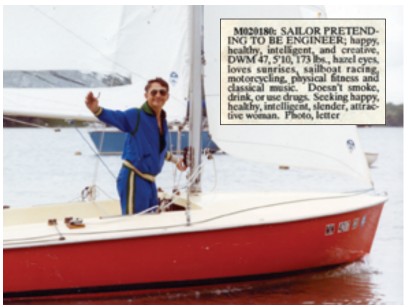
But Jerry and Karen remain at the helm, an appropriate place for two people who have shared a zeal for sailing since Karen answered a classified that began: “Sailor pretending to be engineer.” She joined Jerry racing a Flying Scot on Lake Minnetonka, a 14,000-acre lake just west of the Twin Cities, but she soon asked, “Isn’t there more to this sailing thing than going around the same buoys?” Married in August 1991, they chartered a Catalina 30 on their honeymoon, then started looking at cruising boats, although they told each other they weren’t really interested in buying.
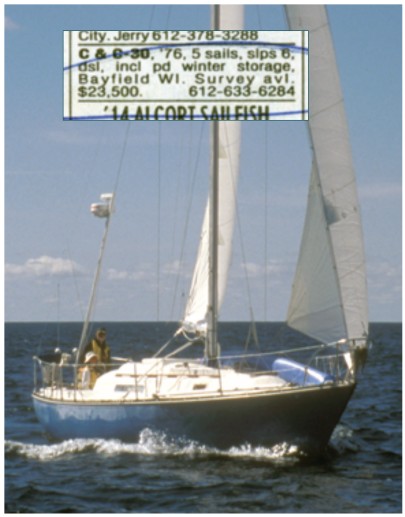
Another classified ad sealed their fate: in one Saturday newspaper, there among the Sunfish and Lasers, appeared an ad for Mystic, the 1976 C&C 30 on which Good Old Boat came into being. As Jerry tells it, “Karen called the number and talked for an hour. When she hung up, she said I had to call the guy back. I talked for an hour too. When I got off the phone, Karen and I discussed the thing like people pretending to be rational adults. The next day we drove five hours for a test sail. When we were clear of the hazards I took the helm. ‘This lady can dance,’ I thought. Mystic will be ours as long as she and I can still sail.”
Sailing remains their chief enthusiasm, even as they make time for family; between them, they have three grown children and three grandchildren. Production schedules don’t permit the longer voyages they covet, although in recent years they’ve juggled responsibilities to allow for trips up to three weeks long, most often on Lake Superior where they enjoy wilderness sailing. They share their adventures with readers, including a 2005-06 passage through the Soo Locks into the North Channel of Lake Huron. Since returning to Superior, Mystic can be found in Thunder Bay, Ontario, and Jerry and Karen plan to sail along the Canadian shore this summer.
Fitting out
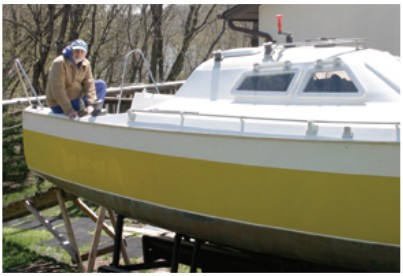
Then there’s the C&C Mega 30, the 1980 trailer-sailer that will extend their cruising range. Since February 2003, readers have watched their struggle to refit this boat, a venture that has not gone as quickly as envisioned. Even so, they live their business philosophy, working on the Mega as time and finances allow. Other activities follow suit: Karen cans with a pressure cooker and knows her way around a sewing machine, making upholstery for their boats; Jerry enjoys hiding out in his home workshop, fashioning water tanks for the Mega, among other projects. They drive a modest car and a truck whose most compelling feature is the Good Old Boat logo on its windows. Jerry’s one indulgence is a red BMW motorcycle, which he’s been known to take for a spin even on brisk autumn days. Karen bikes too, on a “good old bicycle,” transporting magazine proofs in a backpack when weather permits. Both are avid readers of all kinds of fiction and nonfiction; they especially savor the audiobooks that accompany them on their drives to Mystic or to boat shows.
Sometimes they work en route to or onboard Mystic, with Karen reading manuscripts aloud for discussion. But most of Good Old Boat is still produced out of a 1970s-vintage tri-level that sits a couple of lots off Fish Lake, a humble member of Minnesota’s famed 10,000 lakes, just northwest of Minneapolis. Boating memorabilia adorn the walls — racing plaques and photos of sailboats, favorite anchorages, Jerry’s Navy ship. (Jerry served three years on the U.S.S. Newport News, with two tours in Vietnam.) Karen’s study upstairs and Jerry’s workspace downstairs abound with computers, scanners, and printers, all networked together, with a high-speed Internet connection to Transcontinental, their printer in Winnipeg, Manitoba. Yet, despite installing all this electronic wizardry on behalf of the business, they do not own a television.
Fathoming success
These are people who have achieved success by not following the pack, who take pride in a simple lifestyle, who prefer decisions based on common sense rather than detailed business plans, whose choices might come across as unorthodox. They have never put article titles on their covers, for example, even though the vast majority of magazine editors recoil at such a heretical approach. Jerry and Karen, however, prefer to let the ambience of sailing speak for itself, featuring cover photographs — and occasional illustrations — of sailboats in picturesque settings. And they don’t automatically adopt what many business owners might presuppose as standard operating procedure. Jack Culley recalls how Jerry at first refused to accept credit cards: “I argued with him, we virtually had a confrontation. I kept saying a small percentage of something was better than 100 percent of nothing.” Ultimately Good Old Boat did take credit cards; its owners may be unconventional but they’ve never lost their willingness to change course when conditions warrant.
These are people, too, who offer free subscriptions to soldiers and hurricane victims, who will adjust deadlines to accommodate a staffer’s travel plans or another’s son’s baseball game, who will make lunch for everyone who happens to be on site, serving it on the dining table that doubles as conference table. In the case of Karla Sandness, their financial manager, Jerry and Karen not only celebrated her wedding and relocation to North Dakota but were willing to set her up as a telecommuter to keep her in the Good Old Boat family. It is a family that extends far beyond their staff, out into that boating community they sought to engender. “Over the years my writing has yielded numerous successes but also its share of rejections,” says Gregg Nestor, a freelance writer and Good Old Boat contributing editor. “While not everything that I’ve submitted to Good Old Boat made it to the printer, each rejection was accompanied by an insightful comment containing some sliver of guidance or encouragement. It is this type of personal professionalism that has inspired its contributors and readers alike.”
Jerry and Karen’s regard for their readers is visible on every editorial page. “They had a wonderful conversation with readers right from the start,” says Bill Dorn. “They found sailors who truly love their good old boats and provide them with information they want and need.” They routinely address readers directly in print, clarifying terms and how-to steps, with editors’ notes sprinkled throughout articles. Nowhere is this more evident than in the Mail Buoy, the letters to the editor department, where a running dialogue takes place between editors and readers — and between readers and readers. So far, more than 1,500 voices have shared their boating experiences, whether via letters, short tips, or full-length articles. “Readers have good ideas,” Jerry says. “Our publishing model is really not a magazine model, but a journal model. We apply a tight filter so that only the best material goes into print, but the ‘amateurs’ — our readers — are thoughtful and enthusiastic. Even the readers who never contribute will know the magazine is theirs.”
Jerry contributes his engineering insights, evaluating ideas and techniques used to maintain, repair, and restore sailboats. Karen deploys her early career experience as a feature writer, profiling boats and boaters with equal aplomb. They each write a column per issue, sharing their sailing philosophies and opinions on topics from the joys of sailing to federal boating legislation. Watching them prepare an issue is a study in complementary personalities. Jerry takes the lead on technical and strategic matters while Karen prevails as wordsmith and master scheduler. As Pat Morris, an editor and proofreader who has known Karen for nearly 20 years, describes it, “Karen has no ego. She doesn’t whitewash the realities. Meanwhile, Jerry’s engineering brain keeps asking what’s next. He has an intimate sense of how things work, and if he doesn’t know, he’ll damned well find out.”
As for what’s next for Good Old Boat, Jerry says, “We can do a better job of serving our niche, looking for new and better ways to increase subscriptions.” As they continue fine-tuning the magazine, they will also energize their newest initiative, a line of audiobooks, which feature classic and likely-to-be classic tales of sailing and the sea. “We will start anything we think to be in harmony with our readers’ needs,” Jerry adds, including podcasting.
Eventually, they might wish to train the staff to carry on in their absence. They’d own the magazine but not demand much from it financially, preferring instead to spend more time sailing. It is a plan consistent with Karen’s primary definition of success: “We have created lifestyle jobs for ourselves and others.” But she’s also proud that other magazines have rediscovered classic plastic, and she suspects good old boats will endure because they are extensions of who we are or want others to believe we are. “We invest heavily in our boats in terms of time and money but also subconsciously,” she says. “Each boat represents beauty, pleasure, recreation, travel, opportunity, home, a passionate endeavor that we can never truly explain.”
The same could be said of Good Old Boat. After 10 years of issues, Jerry Powlas and Karen Larson remain devoted to their love of sailing, to the enterprise that has grown from it, and above all else to each other. “They love each other, respect each other,” says Bill Dorn. “I’m not sure the magazine would work without both of them.” Bill Hammond adds: “They’re humming along on their own wind. Their humanity comes through on every page. One day at lunch I turned to Karen and asked, ‘What’s it like to be a publisher?’ She said, ‘I’m not a publisher, I’m a sailor.’ ”
So how does launching a magazine compare with launching a boat? Karen says, laughing, “We spent more money and time launching a magazine.” Jerry puts it this way: “I would never take the kind of chances we’ve taken with the magazine with a boat. We could die doing that!” Members of the Good Old Boat community, whether they be readers, contributors, advertisers, or vendors, are no doubt delighted that Jerry and Karen took those chances in print — and that the most impulsive action they’ve taken on the water has been to drop anchor in the Slate Islands and dream up their good old magazine.
Cindy Christian Rogers is an award-winning magazine writer and former magazine editor, publisher, and launch consultant. With the captain of her heart, Randy, she has sailed everything from cutters and cats to iceboats and “good old wood.”
Thank you to Sailrite Enterprises, Inc., for providing free access to back issues of Good Old Boat through intellectual property rights. Sailrite.com