Converting battery power to alternating current
Issue 62 : Sept/Oct 2008
An inverter is an electronic device that converts direct-current (DC) power (the output of your boat’s battery) to alternating-current (AC) power. Although onboard generators (gensets) are necessary for equipment such as refrigerators and air conditioners with high power requirements, the inverter is a good choice for smaller power needs or when high power is used intermittently. There are countless varieties and options available when you’re shopping for an inverter. Prices range from less than $30 to thousands of dollars. Although wattage is important, the waveform output of the inverter and what it is going to power can also be deciding factors.
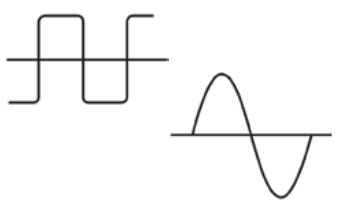
The square wave (left) is the simplest alternating current that can be produced by an inverter. It will operate most appliances, but when used for extended periods with electric motors, these motors may tend to overheat. This is the most common waveform produced by small and/or inexpensive inverters.
Inverters’ waveforms
Inverters come in two basic varieties. One produces a square wave (or a stepped square wave, sometimes called a modified square wave). The other produces a true sine wave similar to the AC waveform supplied by the power company or a genset.
Some electronic equipment will not work well on a square wave and, because there is no simple way to change that square wave into a sine wave, an inverter with a sine-wave output will be necessary. It is always better to purchase an inverter that puts out a pure sine wave if there are no budgetary constraints, but sine-wave inverters are significantly more expensive than the square-wave-output inverters.
It’s easiest and cheapest to create a square wave. A square wave works well for most devices, such as power tools and computers. However, a square-wave inverter will produce horizontal lines on a TV, whereas a sine-wave inverter, which has a waveform for which the TV was designed, will not.
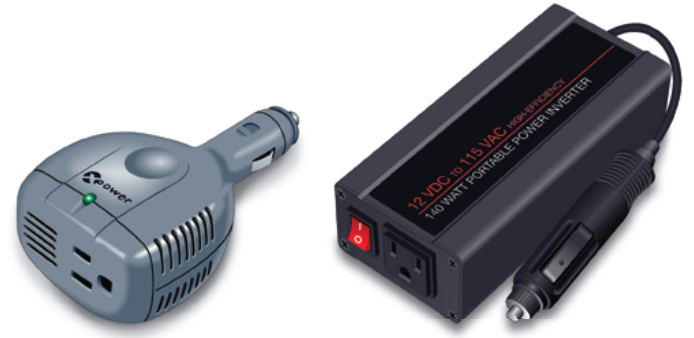
For powering equipment with low-wattage requirements, the small-sized square-wave inverter that plugs into a cigarette lighter outlet works just fi ne. Since most cigarette lighter sockets are fused at 15 amps, the appliance being powered should not draw more than 150 watts.
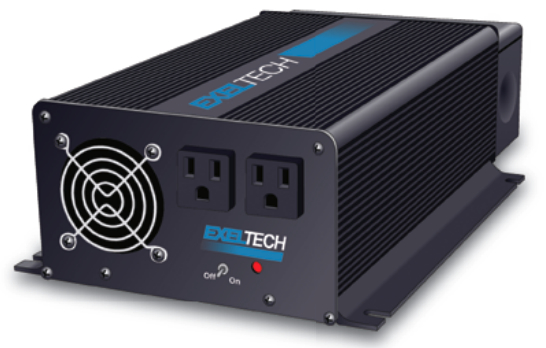
For powering equipment with higher wattage drains, such as large-screen TVs and microwave ovens, a larger inverter that is wired directly to the battery is necessary. The inverter should be close to the battery to eliminate losses in the wiring connecting them.
Battery drain
You can easily determine the current (amps) being drawn from your battery when your inverter is providing power to any 120-volt appliance since:
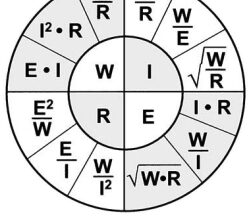
wattage = volts x amps
Using this formula, you’ll note that an appliance rated at 240 watts will draw 20 amps from a 12-volt battery when powered by an inverter:
240 watts = 12 volts x 20 amps
In reality, the amperage will be slightly more than 20 amps; the exact amount is determined by the inverter’s efficiency rating. When choosing an inverter, fi rst determine the maxi- mum number of watts you anticipate using and for how long.
The choice of a genset or inverter is not mutually exclusive. Both systems can live aboard together and serve different functions.
Many high-wattage inverters also have a sophisticated control panel that allows you to monitor the number of amp-hours that have been consumed and calls your attention to a low battery with an alarm. But those amp-hours taken out of the battery have to be replaced by the alternator on your engine or by shorepower, a genset, solar panels, or a wind generator.
Frequency concerns
One additional concern is that while the power company supplies an AC frequency of 60 cycles per second (60 Hz), inverters don’t necessarily create the exact frequency unless they are crystal-controlled. This could cause problems with appliances that are frequency-sensitive, such as equipment using synchronous motors, as well as some TVs and computers.
There are also units that combine an inverter with a battery charger. Some of these units automatically switch to the battery-charging mode, either when the genset is turned on or when you plug into shorepower.
If you want the AC outlets on board to automatically switch from shorepower to the output of an inverter, this can be accomplished with a double-pole-double-throw (DPDT) relay. With the relay contacts in the “at rest” position, shorepower is connected to the AC outlets on board. But when the inverter is activated, the relay is energized and the onboard outlets are switched to the output of the inverter. Be sure to purchase a marine-grade relay that is made for this type of service.
A 1,000-watt inverter that doubles as a 50-amp battery charger when connected to shorepower is an excellent choice, even for a fairly small good old boat.
Don Launer, a Good Old Boat contributing editor, has held a USCG captain’s license for more than 20 years. He built his two-masted schooner, Delphinus, from a bare hull and sails her on Barnegat Bay in New Jersey.
Thank you to Sailrite Enterprises, Inc., for providing free access to back issues of Good Old Boat through intellectual property rights. Sailrite.com