Complying with regulations
Issue 63 : Nov/Dec 2008
It seems that recreational vessels anchored without anchor lights are more the rule than the exception. However, the International Regulations for Avoiding Collisions at Sea (known as COLREGS) require any anchored vessel whose length is between 7 and 50 meters (approximately 23 feet to approximately 164 feet) to show an anchor light visible from 360 degrees for 2 nautical miles in fine conditions.
It is worth noting that both the COLREGS and Inland Rule 30(e) of the U.S. Coast Guard Navigation Rules go on to state, “A vessel of less than 7 meters in length, when at anchor not in or near a narrow channel, fairway, or where other vessels normally navigate, shall not be required” to exhibit an anchor light.
In addition, it is important to know Inland Rule 30(g), which stipulates that a vessel of less than 20 meters in length, when at anchor in a special anchorage area designated by the Secretary of Homeland Security, also is not required to exhibit an anchor light. (A 20-meter vessel is approximately 65 1⁄2 feet long.) Often these special anchorages are inside busy harbors or close to marinas and are usually, but not always, enclosed by solid magenta lines on the chart with “special anchorage” printed within or just outside that designated area. (The fog signal requirements of Rule 35 for an anchored vessel are similarly waived within these special anchorages.)
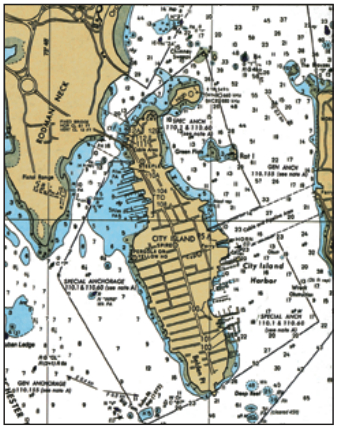
So, just because an anchorage exists, is shown on the chart, and may be defined and administered by the state, county, or local government, that anchorage does not automatically become a designated special anchorage, and an anchor light is required.
Masthead anchor lights
It takes about 5 1⁄2 candlepower to make a light visible for 2 nautical miles in fi ne weather. This candlepower can be obtained either by using a 5-watt incandescent bulb and a Fresnel lens or by using a kerosene (paraffin) light with a 1⁄2 -inch-wide wick and a Fresnel lens. (Fresnel can be pronounced either as “frez-nel” or with its original French pronunciation, “fray-NEL.”)
Both the COLREGS and Inland Rule 30(b) state that when at anchor, “A vessel of less than 50 meters in length may exhibit an all-round white light where it can best be seen . . . ” Most sailboats show an anchor light at the masthead. Although this is a convenient location, it is not the optimal spot. Better to have the anchor light near the bow of the boat and low enough so it also illuminates the deck. This is by far the best location, since boaters going through an anchorage are normally looking straight ahead and not up in the sky for anchor lights.
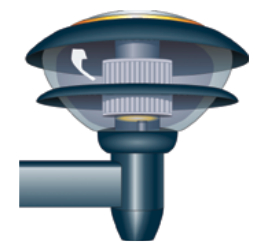
If you do use a masthead light, an incandescent bulb has several drawbacks. One is that it uses more power than other types of bulbs and has a relatively short life. Plus, the long wire up the mast must be of a suitable gauge so the bulb receives enough voltage to meet the 2-nautical-mile visibility requirement.
A better solution is the LED (Light-Emitting Diode) bulb, which has a much longer life (more than 100,000 hours) and uses less electricity. LED bulbs for anchor lights are available as retrofits for many existing anchor-light housings.
Also, some LED lights have circuits that allow their maximum brilliance to continue down to a supply voltage of 10 volts. And since some are also “bipolar,” the polarity of your existing wiring is unimportant. Others have a very rapid pulse-repetition rate, much faster than the eyes’ persistence of vision, with duration of the “on” pulse varying with the battery voltage. This conserves battery power while still maintaining the 2-nautical-mile visibility requirement. Some LED masthead anchor lights have a photocell that turns the anchor light on at dusk and off at dawn, while other
LED masthead anchor lights are solar-powered and completely self-contained. These lights have a solar panel mounted on top of the anchor-light housing and a photocell to turn them on and off. Consequently, such lights have no battery drain.
Rigging-hung anchor lights
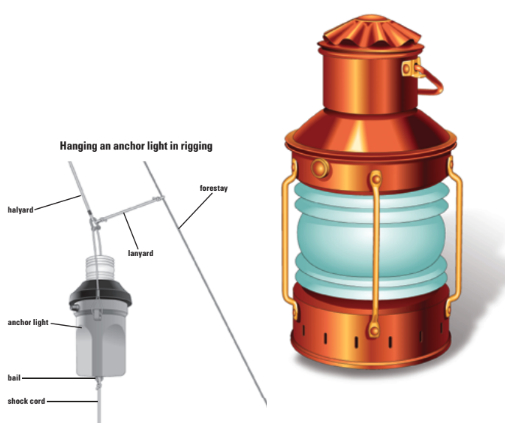
Although the masthead anchor light is certainly the most convenient way of complying with regulations — just by throwing a switch — many sailors opt for an anchor light hung low in the rigging. This not only provides 360-degree light and 2-nautical-mile visibility, but it also illuminates the deck. This makes the anchored boat even more visible and provides a deck light that can be handy for those unexpected middle-of-the-night deck chores.
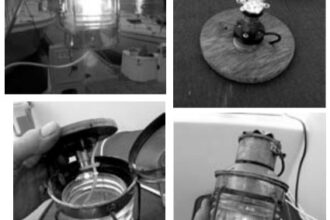
There are many small electric lights available with self-contained batteries that can handle this job. But many sailors prefer to use a kerosene anchor light. Kerosene lamps burn easily in gale winds, are readily available, are made of solid brass, and have a Fresnel lens that directs the beam horizontally. (See “The Lantern Ritual,” in the January 2008 issue.)
Portable electric or kerosene anchor lights can be hoisted using a halyard, with a short lanyard to hold them to the forestay or shrouds. Most have a semicircular metal ring on the bottom (a bail), which is handy for attaching a shock cord to prevent the light from gyrating wildly when the boat rocks. These lights can also be used for interior lighting in an emergency.
Don Launer, a Good Old Boat contributing editor, has held a USCG captain’s license for more than 20 years. He built his two-masted schooner, Delphinus, from a bare hull and sails her on Barnegat Bay in New Jersey.
Thank you to Sailrite Enterprises, Inc., for providing free access to back issues of Good Old Boat through intellectual property rights. Sailrite.com