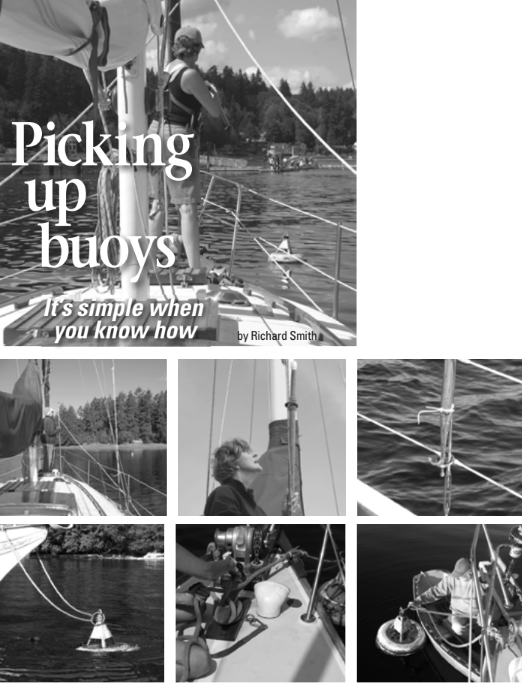
It’s simple when you know how
Issue 63 : Nov/Dec 2008
Coastal cruisers looking for overnight shelter are apt to find three choices: a marina berth, an anchorage, or a public mooring buoy. Many prefer the familiar routine of entering and leaving a slip. Bow, stern, and spring lines are readily available and crew members know how to use them. If they don’t, fellow yachtsmen along the dock will lend a hand. There’s shorepower, good restaurants, long hot showers, shopping, instant camaraderie, and varied entertainments for any nautically challenged teenagers on board.
Other sailors like to anchor. They see a visitor’s dock as all-too-familiar territory and seek a contrast to the way it is back home. They look for a place of their own choosing, far from the madding crowd. Isolation, independence, and the practice of skills that bring them closer to nature — to what life on shore is not — are their goals.
Whether our preference is for marinas or anchorages, like it or not, we all may soon be spending more nights lying to mooring buoys. In some environmentally sensitive areas, anchoring is being prohibited and mooring buoys installed, partly because of the damage anchors and chain can do to the seabed and partly to provide an alternative to building new marinas. Apart from their role in preserving marine environments, however, there are several advantages unique to mooring buoys.
First of all, we can be reasonably sure that mooring to a public buoy is secure. We’re unlikely to drag because of inexperience, bad holding ground, strong winds, or shifting tides. And so are our neighbors lying to windward of us.
For some of us, there is also the advantage of simplicity: fewer lines to handle — and shorter and drier lines too. There are no anchor and chain to lift, no anxiety about scope, and no mud in the chain locker. In tidal areas, there’s less worry about going aground at low water.
State or provincial mooring buoys are often located in strong tidal streams and on exposed shores where views can be spectacular but anchoring may be hazardous. Dinghy distance to shore is often shorter than it would be anchoring out, an advantage for anyone taking a dog to the beach on dark and windy nights. Among the gaggle of dinghies to be found nearby is often a special conviviality, something between the society of a marina and the solitude of a remote anchorage.
Buoys have downsides though: they tend to be placed in areas of high use, near popular attractions. This can make for noisy nights, especially when your neighbors raft up in great gangs. In tidal areas the buoy may nudge (if you’re lucky) or slam (if you’re not) against the boat. This can put a swath of dullness in the gelcoat and/or an end to a good night’s sleep.
How to do it
Mooring to a buoy requires a different set of skills than coming alongside a marina berth or anchoring. A lack of familiarity with the practice can make it intimidating to some skippers.
Think ahead. Have a plan. Notice which way the wind’s blowing and the set and speed of the current marked by water disturbance around the buoy. Look at the orientation of other boats but understand that differing underwater shapes and displacements; currents and windage; and mooring techniques cause boats to act differently as they lie to their moorings.
Your approach should be slow and controlled. It pays to make a pass around your target buoy to judge its condition. My wife, Beth, and I have found buoys that had no lifting rings and others that were barely above water, submerged under a weight of kelp — a sign of poor maintenance. At the same time, check depths and calculate the amount of water available as you swing toward shore at lowest tides. Groundings at mooring buoys are not unknown.
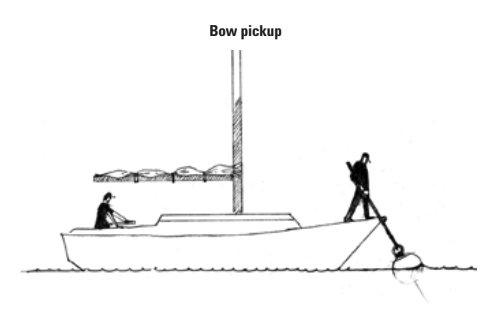
Bow pickup
My preferred pickup method is to have the crew (Beth) make ready our 3/4-inch bridle (the thickness is more for chafe than tensile strength), bending the eyesplice end to the mooring cleat, leading the rest through the port bow chock, under the anchor sprit, and up to the starboard side, where the free end is neatly coiled on deck and ready to slip through the ring. The final arrangement should be carefully inspected to ensure that everything is where it should be.
Beth then points the boathook at the buoy, which should wind up nudging a spot just to starboard of the bow. We close the distance (some skippers like their crew to count off the distance on approach in feet or meters), I stop the boat, and Beth hooks the ring and holds the boathook tightly with both hands (see illustration on page 22).
I put the gear in neutral (a common mistake is to leave the engine idling in gear) before I walk forward and take the boathook from Beth. She then slips the free end of the bridle through the ring and starboard chock before bending it to the bow cleat.
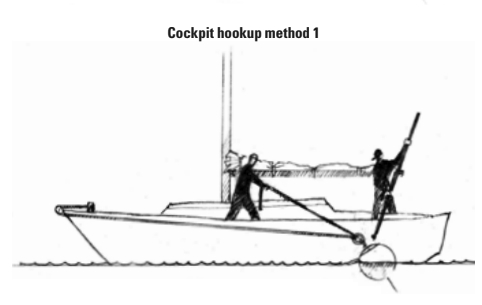
Cockpit pickups
Method 1 – Secure a line to the bow cleat, take it through the starboard chock, across the bow, and back to the cockpit on the port side, running outside all, and temporarily make it fast. We use the jibsheet cleat. The cockpit is brought alongside the buoy, then the line is slipped through the ring (sometimes with the help of the boathook). Then we walk it back to the bow quickly, coiling the line along the way (see illustration on page 22). It can then be secured to the cleat or otherwise bridled as the boat falls back with the wind and/or current.
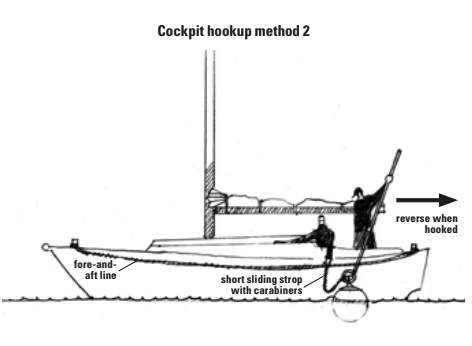
Method 2 – Make a line fast between the bow and stern cleats, running outside everything on the port side. The cockpit is brought alongside the buoy and stopped. A short strop, about 18 inches long and fitted with carabiners at either end, is attached between the fore-and-aft line and the buoy ring and let go (see illustration on page 22). The boat is backed down until the strop and buoy are almost to the bow. The engine is placed in neutral and the buoy secured with a mooring line or bridle.
These methods, of course, can be used singlehanded or with a crew, but given a crew, I prefer the bow pickup. A strong current and a heavy buoy can combine to cause the buoy to disappear beneath the boat as you work it forward. Although I’m not sure why, I’m also in the habit of making cockpit pickups on the port side and bow pickups to starboard.
My friend, Gary Stoop, prefers to make a bow pickup when singlehanding. With the bow as close to the buoy as he can get it, he puts the engine in neutral and walks forward with the boathook. Gary’s got command of his boat, a good eye, over 8 feet of boathook, and a mighty left arm.
The boathook
Collapsing aluminum boathooks should be handled with suspicion or not at all when picking up buoys. They have a habit of jamming or collapsing at awkward times.
We haven’t had much luck with the type of patented hook that puts a mooring line through the ring. We had trouble hooking a ring lying on the opposite side of the buoy one time and gave up. The rather light plastic molding didn’t inspire confidence either. Friends, however, swear by these hooks, but they always have a solid boathook available, just in case.
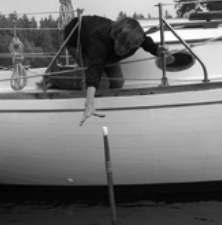
I made our Douglas fir boathook years ago. It’s 6 feet 4 inches long and varies between 1 and 1 1/4 inches in diameter. It could be longer but Beth thinks it’s more manageable this way — less to get tangled up in the forestay, lifelines, and so on. It’s fitted with a bronze hook, and the wood is shaped and weighted carefully so that, if dropped overboard, it floats vertically about 19 inches out of the water. (Gary reports that his off-the-shelf closet-pole boathook floats a mighty 31 inches above the water!) On board it’s attached to a cap shroud in a method described by Glyn Judson in the May 2005 issue of Good Old Boat. I’ve painted the handle white to make it easier to spot and grab if it slips overboard.
The bridle
Some single-line painters are led over bow rollers or bent to bow cleats on one side or the other. Some powerboats moor to buoys from the stern. Our bridle seems to work well for us. Kuma doesn’t tend to “sail” over the buoy as some boats do, although I suspect this has as much to do with her scimitar keel and low windage (no dodger) as it does our bridle.
Although the bridle can be made of almost any fiber, polyester double-braid is my recommendation. It’s so short that elasticity is not a significant factor, and qualities of strength, UV-resistance, internal friction, and abrasion all favor polyester double-braid.
Distance from the buoy varies between boats. One formula sets it ideally at about two-and-one-half times the distance of the stemhead fitting from the water. Ours seems to work well in most conditions at a little less than that. Good advice would be to experiment with your boat in varying conditions.
The bridle should be fitted with antichafing gear at points of wear. Garden or plumbing hose or lengths of split fire hose will work well where the line runs through chocks. Rawhide is traditional, purposeful, and when well stitched, brings credit to any sailor. We’ve wrapped our bridle at the chocks with lengths of old canvas.
Points of wear at the ring should be inspected after each use. A carabiner or other metal connector would be possible (and perhaps less apt to chafe), but the sound of clanking could drive you nuts. After 10 years of moderate use, our 3/4-inch braided Dacron bridle shows few signs of wear.
One of the joys of lying to a buoy is the quickness and ease of leaving it, but a rambunctious night can result in twisted lines that bind on the ring. If the ring cannot be reached from the deck, take the dinghy up to the buoy and flop the ring over and over to straighten it out before leaving.
Most of all: plan ahead. Go slowly. Learn to put your boat exactly where you want it. Maintain good tackle and remember that it’s better to go around again than to keep stabbing at an elusive ring. Find a method that works for you and stick to it.
Richard Smith is a contributing editor with Good Old Boat. He has built, restored, and maintained a wide variety of boats and sailed them in Michigan lakes, Oregon reservoirs, and the Irish Sea. He currently sails Kuma, an Ericson Cruising 31, with his wife, Beth, in their home waters of the Pacific Northwest.
Thank you to Sailrite Enterprises, Inc., for providing free access to back issues of Good Old Boat through intellectual property rights. Sailrite.com