A roomy coastal cruiser that’s fun to sail
Issue 63 : Nov/Dec 2008
In 1963, brothers Howard and Peter Hughes of Willowdale, Ontario, formed a partnership to build dinghies. Their venture was quite successful, and by 1968 their product line included auxiliary sailboats ranging from 22 to 48 feet.
Wanting to diversify, U.S. Steel bought Hughes Boat Works Limited in 1969 and changed the company name to Northstar Yachts Limited. Concentrating on performance boats, the new company introduced eight racers. However, despite the boats’ racing prowess, Northstar disappeared from the marketplace in 1975. Howard Hughes purchased the defunct Northstar Yachts in 1977 and renamed it Hughes Boatworks, Inc. With the focus redirected toward family cruisers, business improved dramatically.
When Columbia Yacht Corporation of Costa Mesa, California, went bankrupt in 1979, Howard bought it and renamed his new company Hughes-Columbia. Using the designs of Alan Payne and William Tripp Sr., seven new models plus five reworked Sparkman & Stephens designs were introduced under the Hughes-Columbia name. Due to the debt incurred by the acquisition of Columbia Yachts, which was compounded by a deep recession and high interest rates, Hughes-Columbia went into receivership. In 1982 the factory was closed and the business sold to Aura Yachts, which unfortunately was unsuccessful in making a go of it.
Around 1986, after the failure of Aura, Howard again entered the picture and bought the assets. He concentrated on building a custom 41-footer, as well as branching out into one-piece fiberglass swimming pools. In 1991, the combination of a catastrophic fire and a fraudulent insurance company closed the plant for good. Howard leaves a legacy of 3,500 boats and, for several years, his company was the largest Canadian sailboat manufacturer.
Design
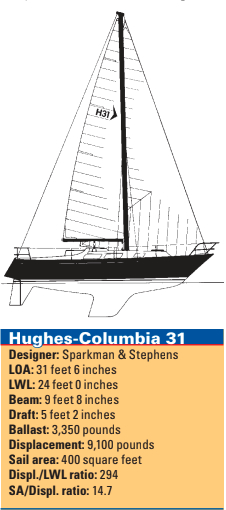
While under the ownership of U.S. Steel, Northstar Yachts hired Sparkman & Stephens to design six boats ranging from 25 feet to 36 feet. One of them was design #2098-6c, marketed as the Northstar 1000 (NS1000). Subsequent to the formation of Hughes- Columbia, the NS1000 was modified to become the Hughes-Columbia 31 (HC31), and it remained in production until 1982. The changes included rolling out the sides to create tumblehome and stretching the transom.
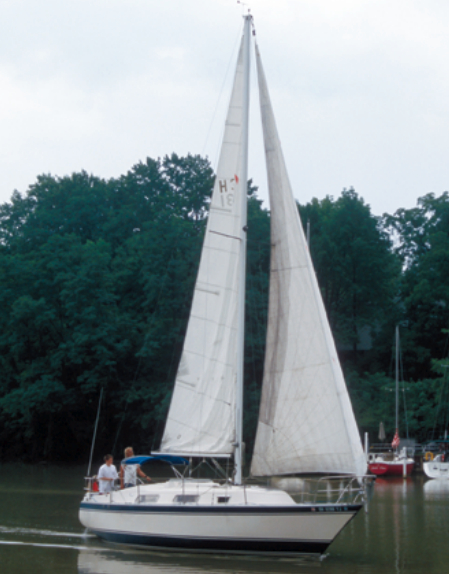
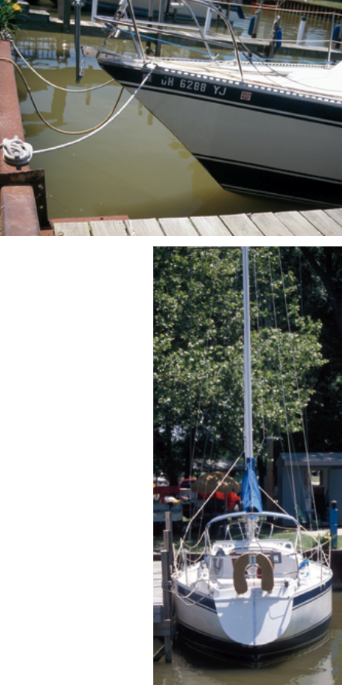
Even after the modifications, the design of the HC31 was still highly influenced by the International Offshore Rule (IOR). The boat features a bald clipper bow and a modern reverse counter that is very narrow and pinched. The long bow and moderate stern overhangs are connected by just a hint of curvature in the sheer. Those sections of the topsides forward of amidships are flared, and the tumblehome of the Northstar 1000 is no longer in evidence. The boot stripe and wide cove stripe cleverly camouflage the boat’s moderate freeboard, while a generous coachroof crown minimizes the cabin’s height. The boat’s appendages are typical of ’70s styling, including a slightly swept-back fin keel and a rudder attached to a skeg.
Construction
Both the hull and deck of the HC31 are solid hand-laid fiberglass. Prior to mating these two parts, a molded fiberglass pan was glassed into the empty hull. This pan incorporates the engine bed, berths, and most of the other “furniture.” In addition to the pan, there’s a fiberglass headliner. These two interior components not only stiffen the boat structurally, but also greatly speed up construction. The hull-to-deck joint appears to be an inward-turning, overlapping flange that’s been chemically bonded and mechanically fastened with closely spaced bolts through a slotted aluminum toerail.
The wooden bulkheads and cabinetry are marine-grade plywood that have been veneered with mahogany. All trim, plus the overhead handrails, are solid wood. The galley counter and chart table are finished in an off-white plastic laminate, and the sole is teak and holly. Exterior brightwork is minimal and limited to the companionway trim, hatchboards, and sometimes the cabintop handrails.
Underwater, there’s a 5-foot 2-inch fin keel comprising a solid lead casting and a solid fiberglass spade rudder mounted to a moderately sized skeg. All chainplates are electrically bonded to the keel. Deck hardware is of good quality and is properly through-bolted with backing plates.
At one time, the HC31 was widely marketed as a “kit boat” for amateur completion; however, most were factory finished.
Deck features
An anchor roller is incorporated into the boat’s stemhead fitting, while a pair of mooring chocks are situated outboard at the forward terminus of the slotted toerails. Owing to the sharpness of the bow, the foredeck is a bit on the narrow side. Even with this being the case, the area is fairly clutter-free, except for a 10-inch cleat mounted directly in the foredeck’s center. The sidedecks are a generous 18 inches wide and allow easy movement. Outboard, they are flanked by dual lifelines that terminate at stainless-steel bow and stern pulpits.
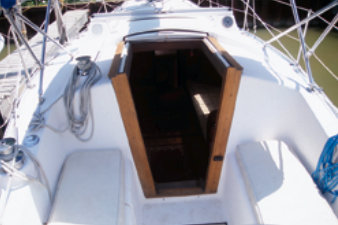
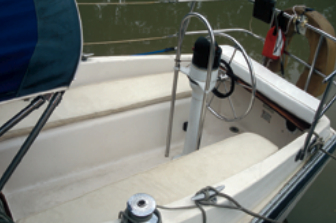
Forward, on each side of the cabin trunk, is an opening portlight followed aft by two larger fixed portlights. Situated on the cabintop are a forward opening hatch, a pair of cowl vents, port and starboard grabrails (either stainless steel or wood), and a sea hood. The cockpit is T-shaped and, owing to the boat’s IOR-influenced design, small. The cockpit seats are 5 feet long; beneath the port one is a sail locker that also houses the fuel tank. There’s no bridge deck to help prevent water in a pooped cockpit from cascading below. There is, however, a pair of 1 1⁄2-inch cockpit scuppers. Unfortunately, their openings are raised about 3⁄16-inch above the cockpit sole, which precludes the cockpit from draining completely.
Belowdecks
The interior was undoubtedly a strong selling point of the boat, and for the most part the belowdecks finish is well done.
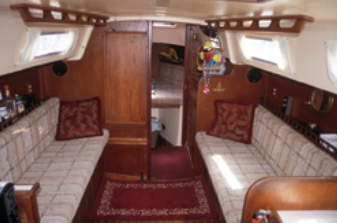
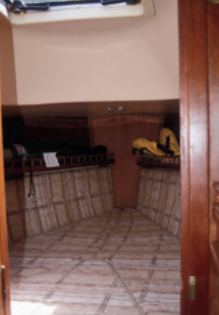
The layout is conventional, with a V-berth forward, followed by a head to port and a hanging locker-and-bureau combination to starboard. The V-berth is 6 feet 4 inches long and, with its insert, 5 feet 3 inches at its widest. Above is a pair of shelves and beneath are the holding and potable water tanks. The head features a marine toilet, a single stainless-steel sink, hot and cold pressurized water, and a shower with teak-grated sump that drains to the bilge. A double-duty wooden door offers privacy to either the V-berth or the head, depending upon which way it is swung.
The saloon consists of opposing settees and a bulkhead-mounted table. While the port settee converts into a double berth, the starboard settee is a fixed single berth. The space beneath the port settee houses the hot water heater, the inverter, and the 110-volt breakers.
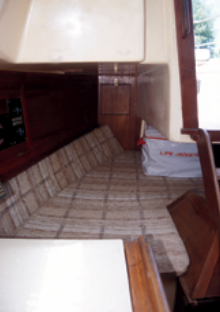
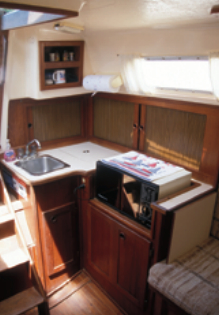
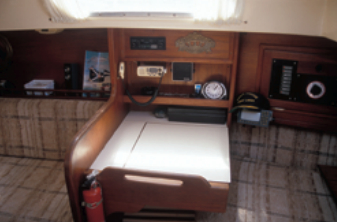
The L-shaped galley, with its single sink, icebox, pressurized alcohol cooktop, and flip-up counter extension, is to port. Across from it is the forward-facing navigation station with a lift-up chart table. A spacious quarter berth follows directly aft. The 12-volt electrical panel is situated above and at the head of the quarter berth; the batteries are housed beneath. At the foot of the quarter berth is a removable panel that accesses the cockpit locker.
There is plenty of stowage above, behind, and below the settees and quarter berth, as well as in the galley. The settees and quarter berth are 6 feet long, and headroom measures 6 feet 1 inch.
The rig
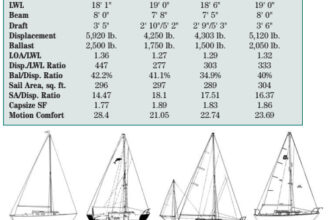
The HC31 is rigged as a masthead sloop. Its mast is deck-stepped and supported by a pair of cap shrouds, a single pair of spreaders, fore and aft lower shrouds, a headstay, and a single backstay. Comprising a main and a 100% foretriangle, this high-aspect-ratio sloop has a sail area of 400 square feet.
A pair of Lewmar #7 halyard winches is mounted on the mast. The headsail’s sheets are led aft through snatch blocks that can be infinitely positioned on the slotted toerails and terminate at two-speed Lewmar #30 primaries. The main is sheeted mid-boom to a cabintop traveler and is controlled by a third Lewmar #7 that’s mounted to port on the cabintop. Other sail controls include jiffy reefing, a vang, an outhaul, and a topping lift. The halyards, outhaul, and topping lift are led internally.
Under way
The HC31’s fin keel and lean hull form make for good upwind sailing performance. Its speed, seaworthiness, stability, and balance are average, if not slightly above. Its PHRF rating is 186. In comparison, a Ranger 30, another late-’70s design, rates between 168 and 174, and that old stalwart, the Catalina 30, usually rates 180 or 192 in fleets around the country.
The boat’s best point of sail is upwind. The boat, like many other IOR boats, isn’t known for great handling under a spinnaker.
Whisper, the review boat, is equipped with a 15-hp, raw-water-cooled 2GM Yanmar diesel and a 15-gallon fuel tank. Access to the engine is excellent and easily achieved by removing the companionway stairs and the cabinetry housing the engine.
Things to check out
Most complaints seem to be age-related rather than chronic production-related faults. These include leaking portlights, tired rigging, and the effects of poor maintenance.
In general, the overall integrity of the hull and deck structures seems to be above average. Unfortunately, the HC31 was widely marketed as a “kit boat” for amateur completion. As such, there’s a chance that the interior of some boats may suffer from less than professional workmanship.
Also, some boats were fitted with inexpensive 15-hp OMC Saildrives. This gasoline engine is essentially a de-tuned 30-hp outboard motor and is the least desirable auxiliary. Fortunately, many boats have been re-powered with diesel engines.
Conclusion
The Hughes-Columbia 31 is of fundamentally good design and can represent excellent value if it is in good shape and reasonably well-equipped. It’s fun to sail and makes for a roomy coastal cruiser. Most HC31s are located in Canada and range in price from $19,000 to $35,000.
Gregg Nestor is a contributing editor with Good Old Boat. His third book, currently at the publisher and yet to be titled, is a comprehensive handbook for trailersailors. His wife, Joyce Nestor, is responsible for most of the photos associated with articles by Gregg. The two choose between cruising Lake Erie aboard their Pearson 28-2 and trailersailing their O’Day 222.
Thank you to Sailrite Enterprises, Inc., for providing free access to back issues of Good Old Boat through intellectual property rights. Sailrite.com