Pick up a mooring with grace and élan
Issue 66 : May/Jun 2009
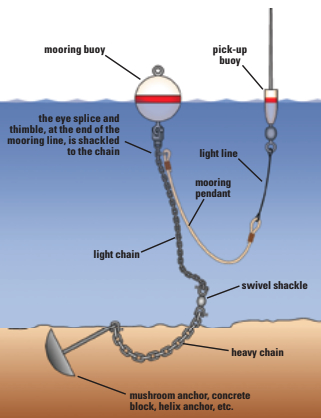
A mooring-and-buoy system consists of an anchor, a length of chain, and a mooring buoy that both holds up the chain and marks the location of the mooring. The anchor may be a mushroom anchor, a block of concrete, a helix anchor, or simply an old engine block. The size of boat the mooring can safely handle depends on the size of the chain as well as the size and type of anchor it’s attached to.
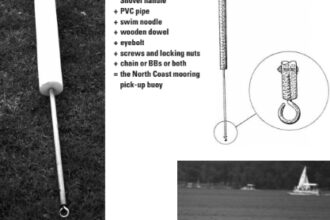
The buoy normally has a ring on top so it can be easily picked up with a boathook, but many moorings will also have a rope mooring line, or pendant, attached to the chain, with another small buoy at the end of this line to facilitate snagging it with the boathook. Sometimes this small pick-up buoy will have a vertical fiberglass whip, 4 to 6 feet tall, so the pendant can be brought aboard without the need for a boathook.
Picking up a mooring buoy is not always easy, especially in a strong wind, if a rapid tidal current is flowing, or when you’re sailing alone. If you don’t catch hold of the mooring on the first try, it’s usually not a problem. Ignore the critical gaze of sailors on nearby boats and act as though it were a practice run.
If you plan to pick up a mooring in an unfamiliar location, first check with the yacht club, marina, or harbormaster to be sure that the mooring is adequate for your boat. You don’t want to pull an undersized mooring out of the bottom. Sometimes the maximum boat size will be marked on the buoy itself.
Well-managed mooring buoys are pulled up and inspected annually and worn or corroded parts are replaced. The frequency of inspection required in salt water is much greater than in fresh water. If weed growth on a mooring buoy appears excessive, it’s a good indication that the mooring hasn’t been serviced in a long time.
Picking up a mooring
The most basic method of picking up a mooring is by using a boathook to either pick up the mooring line or, if there is no mooring line or pendant, to snag the ring on top of the buoy. In all but the smallest of boats, you should know when you’re doing the pickup not to try to hang on to the mooring ring with the boathook if the boat is swept away from the buoy. When this happens, you’ll probably be unable to release the hook from the buoy and the boathook will either break or be ripped from your hands.
If the mooring buoy has no mooring line attached, you should have a mooring line already fastened to a bow cleat and be prepared to connect this line as quickly as possible to the buoy’s ring.
Communicate with signals
During the last stages of the approach the buoy will be lost from the view of the helmsman, so the pick-up crew should use signals to guide the helmsman’s actions. It’s of vital importance that the boat not run over the buoy’s pick-up line. To prevent an unfortunate incident with propeller and mooring line, the pick-up crew must be able to communicate with the helmsman.
Hand signals are much more effective than shouting. Every crew that works together seems to develop its own set of signals. Whatever those signals are on your boat, all aboard should understand and use them.
After the buoy becomes invisible to the helmsman, the pick-up crew should point at it with an outstretched arm so the helmsman will know where it is and can maneuver accordingly. When it’s time for the helmsman to put the boat’s transmission in neutral, the pick-up crew should give him a specific signal. This might be a slashing motion across the throat indicating, “Cut,” or a raised clenched fist, as used by the military, police, and heavy-equipment operators. A palm held backward often means, “Go into reverse.”
The solo sailor
Picking up a mooring presents special problems when you’re single-handed. It’s usually impractical to pick up the mooring from the bow because you lose sight of the buoy from the helm during the final approach. By the time you reach the bow, the boat will have fallen off, leaving the mooring out of reach. A far better way for the solo sailor is to fasten a long mooring line to a bow cleat and lead it back to the cockpit, outside of the shrouds and the lifelines. Now you can complete the pickup without making a mad dash to the bow. Once the boat is attached to the mooring, you can shorten the pick-up line and properly fasten it to the mooring chain.
Special equipment
Things are a bit more difficult when there is no mooring pendant or pick-up buoy. Fortunately, several handy inventions are available to assist in the pickup. These are especially useful for the solo sailor or when sailing with a novice crew.
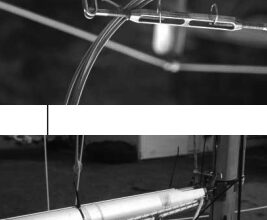
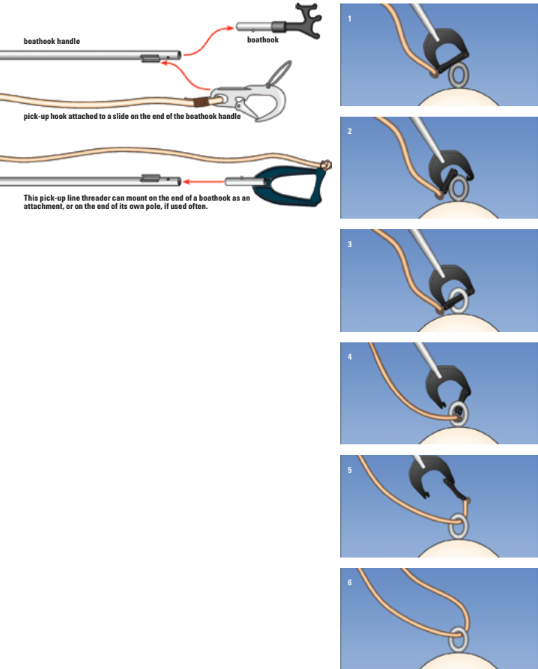
In one method, a snap hook at the end of a mooring line attaches to a slide at the end of the boathook. When the hook is snapped onto the mooring buoy’s ring, the hook and mooring line slide off the boathook track and the boathook handle can be pulled away smoothly.
Another ingenious device actually threads the mooring line through the ring at the top of the mooring buoy with one simple motion, pushing the line through one side of the ring and retrieving it on the other side. When leaving the mooring later, you can let go one end of the line and pull it through the ring, thus eliminating the need to pull up the mooring buoy.
Don Launer, a Good Old Boat contributing editor, has held a USCG captain’s license for more than 20 years and has sailed the East Coast from Canada to the Caribbean. He built his two-masted schooner, Delphinus, from a bare hull.
Thank you to Sailrite Enterprises, Inc., for providing free access to back issues of Good Old Boat through intellectual property rights. Sailrite.com