A boat’s bow says a lot about its behavior
Issue 69 : Nov/Dec 2009
In my first column (September 2009), I established the terminology I will use. In this issue and the next, I will apply those terms to the bow and stern to touch on how their shapes affect performance and handling. This is a complex subject and there is some danger in looking at parts of the boat independent of the whole boat, but I will try to tie it all together. I’ll focus on the shapes we’re likely to find in the typical good old boat built in the last 30 years.
The hull shape of today is the scientifically perfected shape we see on most of the box-rule boats like the Trans Pac 52s. The simplest box rule dictates the dimensions of a box into which the hull must fit — like an open shoe box. The type of rule we usually see today is a box within a box where the outer and inner boxes dictate the maximum and minimum allowed dimensions of the hull. In both cases, limits are added to cover draft and sail area. With the specific allowable dimensions that form a box rule, designers very quickly find out what works and what doesn’t. In Europe, where the International Rule (IRC) is now the dominant handicap or rating rule and a static, at-rest waterline is measured, designers have been getting the best results by putting almost all the overhang in the stern. The hull shapes of today are very effective but I miss some of the more diverse, and sometimes wacky, older shapes.
We will start at the bow. We’ll treat stern overhang in the January 2010 issue. I want to be certain that you do not lump bow overhang and stern overhang together. They do very different jobs. This is a touchy subject because I know many sailors subscribe to the theory that overhangs in general increase the sailing length of the boat once it heels over. That’s true of the stern overhang but to a far lesser degree in the bow. That is why the near-plumb stem is so prevalent in today’s new designs. If you want the maximum boat speed and volume for a given overall length, then bow overhang must go.
Prismatic coefficient
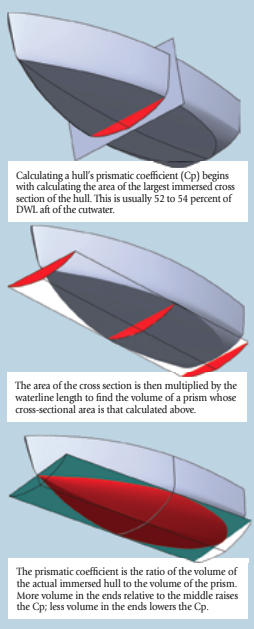
The effectiveness of bow overhang is a function of the distribution of volume along the length of the hull. You can identify the character of a boat’s distribution of volume by its prismatic coefficient (Cp). This measures the fineness or fullness of the immersed hull. To quantitatively measure the effect of overhangs, you need a much more complex calculation involving “second moment lengths” at various heel angles. These were first used in the International Measurement System (IMS) rule and indicate how much more speed you get as you heel and overhangs immerse. That calculation is beyond the scope of this article, so we will rely on our eyes and some representative shapes.
Prismatic coefficient sounds complex but is simple. It’s just a number, usually between 0.50 and 0.56 for sailing vessels, that indicates how much relative volume there is in the ends of the boat compared to the maximum volume near the middle of the boat. A low Cp of 0.50 indicates a boat with very fine ends. A high Cp of 0.56 indicates a boat with full ends. By “full,” I mean more volume. The textbook “medium” Cp is around 0.54. The keel is not included in this calculation. In a boat with a wineglass mid-section and full garboards, this is a problem because there is no clear distinction of where the hull ends and the keel begins. Modern boats with distinct hulls and fin keels are easy. If it’s a classic wineglass section, it’s up to each designer to decide how he will calculate the Cp.
The important thing, as the Cp will be used to compare hull forms, is to do the calculation the same way each time. A low Cp means the hull will be easy to push through the water but your ultimate hull speed will be lower than a similar boat with a higher Cp. The higher the Cp, the higher the potential hull speed, as the bow and stern waves get pushed farther apart. Planing powerboats have Cps up around 0.7 but at low speed they are very inefficient as they drag their big fat transoms though the water, creating a lot of drag.
The primary problem with the Cp calculation is that it combines the bow and stern volumes in one equation. A boat could have a very full stern and a very fine bow but the Cp would not reflect this. I suppose you could cut the boat in half and do a Cp for each end, but I have never done this and I don’t know any designer who does. Over the years, I have always compared the Cps for my designs and I now have a pretty accurate feel for what the Cp does, how it works, and how to use it.
Bow overhang and volume
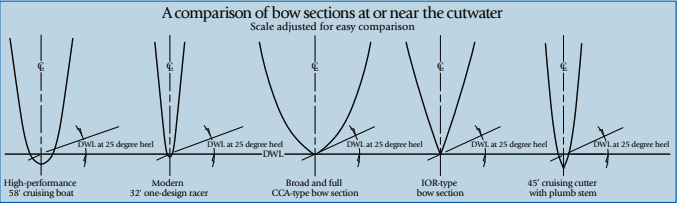
The problem with thinking that bow overhang extends the design waterline (DWL) when the boat is heeled is that most bows are relatively fine and there is just not enough volume in the bow of most sailboats to change the overall distribution of volume. If you heel over a typical bow from 30 years ago — say a hull influenced by the International Offshore Rule (IOR) with straight bow sections — the bow pretty much just lies on the water and does not move volume forward to any significant degree. If you go back farther than the IOR, to the days of the Cruising Club of America (CCA) rule, bows were much fuller and you could argue that they were more effective when heeled. You would be right, but not by much. Look at the odd bows of the last few America’s Cup boats. Those shapes are rule-driven and an effort to push as much volume forward as the rule would allow.
Today, we know the bow should cleave the water and not shoot a plume of water up the stem face. The energy it takes to create that geyser of water at the stem, called affectionately by the old timers a “bone in its teeth,” is drag — energy deducted from the boat’s forward motion. The bow wave should peel cleanly off the hull immediately aft of the stem with as little fuss as possible.
The handicap rule influence
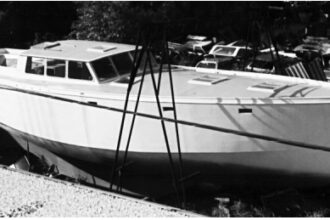
Bow shapes very often reflect the influence of the prevailing handicap rule of the day and exactly how that rule measures “sailing length.” The typical bow section of an older CCA type, like an Alberg 35, is quite full and rounded at the stem, a result of the way the CCA measured sailing length. The topsides bulge out in what they used to call “flam,” as opposed to the bow sections of a boat like my own Valiant 40 that show concave “flare.”
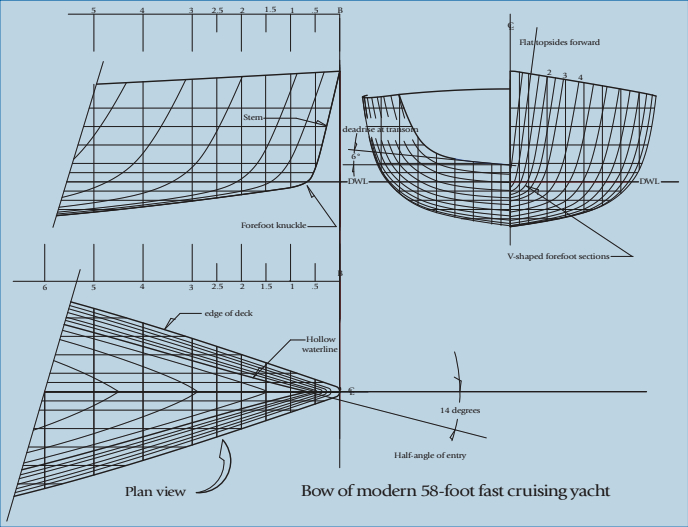
The IOR-influenced types, like a Tartan 37, show almost a straight line in section from the cutwater to the sheer — no flare, no flam. In “plan view,” that is, looking down on the boat, the typical high-performance boat of today has a very fine bow with half-angles of entry (the angle made between the DWL in plan view and the centerline) of less than 16 degrees. You even see designs now that use a concavity, or “hollow waterlines,” forward in order to reduce the half-angle of entry.
The half-angle of entry for older boats, like the famous Phil Rhodes racer, Carina, is 24 degrees. Carina’s bow section at station 0, the cutwater, shows considerable fullness or flam and the forefoot section is a deep, sharp V. The racer of today will have dead-flat, almost vertical, topsides sections at the bow and a rounded, bullet-like, shallow forefoot, a shape that retains a narrow half-angle of entry while volume is pushed forward. For reference, Bill Lapworth’s Cal 40, the boat that marked the end of the CCA’s dominance of American handicap racing, had a half-angle of entry also of 24 degrees. IOR boats brought the half-angle of entry down to around 19 degrees.
Benefits of full bows
However, there are definite benefits to bow overhang. Fullness forward can make for a dry boat when you are punching into waves. Back in the days of the America’s Cup Class (Note: The future of the class, and the America’s Cup, is currently cloudy. –Eds.), designers found that bows with overhang seemed to quiet down the motion of the boat compared to the chopped off “dinghy” or “destroyer” bow. But this is not your Grandpa’s bow overhang. This AC bow had an extremely fine half-angle of entry of around 13 degrees.
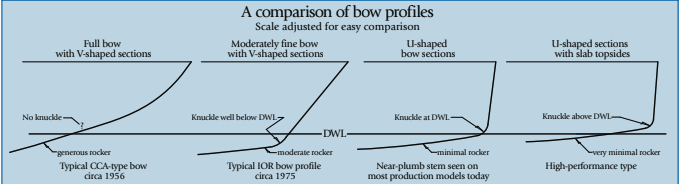
I prefer some bow overhang to get the anchor and chain clear of the stem. A full bow will generally have more deck space forward, and this is handy for deck gear and working on the foredeck in rough weather. Given the pragmatic benefits of a full bow, I still think it is safe to say that a fine bow is faster. If you want to read more about bow shapes I devote an entire chapter to bows along with comparative VPP (Velocity Prediction Program) runs in my book, Yacht Design According to Perry.
In the January 2010 issue, we’ll look at stern shapes.
Robert Perry is the principal of Robert H. Perry Yacht Designers in Seattle, Washington. His best-known production designs include the Valiant 40, Tayana 37, and Passport 40. He has written numerous articles for various sailing magazines.
Thank you to Sailrite Enterprises, Inc., for providing free access to back issues of Good Old Boat through intellectual property rights. Sailrite.com