One project serves dual roles in the dinghy
Issue 72 : May/Jun 2010
There are times when boaters face minor problems that appear unrelated but can be resolved together.
After I purchased a used Avon dinghy, I realized it had nowhere to stow a folding anchor to keep it from rolling around underfoot. Then, when I painted the dinghy to cover the name of the original owner’s yacht, I added the state registration numbers but I had nowhere to place the registration decals — they rarely survive for long on an inflatable tube.
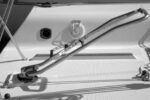
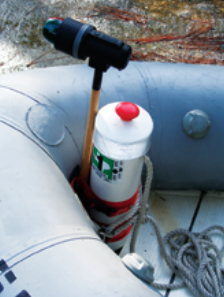
The solutions to these apparently separate problems came together when I found some scrap PVC pipe in my shop. With it, I created an anchor holder that sits vertically in the bow of the dinghy and is high enough to display the decals required by local law.
This project took only a few simple tools: a drill and 1/4-inch bit, awl, screwdriver, wrench, hand saw, sandpaper, and a router or a keyhole saw. For materials, I used a short length of 4-inch-internal-diameter thin-wall PVC pipe, two pipe caps, PVC adhesive, two nylon tie-downs with buckles, a simple drawer pull, and a couple of #10 screws with matched washers and nuts. Depending on your personal taste, a little paint may improve the appearance of the finished holder. Some dinghies may not have D-rings conveniently located in the bow, so they will need to be installed.
The only trick is to cut the PVC long enough for the decals to be visible over the tops of the tubes. For my Avon, I made the cut at 15 inches, which included an allowance for the upper cap so it doesn’t cover the decals.
I drilled 1/4-inch weep holes in one of the caps and glued it to the pipe. This was the bottom of the holder. Next, I made an outlet for the rode by cutting a 2-inch-long by 1/2-inch-wide slot down the length of the pipe on the open end. This can be done with a router, but a fine-toothed keyhole saw works just as well. This slot allows clearance for the anchor rode when the cap is in place. I smoothed all the cut edges with sandpaper.
Easily mounted
My Avon was fitted with D-rings and a rubber mount for a spray hood. When fitted with a short dowel, these provided an excellent place to attach the holder using two nylon tie-downs. If your dinghy has no suitable D-rings you may need to attach a pair inside at the bow, one 4 inches above the other. Experiment with where your tie-downs should go.
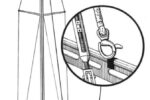
I set the anchor holder pipe in the bow and worked with the tie-downs until they were tight. I then marked the location where the tie-downs cross the back of the holder and drilled a hole for each tie-down. Then, using the awl to make a hole through the webbing, I attached the tie-downs with screws.
The final job was to make a top from the remaining PVC cap. To make removing it easier, I added a handle made from a simple drawer pull. All I had to do was drill a hole in the middle of the cap. Finally, with the top cap in place, I affixed the registration decals as high as possible on each side. To add color, I painted the drawer pull and a stripe above the bottom cap with leftover paint. To help me find the dinghy at night, I added reflective tape to the top cap.
The holder keeps our dinghy anchor out of the way and provides a prominent place to display the decals. Most of the parts in my holder came from material I had saved from other projects but, during a recent visit to a home store, I noted that the total price for the caps, pipe, and adhesive was roughly $20. D-rings can be purchased from most marine chandlers or whitewater-raft dealers for as little as $4 each. Hypalon and PVC D-ring adhesives start around $15 but vary in price.
Buying all of the parts listed above would cost about as much as a dedicated registration kit and the associated mounting hardware, but then there would still be an anchor left to stow.