Ascertain their state of charge the eBay way
Issue 73 : Jul/Aug 2010
I suspect most good old boats are used infrequently and, when they’re used, the engine is run just long enough to get to and from the slip or mooring. The load on a battery, not to mention the self-discharge rate, just isn’t made up by the engine’s alternator. We need to periodically top up the batteries’ charge, but the question is, when?
Some battery monitors sell for hundreds of dollars. They’re computerized devices that tally up the number of amp-hours going into and out of the batteries and indicate the state of charge. For cruisers, these devices are justified. But they’re overkill for occasional daysailors and weekenders.
A simpler, although limited, indicator of battery charge is its voltage after it has been resting (having no loads or charging) for several hours. This is best measured before any electrical load is applied after that period of rest as any current draw from the cabin lights or water pump, for example, will depress the voltage slightly.
The accompanying tables, developed by battery companies, offer a conversion between measured voltage and the state of a battery’s charge. The particular lead alloy used in battery plates can lead to slightly different voltages for a given amount of charge, which may explain the slightly different values for lead-acid batteries from the two companies.
Measuring options
A digital multimeter can be used to measure battery voltage but I wanted something a little more elegant attached to my electrical panel. I found two inexpensive options.
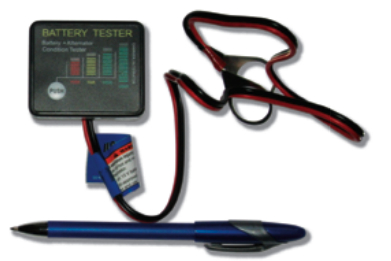
Harbor Freight sells a battery and alternator tester (item # 65928) for $5. You push the test button and LEDs light up to indicate poor, fair, or good condition. Another LED lights up to indicate the alternator is good when the engine is running. I put a unit to the test and found the “poor” LED lights came on at 11.4 volts (which would mean fully discharged), the “fair” lights at 11.95 volts (about 20 to 40 percent charge, depending on the battery) and the “good” LED lights at 12.6 volts (about 90 percent charge).
Unfortunately, this unit simply can’t differentiate between a battery that’s fully charged and one that is almost dead. Batteries should be kept above 50 percent charge to maximize life, and this device won’t tell us where that point is.
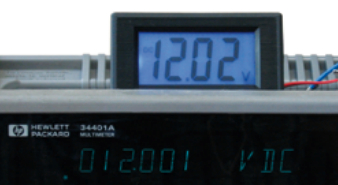
The second device is a liquid crystal display (LCD) digital voltmeter I bought on eBay. It was $10 including shipping and arrived in two weeks. Overall it’s about 1 1/2 x 3 inches with digits about 3/4 inch high.
These devices are generically known as digital panel meters and are offered by a number of vendors. The vast majority, however, require a power supply that is isolated from the voltage to be measured. That means you need a separate battery to power the meter. To avoid that hassle, find a meter that the vendor explicitly states can measure its own power source. My meter has only two wires, so it can only measure the voltage of its power supply. (I liked it enough that I later bought a matching 50-amp ammeter and shunt for $20 from the same vendor. Naturally, I didn’t follow my own advice. I assumed if one model it sold could measure its own power supply, others from the same vendor would do likewise. Wrong. The ammeter requires an isolated power supply, so it looks like I will have the hassle of adding a 9-volt battery and switch to power it. Live and learn . . .)
To test the meter’s accuracy, I compared it to a good-quality lab voltmeter. They agree well, with the inexpensive meter consistently reading 0.02 volts high, which isn’t a problem. The power draw on this unit was 7.5 milliamps (in other words, it will take 133 hours to use 1 amp-hour from the battery). We always turn the master battery switch off before leaving the boat, so I can wire this meter permanently into the electrical panel and not worry about it draining the battery.
So we have our solution. Mounting this $10 digital meter permanently on the electrical panel and posting a copy of the charge-vs-voltage table nearby makes it easy to keep an eye on the state of the batteries.
Tim Nye teaches mechanical engineering and in his spare time drags home and resurrects derelict machinery. After meeting and marrying Elizabeth, a sailor, he’s switched to dragging home and resurrecting good old sailboats. Their current boat is a 1976 Grampian G2-34, Sea Rose, mostly complete and sailed out of Hamilton, Ontario.
Thank you to Sailrite Enterprises, Inc., for providing free access to back issues of Good Old Boat through intellectual property rights. Sailrite.com