Employ virtual dock hands to control your boat’s bow
Issue 73 : Jul/Aug 2010
At our marina, the finger piers are aligned north and south but the winds are generally easterly or westerly. On most days, therefore, half the boats face the problem, when arriving or leaving, of the wind blowing their bows away from the dock.
For owners of powerboats and sailors with newer sailboats with fin keels and effective blade rudders, this is not too much of a problem, but for those of us “of fuller keel,” it can be. When leaving the dock, the bow of our boat may swing downwind to the point where we have to back out the full length of the channel, to the amusement of our neighbors. When returning, we get one chance at snagging the springline or bow line before our boat nudges “hello” to our next-door neighbor.
When we see friends leaving in these conditions, we walk over and volunteer to walk their bow to the edge and give them a nudge upwind as they depart. On their return, we saunter over and stand by to grab their bow line (or hand it to them depending on how they rig their docklines). They do the same for us.
But there are times when nobody is around and, because of that, we’ve worked out two techniques that you, too, might find useful when the wind doesn’t cooperate.
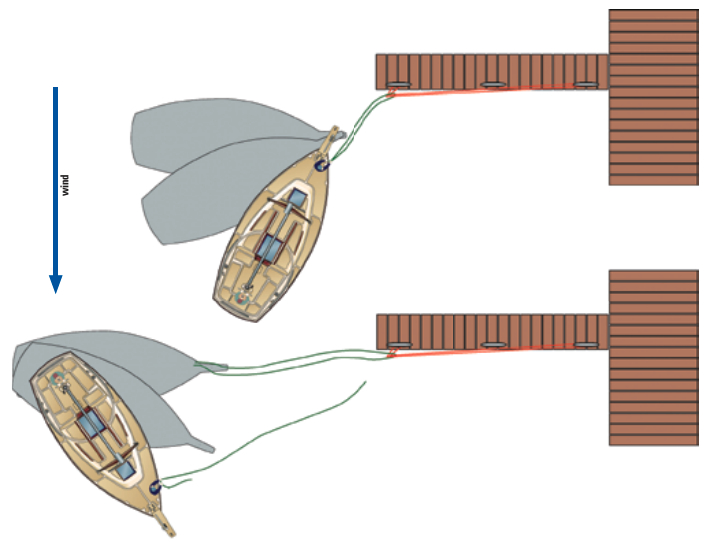
The pier banister
We tie a line from the first horn cleat on the finger pier to the last one at the end. This line forms a seamless “pier banister,” or handy grab line, the length of the pier. When leaving, we loop the bow line, or any spare line, through the banister and the crewmember at the bow holds both ends. As we back the boat out of the slip, the line slides along the banister while holding the bow near the fi nger pier. It works exactly like a friend walking along the slip holding the bow line. When the bow reaches the end of the slip, the crewmember at the bow releases one end of the line and pulls it aboard from the other.
We’ve found that if this crewmember holds a little longer as the boat backs beyond the finger pier, the stern will swing downwind leaving the bow facing the wind. If we want to head downwind, we back down with some force, set the rudder to steer the stern upwind, and coast so there’s no prop walk. The crewmember then releases the line after we are well clear of the end of the pier and the wind blows the bow in the direction we want to head: downwind.
If you worry that the line might get wedged somehow when you try to pull it aboard, put a ring or a carabiner on the banister line and run the bow line through that. Alternatively, take a length of a high-strength line that fl oats, such as Amsteel, and attach a loop of it to the banister. After you’ve used it to guide your boat out, let it go, and it’ll be waiting there to guide you in when you return.
We leave our banister on the dock all the time. It’s easy to grab with a boathook from any spot on the boat . . . much easier than trying to get a dependable hold on a horn cleat.
A bow walker for the soloist
Leaving a slip with the wind blowing your bow off the dock can be particularly dicey if you’re a solo sailor. You have to cast off the bow line, springline, and stern line. By the time you reach the throttle, the bow is swinging fast toward that 50-foot Hinckley in the next slip. To avoid a costly crunch, you need a solo bow walker. Try the solution that works for us.
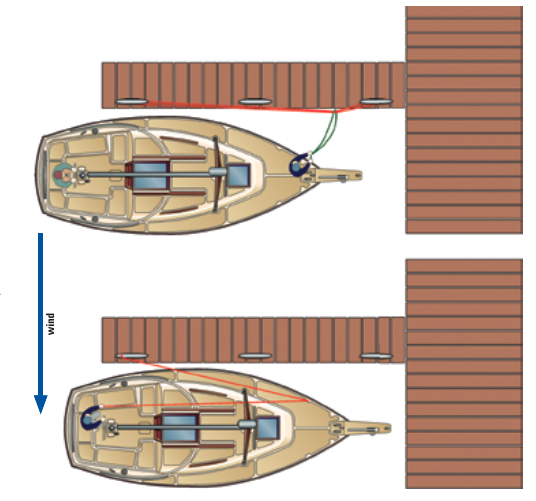
Tie a loop in one end of a long line. Hook the loop around the outside of the horn cleat at the outside end of the pier, run the line up to the bow and reeve it through a spare block attached to the pulpit stanchion or toerail, then back to the cockpit (see the illustration on facing page).
When ready to leave the slip, lock your rudder about 20 degrees in the direction you want the stern to go and throw off or haul in the docklines. Take your place at the helm. Don’t use the engine but pull the bow-walker line toward you. The boat will back out of the slip and the bow will stay near the dock. Keep pulling as the boat gains momentum. At the end of the slip, the loop will slide off the horn of the cleat and you’ll be on your way and facing the right direction.
Jess Gregory is a former Navy weatherman, then journalist, then PR and advertising guy. He now coastal cruises and dabbles in inventions, most notably the FinDelta at-anchor riding sail. His company website is www.bannerbaymarine.com.
Thank you to Sailrite Enterprises, Inc., for providing free access to back issues of Good Old Boat through intellectual property rights. Sailrite.com