Listening to the lovely sound of no engine
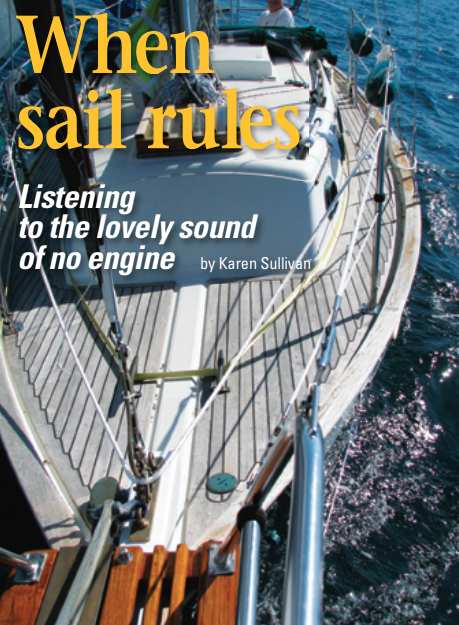
Issue 73 : Jul/Aug 2010
“If you don’t mind, let’s not start the engine yet,” Jim said as we sailed across a tide rip between Sucia Island and Patos Island State Parks, in Washington’s San Juans. “I’d like to practice as a team, doing everything we can under sail alone.”
This may sound odd, but these were some of the most romantic words I’d ever heard. Although we’d been dating for seven months, this was our first real cruise together, and the sound of no engine, even if it’s only a modest Yanmar 2-GM20, is music to my ears. Somehow, when you’re sailing and you start the engine, everything changes — for the better if you’re seeking convenience and comfort or for the worse if you’re reaching for a more satisfying pure sailing experience.
I’ve been soloing on Minstrel, my Dana 24, for several years and find that I prefer to choose a totally anachronistic solution over a perfectly good engine whenever possible. I learned this about myself while sailing and motorsailing from Puget Sound to Prince William Sound and back. In Alaska, wildlife is everywhere, and I realized you can miss a lot of amazing sounds if the engine’s on: a family of orcas breathing, the whistle-difference between the wing-beats of a puffin and an eider, the sound of an iceberg melting. With music like that surrounding you, why hurry to get somewhere else?
Jim has also been sailing solo for several years on a Dana 24 named Sockdolager (pronounced Sock-DOLL-a-jur). Two singlehanders, each with strong views on how things ought to be done, made for some comical moments as we worked in and out of harbors together under sail. We did things that when alone would have required three arms, six legs, and a brain-and-a-half. In choosing to use just sails when possible, we entered a little parallel universe of focused concentration and fun. We reveled in the quiet and perhaps earned a little nod from ghosts of schooners past.
Blew a gasket
In the fall of 2008, when Jim sailed alone to the far end of the Strait of Juan de Fuca, his engine blew a head gasket and the stage was set: “I checked into having it towed a hundred miles back to Port Townsend,” he said on the phone from Neah Bay. “They want $3,800.”
“Yeeks,” I said. “What do you want to do?”
“I think we should sail it back,” he said. It was October in the Straits, when the weather can get exciting. We waited for a fair tide between gales, and our odyssey began on a pitch-black night. We turned the boat bow-out in the slip at Neah Bay Marina and, with a homemade towing bridle led to the dinghy and our hearts in our mouths, Jim rowed while I steered. He had Sockdolager moving in calm water at 1 1/2 knots within a minute. A crowd of fishermen gathered on the other side of the fairway. “Hey!” one shouted, “It’s midnight. Are you two stealing that boat?”
“No,” I answered.
“What?” bellowed Jim from the dinghy. He couldn’t hear the fisherman.
“Row!” I yelled at him.
A fisherman called, “Why don’t you start your engine?”
“Because it doesn’t work,” I said.
“What?” shouted Jim. Right about then, I noticed two large, agitated sea lions on a finger pier just ahead of him. He hadn’t seen them. They were shuddering and swaying, ready to lunge into the water. They were awfully close to the dinghy.
“Look out! Sea lions!” I yelled and pointed. With a succinct reply, he veered away, but a wind was coming up and this would put us too close to the breakwater, so I pointed and yelled “ROWWW!” as the fishermen watched in amazement.
Unnerved by surf
We set sail in the dark and caught the last of the ebb and a light west wind out of Neah Bay. Immediately outside the harbor, we heard surf on both sides. It was unnerving in the pitch black. “Can you hear where it’s coming from?” we asked each other. We could. “Is the sound getting closer?” Our ears told us we were still safe. We talked through what we’d do if the wind died and the tide carried us too close. We discovered a new way of thinking . . . actually a rather old way of thinking.
If there’s wind, we can sail. If there’s no wind, we must wait. If we drift near rocks, we can anchor. If we drift near shipping lanes, we must row. If we’re too close to either and there’s wind, we can sail. We had everything we needed to stay out of trouble. But to understand this at a gut level, rather than an intellectual one, was to relinquish a fear-based reliance on the engine.
We stood three-hour watches in a northwest zephyr that brought fog. The next day, we spent seven long hours off Clallam Bay fighting the tide with the asymmetrical spinnaker. A light-air sail is not a luxury, it’s a necessity if you’re engineless. With that spinnaker we made half a knot; without it, we’d have gone backward. Half a knot felt like progress; 2 knots felt like victory. When we finally got enough wind to move at 3 knots, we joked about donning seat belts.
On my watch that night, in windless fog so dense I couldn’t see stars to steer by, I heard sounds. Faint at first, there was a low roaring, but it didn’t sound like a ship’s engine. I listened, alarmed. Off the port bow, it got louder. Then I heard, over the roaring, a rustling, hissing, chuckling noise. It sounded like a waterfall, and I imagined the fear felt by early sailors in uncharted seas who really believed “there be dragons” and an edge to the earth over which you could fall. In the dim light of our masthead tricolor, whitecaps revealed a chaotic lumpy seascape as we were drawn into a 50-acre tide rip. The rip soon spit us out the other side as slick as a watermelon seed.
Constant fog
Jim and I were queasy from a combination of the crazy motion, our fatigue, and the disorienting effects of constant fog. At that time, I wished we could start the engine to steady us with some speed. It would have been nice to have a boost of speed from an engine to reduce pitching and yawing, increase comfort, and reduce seasickness.Without an engine we had no alternative: just get used to it. That’s when I thought of the sounds we might have missed. Besides the creaks in the rigging and the lapping of wavelets on the hull, a “Poosh!” of breath revealed a seal, its curious eyes watching us glide by. High above the fog, soft peeps betrayed birds migrating under cover of night. Off in the distance, a fish jumped and an unseen sea lion belched.
We had a battery-driven handheld GPS with our course plotted on it to help us stay outside the shipping lanes and away from shore and other hazards. But the most important piece of equipment we carried that night was a radar reflector mounted on the backstay. Nearly all the other boats out on the Straits that October night would have had engines and radar running. They should have been able to see us, and we could hear them. We kept the VHF radio on to listen to and stay in touch with Seattle Vessel Traffic Service and in case we needed to make a Sécurité call.
It took us 34 hours to sail 55 miles to Port Angeles, then another 161/2 hours to sail the remaining 52 miles (that would have been 32 miles as the crow flies, but the wind was on the nose) to Port Townsend. Jim rowed Sockdolager from time to time, for a total of two or three miles. Rather than try to sail into Port Townsend’s crowded marina at dusk, we anchored out. On our small green solitary sailboat, surrounded by a watercolor evening, we imagined whispers of old ghosts along the waterfront: “Not bad living by wind and wit, now, is it?”
Early the next morning, watching each other grin as we rowed Sockdolager quietly into harbor, we felt as if we could do just about anything.
Karen Sullivan discovered sailing in 1973 with a wooden Folkboat in New England. After 10 years on larger boats and a spell ashore, she returned to her small-boat roots, sailing her Dana 24, Minstrel, to Alaska in 2001, then back to Puget Sound in 2006. After she met Jim Heumann she sold her Dana. Now they cruise together on Sockdolager out of Port Townsend, Washington.
Thank you to Sailrite Enterprises, Inc., for providing free access to back issues of Good Old Boat through intellectual property rights. Sailrite.com