Comparing three light-displacement cruiser/racers
Issue 73 : Jul/Aug 2010
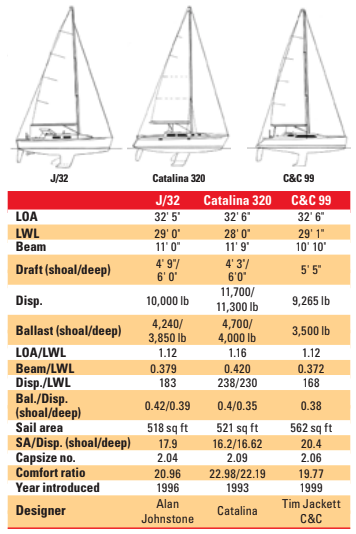
I would hardly call any one of these three beamy designs a good old boat, since two of them are still in production today and the last of the J/32s is only six years old. They are quite interesting designs, though, and they all have the numbers that add up to being top-performing cruiser/racers.
All three of the boats are of reasonably light displacement but within a fairly wide spread from the Catalina’s moderately light D/LWL ratio of 238 to the J/32’s 183 and the C&C’s very light 168. In addition, two offer shoal-draft versions. The Catalina’s 4-foot 3-inch draft option uses a wing fin and an additional 700 pounds of ballast to make up for any loss of stability, while J/Boats added another 390 pounds to the 32’s shoal 4-foot 9-inch draft fin. Mysteriously, this substantial added weight contributes little or nothing to the advertised displacement. Still, the increased ballast will help offset the loss of stability created by the shoal draft.
How the optional shoal fins might affect weatherliness is harder to ascertain. The shoal-draft boats may heel a bit less due to the added ballast as well as to the slightly shorter heeling arm. Also, a well-designed wing fin can add to a boat’s windward ability but whether it can offset a loss of 21 inches in draft is open to question. And can the heavier ballast offset the 15-inch loss of draft on the J/32? My own advice is that if you normally sail in waters where the bottom is close to the top, go for the shoal-draft version. Otherwise, enjoy the added windward performance and power that a deep fin provides.
The wide-stern effect
Getting back to stability, the Catalina is the heaviest and beamiest and has that incredibly wide stern so she will, undoubtedly, be the stiffest of the three, at least in her deep-fin version. The C&C is another fat-sterned offering and the form stability this adds to her lighter hull will prove beneficial in a stiff breeze as well. I have to wonder, though, how those super-wide sterns affect the helm balance and trim when the beast is pressed hard on the wind and heeled well down. My own experience tells me the J/32, with her more balanced hull form, will be much easier on the helmsman under such conditions.
Considering the deep-draft versions, thanks to her stability the Catalina 320 should do well in a spanking breeze while her huskier displacement will give her the momentum needed to knife through a chop. Like the C&C 99, she has a masthead rig, so will spread a good-sized spinnaker offwind. The C&C outdoes her, though, as she has considerably more sail area to begin with but also carries an oversize 14-foot 6-inch spinnaker pole. That’s like adding a turbocharger to the family car! In effect, despite her six-berth layout, the 99 appears to be more sport boat than family cruiser and should be an excellent choice for the serious racing skipper.
The J/32, in comparison, takes the middle course and, for that reason, seems to be even more suitable as a fast cruiser for a young family. Her 7⁄8 rig spreads ample area but sets smaller headsails than the masthead rigs of the other two. This will ease the work for a shorthanded family crew, but she should still be fast enough to prove competitive in club racing. The J/32 is longer on deck, due to her conventional transom. That gives her more cockpit space and undercockpit stowage. Her layout provides four berths instead of the six and seven berths of the other two boats. Does anyone, except a charter skipper, really need that many berths in a 32-footer? Still, I think it would have made good sense for the J/32’s starboard saloon berth to be convertible to a double.
All in all, these are three good boats for three different needs. The J/32 gets my nod, though, due to her shipshape layout and her uncluttered appearance. She is a handsome yacht indeed and has a clean, understated, New England elegance that will make experienced sailors look at her with a nod of approval in any harbor she enters.
Ted Brewer is a contributing editor with Good Old Boat and one of North America’s best-known yacht designers. He has designed all manner of sailboats.
Thank you to Sailrite Enterprises, Inc., for providing free access to back issues of Good Old Boat through intellectual property rights. Sailrite.com