One size, or style, does not fit all
Issue 74 : Sept/Oct 2010
Writing about rudders was not much fun. Writing about rigs will be more fun. Everyone has an opinion about sailboat rigs. I have opinions too.
This month marks 50 years that I have been sailing. I have sailed on everything from a traditional Chinese junk to gaff schooners to staysail schooners to catboats to ketches to cat ketches to a variety of cutters and all manner of sloops from meter boats to CCA types to IOR types to modern carbon-sparred sportboat types. I have even sailed on yawls, including perhaps the most famous yawl of all, the S&S-designed Dorade. So, I thought, rather than do the same old article, “This is a sloop, this is a ketch,” I’m going to assume that you all know the basics of rig geometry and I’m going to air some of my own opinions on rigs.
It’s important to understand that the rig has to fit the hull. There is no point in having a high-tech, high-pointing, i.e. weatherly, rig on a boat that has a low-tech, low-pointing hull. The rig will have to work in concert with the hull. This means that a heavy, bluff-bowed, full-keeled boat may do just fine with a gaff rig, while a light, narrow-entry boat with a deep fin keel will take advantage of a thoroughly modern rig. Classic boats need classic rigs. There is an aesthetic element to the rig that has to enhance the styling of the hull while optimizing the potential performance of the boat.
The role of handicap rules
It’s also important to recognize that many of the rig features and proportions we see on today’s boats and the good old boats going back to the 1950s are artifacts of the handicap rule that was in vogue at the time. The boats designed to the Cruising Club of America (CCA) rule will have big mainsails and small foretriangles with huge overlapping jibs. The CCA penalized the aspect ratio of the rig, so rigs became short and squatty. Mainsail area was penalized slightly less than headsail area, so mains got big and foretriangles got small. But the CCA was extremely generous toward headsail overlap, and this led to some extreme cases. Bill Luders dominated one season racing his Storm without any mainsail at all. He just used huge overlapping genoas with LPs (luff perpendiculars) above 180 percent. The CCA then changed the rule to require a mainsail, and Luders came back with Storm carrying the mainsail off a Penguin dinghy, if memory serves, and cleaned up again.
The International Offshore Rule (IOR) corrected this imbalance of weighted sail areas and had both mainsail and headsail areas weighted pretty much evenly. But bigger foretriangles meant bigger spinnakers, so foretriangles grew and mainsails shrunk again to the point of what we called the “IOR minimum ribbon mainsail.” The size of the mainsail was restricted by limitations on just how small it could be.
The yawl rig has a very strong connection with the CCA rule as the CCA did not include the area of sails flown off the mizzen. You could be more competitive off the wind if you carried this unmeasured additional sail area in mizzen staysails and mizzen spinnakers. Yawls abounded under the CCA. There are few sailing sights more dramatic than a big CCA yawl like Carina, Bolero, or Orient racing downwind with a big mizzen staysail working.
The influence of choice
Probably the most important aspect of rig design is personal choice. When we talk about sailing yachts, we are not talking about a subject that can be approached from a strictly objective point of view all the time. Sailing yachts don’t make a lot of objective sense to begin with. They are toys. To many of us they are important toys, and our lives would be empty without them, but they are still toys. Sometimes, I have to remind my clients, “We are not talking about starving children here. We are talking about sailboats.” If you like gaff-rigged ketches because you like the way they look then good for you. I can’t argue with that. If you tell me you like gaff-rigged ketches because they possess some magical performance advantage upwind, I may choose to pursue the argument.
Sloops and cutters
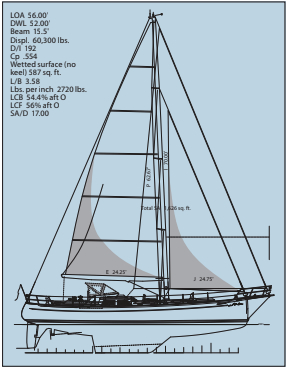
Sloops have one mast and a cutter has one mast, but the mast on a sloop will be stepped more forward in the boat than where it is stepped on a true cutter. There is room for argument here, though. Today, we tend to call any single-masted boat with two headsails flown simultaneously a “cutter.” In a true cutter, the foretriangle is bigger, allowing for a larger staysail. I am not in favor of rigging a staysail on a sloop with a smallish foretriangle. You will not be able to carry, at the same time, the staysail and masthead headsail with any efficiency unless you are reaching. The true cutter does quite well with both staysail and high-clewed (but not too high, please) Yankee, although you are not going to point very high with this three-sail setup. I like a low clew on the Yankee, which really makes it a jib or a genoa. Cutters have that huge advantage of being able to shorten sail quickly by dropping the outer jib. In a real blow, there is no better rig than a cutter with staysail and reefed mainsail.
If you insist on adding a staysail to a sloop with a small foretriangle, then take the tack of the staysail forward as far as possible. That will give the staysail a decent aspect ratio and, at the same time, pull the center of pressure forward to avoid building up weather helm.
Once in a while, I get to design a boat with a bowsprit. Adding a bowsprit gives me more freedom in arranging the sail plan, in that the foretriangle can be opened up by extending the “J” dimension, making room for two headsails. Bowsprits also look right on some hulls.
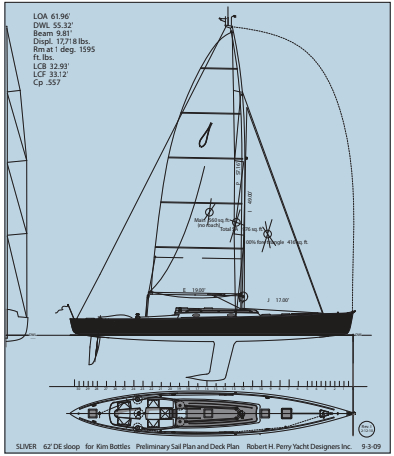
The modern fractional sloop is a nice rig for ease of handling. The jib is small and oftentimes has very little overlap or LP, typically no more than 110 percent. The mainsail, the big sail, is on the boom, where it is easier to handle. With the mast well forward in the fractional sloop, you also have the option of sailing under mainsail alone. I don’t recommend it, but in a pinch it can be done effectively. With a large-foretriangle boat you are not going to sail efficiently at all without your jib up. In fact, with only the mainsail up you might have horrendous weather helm. Almost all of today’s cruiser/racers and racer/cruisers have fractional rigs. The big 150 percent or even 160 percent genoa is quickly becoming a thing of the past. The small foretriangle of the modern fractional rig is combined with a retractable, in most cases, or fixed bowsprit to open up the foretriangle for large off-the-wind sails set flying.
Ketches and yawls
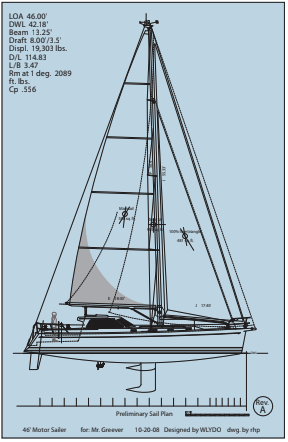
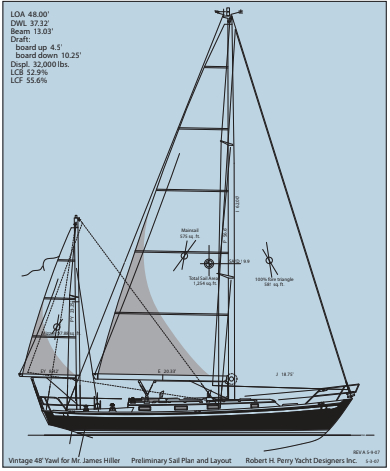
For me, the difference between a ketch and a yawl is one of proportion. The old definitions relative to helm and rudder placement just don’t work reliably on modern designs. If the mizzen is small and stepped well aft, the boat is a yawl. If the mizzen is large and stepped forward, the boat is a ketch. I have no hard formula for these proportions; I just use my eye.
As mentioned earlier, the mizzenmast on a yawl is really only there for carrying mizzen flying sails. The little mizzen on a yawl also makes a great riding sail when at anchor. Upwind, most yawls furl the mizzen.
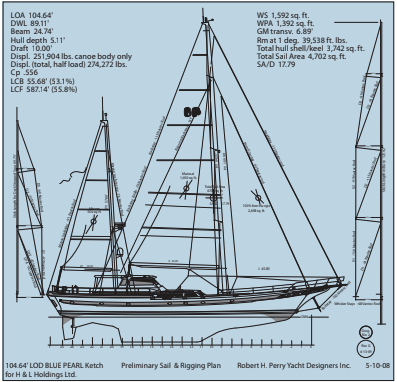
The ketch rig is not a favorite of mine but I have designed quite a few ketches. With the mizzen operating in the draft of the main and jib, the mizzen sees a higher apparent wind angle than the main and jib. This means, to effectively trim the mizzen upwind you have to over-sheet it, which can increase weather helm and slow the boat down. Of course you could bear off a bit, but then your VMG would go down. If you don’t care about VMG, then the ketch certainly can go to weather. But, if you are after a close-winded boat, the traditional ketch rig is not for you. The mizzen also puts a lot of rigging clutter back around the cockpit. It also requires extra chainplates and that can increase the build cost. If we are not talking about VMG, it comes down, once again, to a sailing-style issue. The ketch gives the option of sailing with jib or headsail and mizzen in a blow, and while this is not a very weatherly arrangement, it sure is convenient. If you have a center-cockpit design, the mizzen can be aft of the cockpit and not interfere with the cockpit. If there is one reason we don’t see more ketch rigs on modern boats, performance to weather aside, I’d have to say it was cost.
My most interesting ketch experience was when I designed the Tayana 37. I drew both cutter and ketch rigs for the Tayana 37. The mainmast location for the ketch was farther forward than the mast location for the cutter. I thought the ketch was a far superior sailing boat. While the cutter was a bit difficult to trim to reduce weather helm (I later eliminated the mast rake), the ketch was impeccably balanced and quite fast. Still, they built 600 Tayana 37s and only a small handful were built as ketches.
Schooners
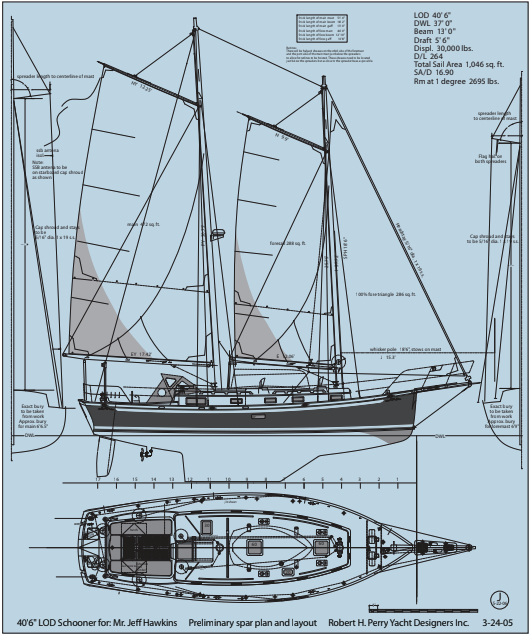
I designed my very first modern schooner about five years ago. Jakatan uses carbon-fiber spars and a single-halyard system. I was all for the carbon to reduce the weight of the rig with its gaffs but I was nervous about the single-pick-point halyards. Part of the effectiveness of the gaff rig comes from the ability to adjust throat and peak halyards for optimal sail shape. We gave that up with the singlepoint pick. But my client, a very smart man, was adamant, and so we proceeded. I was very happy with the result. With some experimentation, we found the correct pick placement for each gaff, and I had designed-in the ability to easily adjust the pick point. It really became a non-issue element of the design. The boat sails great. It’s not close-winded, but you would not expect that of a schooner. It sure is pretty, though. The modern schooner rig is about making an aesthetic statement.
Catboats
I love Cape Cod catboats. I always have. I’ve had a lot of fun sailing Beetle Cats. They just have a no-nonsense look to them. Catboat rigs can be very effective but do have some areas of concern. They can be a bit tricky to jibe in a breeze and can develop vicious weather helm, but they give you “one string” operation once the sail is up. They also get the mast forward where it does not clutter the interior. I think the catboats Mark Ellis designed for the Nonsuch line are great boats. I have sailed the Nonsuch boats and they are surprising performers. Tom Wylie has also designed some high-performance catboats that do quite well racing in San Francisco.
We see a constant stream of wacky ideas, gadgets, and gillhickies, all designed to make sail handling easier. Some of them work. We all accept roller furling for our jibs today, although I sail with hanked-on jibs on my current boat because it’s just not big enough to require roller furling. We can even roll up our mainsails now. I hate in-the-mast furling. You lose sail-shape control and sail area. I love the Leisure Furl system and the Schaefer version of in-boom furling. By the time this article is printed, I’ll be 64 years old, and I have grown to really appreciate roller furling for both jibs and mainsails.
So, what’s the perfect rig? For me it’s a fractional-rigged sloop because that’s what I own. I’m sure you have your own opinion on the perfect rig. Maybe your best answer to that question is the same as mine, “The perfect rig is the one I have on my good old boat.”
Robert Perry has been designing yachts from around the time the yawl was declared near extinction. He has kept this and other endangered rigs alive by nurturing clients who are very interested in performance but are not consumed by the need to be first to the windward mark.
Thank you to Sailrite Enterprises, Inc., for providing free access to back issues of Good Old Boat through intellectual property rights. Sailrite.com