A well-thumbed book has been a faithful companion
Issue 75 : Nov/Dec 2010
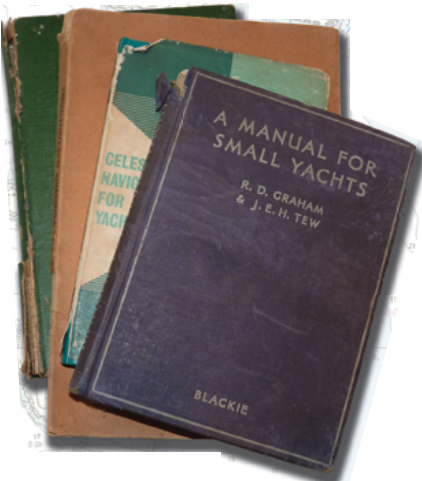
I was fossicking around in a used-book store the other day when I came across a copy of A Manual for Small Yachts, by R. D. Graham and J. E. H. Tew. It was a 1946 copy, beautifully and miraculously preserved after all those years. I was greatly tempted to buy it because I have that very same edition at home, right down to the purple cover. But my copy is tattered and ravaged from the passage of more than 60 years. I love it dearly, nevertheless, because, as far as
I can remember, it’s the first book I ever stole. I was 14 years old when I smuggled it off the sloop Albatross, then owned by Harry Pegram, one of the landed gentry from the wine country near Cape Town. It was inscribed “To the Boatswain of the Albatross. From the Skipper, 12/7. Thanks a lot.” I never knew who the boatswain was, and he must have been gone for several years before I came on the scene. I think I replaced him as crew, though, after which the good old Albatross sailed without a proper bosun.
Now, all these decades later, we’re both showing signs of age, the book and I — honorable scars of usage and experience, I like to think. I don’t care what the book looks like now, and I realize it’s worth nothing to anyone else, but we’ve grown up together. We’re like family, that book and I. I have pored over it countless times and it has taught me many useful things you won’t find in modern books on the subject of sailing.
I do have other books, of course, some obscure, some fascinating, some given to me by famous sailors, among them Bernard Moitessier, long before he became famous. And I have clippings from magazines with articles by people like that superb seaman and writer, Miles Smeeton, whose words of wisdom all too often (like Thomas Gray’s flowers) were destined to blush unseen and waste their sweetness on the desert air.
Most of my little boating book collection is well thumbed (OK, pretty shoddy) and largely comprised of books picked up cheaply from library sales, given to me for birthdays, and, very occasionally, awarded as a prize for some sailing competition. The only ones that look smart and new are those that haven’t been opened because I wrote them myself and I already know what’s inside.
Almost every time I approach the bookshelves, my eye falls fondly on A Manual for Small Yachts and in passing I’ll give it a little pat or open it to some page at random. Last time I picked it up, it fell open at the last page of the glossary and there I read: “Way: a ship weighs her anchor but gets under way, but some of you spell it underweigh, which is incorrect until enough people do it often enough to make it right.”
That hasn’t happened yet, but I notice that many people insist that a boat gets underway. Why that should be, I can’t imagine. One doesn’t hide undertable when an earthquake rumbles. A daring pilot doesn’t underfly a bridge. No, a boat gets under way, separated by a proper honest space, and that’s that.
That’s the kind of useful information you won’t find in modern sailing manuals. So thank you for your assistance, Commander Graham. Thank you, too, Mr. Tew. Perhaps, after all, I should start thinking about having your dear little book re-bound before it falls completely to bits.
John Vigor, a former newspaper columnist and editorial writer, is the author of 12 sailing books. He is a sailing and navigation instructor accredited by the American Sailing Association. He writes three boating columns a week on his blog, www.johnvigor.blogspot.com.
Thank you to Sailrite Enterprises, Inc., for providing free access to back issues of Good Old Boat through intellectual property rights. Sailrite.com