Code words let Mars understand Venus
Issue 75 : Nov/Dec 2010
The question comes up a lot. Not from sailing friends, they are mostly too polite, but landlubbing friends don’t mind asking, “When you’ve been together 24/7 nonstop for umpty-ump days cooped up on that tiny little boat, how on earth do you keep from tearing each other’s hair out?”
Jim Heumann and I spent 101 days cruising to Canada’s Queen Charlotte Islands aboard Sockdolager, his Pacific Seacraft Dana 24. Lots of people asked us this question. It was always delivered sotto voce, with sideways glances like the kind Jimmy Cagney used when asking Edward G. Robinson about doing a bank job.
We are relieved to report that, although the cruise was not without its moments, both of us retain full and healthy heads of hair. Most of the “moments” revolved around miscommunications. Not everyday miscommunications, mind you, such as the time in Johnstone Strait when I admired a sturdy ketch designed by the famous marine architect William Garden and remarked, “What a well-kept Garden ketch!” to which Jim replied, “Do you think they have any tomatoes?”
No, not those kinds of miscommunications. We mean the dreaded gender-based kind . . . like when a newly-minted couple we know went sailing together for the first time and he, standing at the mast where he’d just raised the luffing mainsail, yelled, “Fall off!” She, thinking he was initiating a man-overboard drill, yelled back, “Why don’t we just throw a boat cushion?”
His and her language
If you subscribe to the theory of gender stereotyping, you might say that in matters of speech women have a tendency to be more indirect than men. This can result in a lot of annoying little clarification discussions. For example, let’s say I am at the helm and notice that Jim’s leg is blocking my view of the depth sounder. I say, “In a few minutes I’m going to need to see the depth sounder.” The cross-gender translation is: “I would like you to get this hint because your leg is posing a threat to life and safety.”
Jim says, “OK.” He doesn’t move his leg.
A few seconds pass and I say, “It’s getting shallow. I need to see the depth sounder, now!”
Jim looks down at his leg and replies, “Why didn’t you just say, ‘Move your damn leg?’”
I: “I dunno, it sounds kind of rude.”
So, in order to satisfy the simultaneous needs to be direct and yet not rude, we invented a few acronym-words that are short, sharp, and satisfyingly ambiguous. The new word for “Move your damn leg!” is “MYDL!” This is pronounced meedle to avoid confusion with the medication for women only. In the event the recipient does not register the meaning of this command after two utterances, the helmsperson gets to bark (but only once), “MYGDL!”
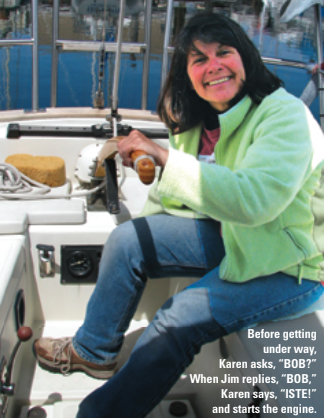
Another one we use is BOB. This is posed as a question, answered as a statement.
Jim: “BOB?”
I: “BOB.”
This means: “Have you turned the battery switch this morning so both will be charging when we start the engine?” “Yes, the battery switch is turned to both.”
Batteries on both. BOB. This saves 26 words, which is significant when we’ve not yet had our second cups of coffee.
There are a couple more, but this should not be overdone. “ISTE” comes after BOB and means, “I’m starting the engine.”
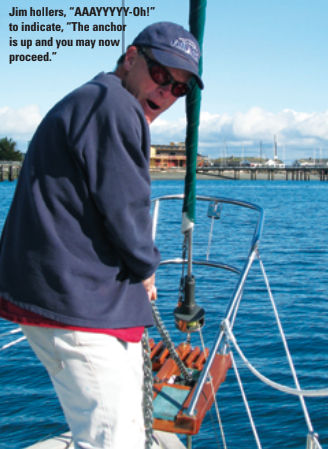
Finally, a favorite of Jim’s is: “AO!” This rhymes with Day-Oh, and means the anchor is up. Yes, Jim knows it would be more correct to say “AU!” or even “AA!” for anchor’s aweigh, but he doesn’t care because he likes hollering “AAAYYYYY-Oh!” from the foredeck.
But wait, there’s one more needed. It comes at the end of a long day’s run in more crowded waters, where some people call dumb stuff to each other over the radio on VHF Channel 16 and half the continent can hear it. You can almost hear the Coast Guard groaning.
“Hey, Rita’s Mink. Rita’s Mink, Rita’s Mink. Ya gotcher ears on? This is Passing Wind calling.” We kid you not, these are real boat names.
Cuteness and methane are the last visuals we want when we’re out there trying to commune with nature. So we imagined the reaction from the Coast Guard’s hardworking rescue team if one of them ever called for help, and we felt better right away.
Coast Guard: “Vessel requesting assistance, this is the United States Coast Guard. Can you say again your name and the nature of your distress?”
Vessel requesting assistance: “Passing Wind! We’re Passing Wind!”
Coast Guard (stifled laughter): “Er, is that your name, sir, or the nature of your distress?”
For unfortunate listeners overhearing this, there can only be one response. “TODR!” Turn off the damn radio.
The best part about this kind of cross-gender (some say cross-species) communication is that any couple can make up all the unique acronyms they want, for those meaning-laden moments when good old nautical-ese just doesn’t cut it. You might even call it an Absurd Vocabulary Accommodating Situations Testy. AVAST, matey!
Karen Sullivan discovered sailing in 1973, with a wooden Folkboat in New England. After 10 years on larger boats, a spell as captain of a sailing research vessel, and a non-sailing interval working for the U.S. Fish and Wildlife Service, she is back to her roots on a good old Dana 24. She and Jim Heumann sail Sockdolager out of Port Townsend, Washington.
Thank you to Sailrite Enterprises, Inc., for providing free access to back issues of Good Old Boat through intellectual property rights. Sailrite.com