The Brother was big, but the Necchi fit the niche
Issue 75 : Nov/Dec 2010
This tale begins with the collapsing real estate market. For 7 years, our few shoreside possessions had been residing in a rented 5 x 10 storage room. Those things really needed were with us aboard our old Allied Seawind, currently in the Eastern Caribbean. But our annual stateside visit in 2008 coincided with the free fall of home prices. Long accustomed to the cruisers’ mantra of “buy it when you find it,” we recognized the opportunity to upgrade our rental closet to a small condominium with but a modest increase in annual outlay and, at current rates, an equally insignificant impact on interest income. So we did.
Aside from the distinctly Christmas-like experience of unpacking boxes sealed years earlier, emptying the storage room also exhumed my industrial sewing machine, a Brother tailor machine. This is the identical machine once sold by Sailrite in a portable case as its Sailmaker model, but mine was purchased locally from an industrial machine supplier and is mounted in a power table, which means it has a honking big motor hanging beneath the table that gives this machine impressive capacity. My wife, Olga, bought me this machine as a Christmas present around 1980. Over the next two decades plus, I made sails, awnings, dodgers, full boat covers, bunk and settee cushions, and all manner of other canvas and fabric items. I also reupholstered sofas and chairs in our home, repaired auto seat covers, and even made a few linen and clothing repairs.
We did not carry a sewing machine on our boat, preferring to do canvas-work and sailmaking ashore where we could find the needed room to spread out big panels. However, when we cast off in 2002, not knowing when we would again have a shoreside base, I decided to put one aboard. Rather than converting the Brother to a portable, I opted to buy a new portable. This time I did buy from Sailrite, selecting one of Matt Grant’s excellent Ultrafeed machines. I chose this machine for the walking foot, which makes sewing canvas in confined spaces much easier. As a zig-zag stitch is primarily useful for sewing sails and I had no intention of trying to loft a new sail aboard a 30-foot boat, I chose to save the money and the complication and bought the straight-stitch model.
So the little Ultrafeed went cruising and the big Brother went into storage for 7 years. Out in the open again, this machine offered the welcome opportunity to escape discussions of Jon and Kate in favor of turning out a Sunbrella forward-hatch rain hood or new canvas tool rolls.
Condo conundrum
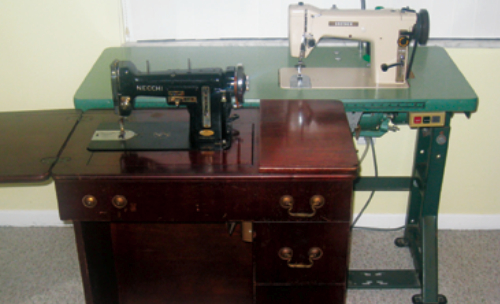
Unfortunately, a big, green industrial sewing machine table is not the most attractive living room or bedroom furnishing and, after those two rooms, our new condo was out of options. I hit on what seemed like a solution when I happened onto a near-antique sewing machine cabinet in a thrift shop. I made a few measurements, then bought the cabinet and included machine for $30. They threw in a chair of similar vintage. The idea was to mount the Brother in the hide-away cabinet, which would do double duty as a computer desk and be an attractive complement to our other “near antiques.”
Of course, few things are as easy as they seem. The Brother was bigger, meaning that the opening would need to be enlarged with a router. The old machine had a motor, but whether it would have the power to drive the Brother was a question. And there was a nearly insurmountable problem with hinges that differ in size and merely tilt up on an industrial machine but suspend a domestic machine.
While I was wrestling with all of the issues, serendipity struck. Twice.
The first thing was I stumbled across an Internet ad for a similar Brother machine for $1,000. That led to some additional research, which revealed that the new price of this machine has inflated over the passing decades to close to two grand. I couldn’t help wondering if I really needed a $2,000 sewing machine to make tool rolls.
Serendipitous event number two occurred as I searched the web for compatible hinges. An unexpected Google result popped up a picture on my screen that was identical to the machine mounted in my thrift shop cabinet. The site touted this machine as the “best domestic machine ever manufactured.” Hyperbole, no doubt, but it piqued my interest. I spent the next hour reading effusive praise for the Necchi BU, a machine manufactured in Italy in the late 1940s and early 1950s.
Hmmmm.
This old sewing machine
My Necchi BU had clearly not run for years. This was someone’s grandmother’s machine, fallen into disuse. I lifted it out of the cabinet and took a fresh look at it — a first look, really. The paint was old and alligatored. The chrome was stained with rust. The electrical insulation had all turned brittle and mostly departed, leaving behind bare wire. The drive belt was missing; likewise, the rubber tire for the bobbin winder and the reflector for the work light. But closer inspection revealed that the mechanical portions of the machine showed little, if any, signs of wear. There was still thread in the bobbin, and the drawers of the cabinet contained a number of special feet, the supplied tools, and the original manual.
I had already dismantled and lubricated the motor. Now I renewed the wiring. I bought a new drive belt ($6) and a new winder tire ($1). I fabricated a new reflector from a section cut from a plastic plumbing trap connector ($1) and some on-hand metallic duct tape. I bought a packet of #18/110 needles ($1). I oiled everything and rotated the machine by hand. When I plugged it in and pressed the knee control, it began to stitch — for a minute. Then it slowed, then stopped. I could turn the wheel but the little motor couldn’t. A 60-year accumulation of light oil (the Italian manual warns against using olive oil!) had no doubt turned into heavy gum on bearing surfaces. I filled the brass oil can with pure mineral spirits and fed that to every oil point. A day later, I could spin the balance wheel with a wrist flick. Fresh oil soon had the ancient Necchi humming.
Before Olga’s most excellent Christmas present, I had already sewn lots of canvas projects on an array of other domestic sewing machines. As I write this, we daily use flotation cushions in our hard dinghy that I covered in Sunbrella more than 30 years ago, the stitching done on my mother-in-law’s particularly inept Kenmore. The stitching from that machine, inept or not, has held together for 30 years.
I have also had the pleasure of sewing on a number of more capable domestic machines, particularly some very old Singers. From those experiences, I have, in books and magazines, assured my fellow sailors repeatedly that almost any solid, simple domestic sewing machine can sew boat canvas and upholstery.

No hemming and hawing
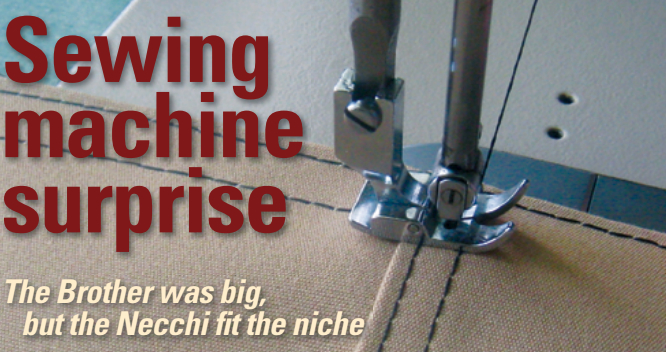
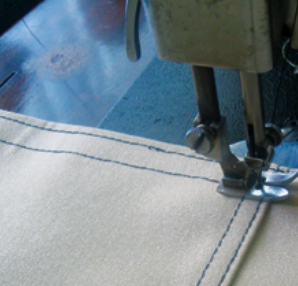
Here is the crux. Do I believe my own press? Am I really willing to give up a machine that can stitch through plywood for one intended for 1940s housewives to make their own clothes? The answer is, yes. Take a look at the pictures. In both sewing shots, the needle is through 12 layers of 9.25 ounce Sunbrella. Twelve layers is what you get when you hem the end of a flat-felled seam. That is the maximum number of layers you are ever likely to want to stitch through. By comparison, the fabric thickness at hemmed corners is just nine layers, six if you miter the corners.
If you compare the two side-by-side samples, you will be hard-pressed to make a case that one is better than the other. Of more import for the sailor, as both were sewn from the same thread, I can absolutely guarantee that there will be no difference whatsoever in strength or in longevity. I can likewise report that the actual sewing was no different; both machines needed a little assistance through the 12 layers but otherwise both stitched without operator assistance other than guidance. Don’t get me wrong; I am not claiming that a domestic machine is the equal of a good industrial machine.
If you are looking down the road at a decade or more of potential canvas projects, a well-chosen industrial machine, if it’s not too shop-worn when you buy it, could deliver the considerable pleasures and astonishing savings mine has over the years. But if you just envision a few canvas projects, if your budget is already busted, or if you lack the confidence in your aptitude for this particular skill, start with a domestic machine. Like a good old boat, a good old sewing machine can deliver the same utility, and often even greater satisfaction, for a tiny fraction of the cost.
So I am returning to my roots, sew to speak. The accidental little Necchi BU is the best domestic machine I have ever used, but among those on the Internet praising the BU were fans of the Singer 66 and 201 and others touting the German engineering of the Pfaff 130. In fact, lots of high-quality machines were manufactured in the first half of the last century, before the incorporation of plastic into sewing machines. These old machines are as strong as a wrench.
If you want to try your hand at fabric work, the lack of a sewing machine should not be a deterrent. Home sewing has lost popularity, orphaning innumerable capable machines in basements and spare rooms. A few calls to relatives and friends might snag you a long-term loan or a gift. Otherwise, you can find old machines in garage sales, thrift stores, Penny Pincher ads, on craigslist, and listed on eBay. Don’t pay too much; you are after a tool, not a collector’s item.
Of course, if you remain unconvinced that a domestic machine can stitch canvas up to your standards, I happen to know where you can buy a terrific industrial machine for a grand — maybe less.
Don Casey sewed up his standing as the authority on boat fix-it projects with This Old Boat which was released in its second edition last year. He and his wife, Olga, have been cruising aboard their 1969 Allied Seawind since 2002.
Thank you to Sailrite Enterprises, Inc., for providing free access to back issues of Good Old Boat through intellectual property rights. Sailrite.com