Shared experiences a world apart
Issue 78 : May/Jun 2011
As we worked our way inshore at Lovell’s Island to anchor for the night — after spending a day ashore in Boston — I waited too long to give the order to drop the anchor and we drifted into an area where the bottom was strewn with boulders. With a little crunch, the keel of the boat became entangled among them; we couldn’t go forward or back out.
“Uncle Homer,” Maiya, my 9-year-old niece, yelled. “We hit something!”
“Yes, I know. We’re in some rocks but we’ll fl oat out on the rising tide,” I replied.
“I’m scared,” Aaliyah, Maiya’s 5-year-old sister, said. “The boat will sink!”
“No, it won’t,” I said. “We’re stuck in some rocks, but it’s dead low tide and we’ll float off.”
This was accurate, but I had noticed a slight current that would move us toward a rocky shoal as we floated off the rocks.
“Maiya,” I said, “I’m going to put an anchor down so we stay put while the tide comes in. Come help Auntie Dee hand down the anchor.” After a little instruction, I got into our dinghy, rowed to the bow to pick up the anchor, and rowed up-current 100 feet or so and dropped the anchor. In less than a half hour, we floated free and moved to another area to set the anchor for the night.
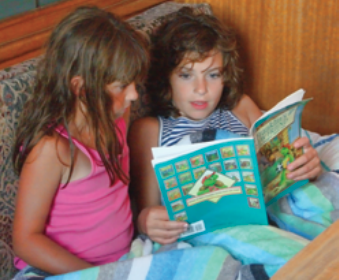
At bedtime, I asked the girls what story they would like to read before bed. We had stocked a dozen or so children’s books from our town library for the trip.
“I want this one,” Maiya said, handing me a copy of Orcas Around Me by Debra Page.
“This looks like a good one,” I said. “It’s about some children who help their parents on a fishing boat.”
“Kind of like us,” Maiya said.
“Very much like us,” I agreed. I began to read a page, then alternated with Maiya, who read the next.
“One major boat rule,” she read, “we always wear our life jackets unless we’re in the cabin.”
She looked up.
“Uncle Homer,” she said, “those are the same rules we have on our boat.”
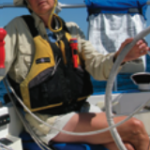
“They’re good rules, Maiya,” I said. “Children and adults should wear life jackets. They could save your life. You noticed that I put on my life jacket before going in the dinghy this afternoon, didn’t you?”
“Yes, you did,” said Maiya. We read on about how the young boy and his little brother lived and worked with their fishermen parents in Alaska. The story detailed an incident with a pod of orca whales that caused them to take their boat into a shallow bay.
“I awoke when I heard a bump,” I read. “The boat teetered to one side in slow motion. We had run aground on a rock . . . My dad had made a wrong turn . . . ‘Drop the anchor,’ Dad told Mom. ‘We can put in Cat’s Paw (their dinghy) and look for a way out.’ ”
“Uncle Homer, you’re making that up,” Aaliyah said.
“No, I’m not,” I said and asked Maiya to re-read the passage.
“That’s amazing,” Maiya said. “They got stuck on the rocks just like we did, and they wanted to use their dinghy to get off, just like we did, except they were afraid of the whales.”
It was amazing. We had chosen the story by chance and it retold a situation so similar to our own that the children identified deeply with the story’s characters. They were getting a valuable life lesson that staying, even living, aboard a boat is unusual but not unique. Other people, perhaps in faraway places, experience the same joys and dangers of life at sea. Dee and I are part of a worldwide community of people who may have different cultures and different languages but share a common bond with the ocean.
Shortly afterward, Aaliyah and Maiya climbed into their bunks. As the sea gently rocked them to sleep, they knew they were part of something much larger than our little boat.
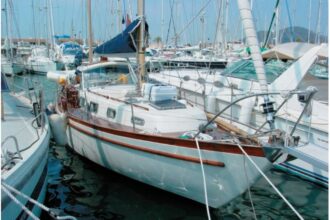
Homer Shannon grew up “messing around in boats” in Hingham Harbor, Massachusetts. Today, he and his wife, Denise, sail a Bristol 29.9 out of Newburyport, Massachusetts. Aaliyah and Maiya have been sailing with “Uncle Homer and Auntie Dee” for about five years, several times for extended trips along the New England coast.
Thank you to Sailrite Enterprises, Inc., for providing free access to back issues of Good Old Boat through intellectual property rights. Sailrite.com