Three of the most brilliant stars of 20th-century yachting
Issue 52: Jan/Feb 2007
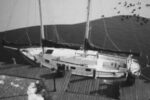
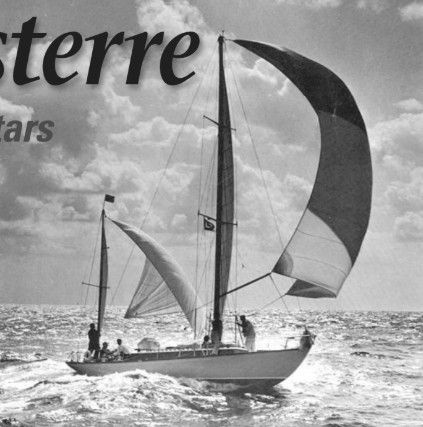
WHAT CAN ANYONE SAY ABOUT A LEGEND? FINISTERRE: length overall: 38 feet 6 inches; length waterline: 27 feet 6 inches; beam: 11 feet 3 inches; draft, board up/down: 3 feet 11 inches/7 feet 4 inches; displacement: 18,640 pounds; ballast: 5,860 pounds outside, 300 pounds inside; sail area: 713 square feet.
Those are the figures. If you care to, you can work out the ratios and compare them with other yachts, but that will not tell you what made Finisterre such an indomitable and successful cruiser/racer in her day. Her secret was the combination of the design genius of Olin Stephens and the driving talent of her owner/skipper, Carleton Mitchell, and his top-notch crew.
Finisterre was not designed as a serious, all-out racing yacht. Rather, Carleton wanted a design that would be a “floating home for two people,” definitely not an out-and-out racer. To many yachtsmen and designers, her 11-foot 3-inch beam was considered to be extremely wide and, although that beam would seem quite normal on a boat of her waterline length today, back in the 1950s she was usually described as fat. That did not seem to slow her down though; Finisterre was able to keep up with any boat her size and outsail a great many of them.
I never had the pleasure of sailing aboard her, but I vividly recall racing against a sister ship one day in Long Island Sound. That handsome little yawl was skippered by Arthur Knapp, a sailing legend of the time and the skipper of the 12-meter yacht, Weatherly, in the 1958 series for the America’s Cup defense. I was aboard Storm, Bill Luders’ powerful 39-foot sloop, an extreme racing machine, 1 foot 9 inches narrower than Finisterre, with 1,100 pounds less displacement and carrying over 2,000 pounds more ballast on a 2-foot deeper draft.
Two came together
It was a long-distance race and, nearing the end, the two yachts came together on a windward beat with Storm ahead by about a boatlength. And that’s where we stayed for hour after hour, neither yacht gaining nor losing more than a few feet. Although we could not shake Arthur, we did maintain our lead, and Storm finished slightly ahead of the chunky centerboard yawl. But so she should have, because she was a stripped-out racing yacht with only bare sitting headroom below her flush deck. In comparison, Finisterre’s sister was a comfortable cruiser/racer with full accommodations for her crew. Yet she gave away little or nothing when it came to out-and-out performance, both on and off the wind.
The Cruising Club of America (CCA) rule was the ocean-racing rule on this side of the pond at the time. The rule tended to favor short waterlines, wide beam, and light ballast, while the mizzen sail and mizzen staysail of the yawl rig were rated fairly lightly. This, along with her fi ne performance, made Finisterre a very competitive yacht indeed. Yachtsmen and designers opened their eyes after she won two Bermuda races in a row. The third win, the very next year, showed that it was no fluke. It was not long before beamy keel-centerboard yawls showed up in every distance race. Spinoffs include the Bermuda 40, the Block Island 40, and the Bristol 39 and 40 . . . all production yachts. There were numerous custom-built keel-centerboard yawls in smaller and larger sizes as well, ranging from 24-foot Midget Ocean Racers to 60-footers.
Olin Stephens definitely started a trend with the design of Finisterre, one that would last until the CCA rule was dumped in favor of the very different IOR rule. The perky little yawl and her designer will both be remembered as brilliant stars of 20th-century yachting as long as sailors race across the seven seas.
Thank you to Sailrite Enterprises, Inc., for providing free access to back issues of Good Old Boat through intellectual property rights. Sailrite.com