A homemade filter keeps the cabin sweet
Issue 80 : Sept/Oct 2011
Boating equipment retailers offer dozens of chemicals to make your head smell fresh. We tried them all in our attempts to eliminate the smell generated by the holding tank on Diversion. I reviewed the entire system looking for defects to correct:
- The toilet didn’t leak.
- Hoses were top-grade sanitation-type and in very good shape.
- The vent line ran as near vertical as possible and was clear of obstructions.
- Hose clamps were tight.
- The holding tank didn’t leak.
I knew the smell was coming from the vent line. I learned there wasn’t enough oxygen available to support the normal breakdown of waste in the tank. Flushing the holding tank provided only temporary relief. Enzymes meant to help activate the waste breakdown, as well as chemicals that are supposed to mask the smell, had very little effect. Nothing worked for very long.
A friend suggested a carbon filter for the vent line. That seemed like my only option, yet it was a fairly expensive one. The cost of such a system is $80 to $100, and the replacement element (required at least yearly) is only a few dollars less. So I made one myself.
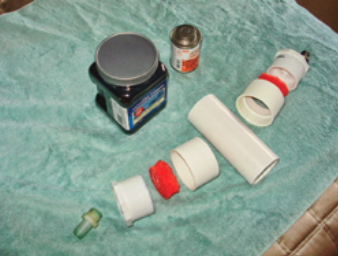
This turned out to be a very easy, inexpensive project. Once you acquire the parts (most are sold by your favorite hardware store), assembly takes less than an hour.
Component parts
- PVC pipe of any diameter and length suitable for your sailboat, e.g. a 6-inch length of 2-inch-diameter pipe
- Two PVC pipe sleeves of the same diameter as the pipe
- Two PVC reducing bushings; one end of each slides into the sleeve, the other is threaded to accept NPT pipe thread
- Two male pipe-to-hose adapters; the pipe thread matching the female end of the bushing; the hose barb matching the diameter of your vent hose, usually 5⁄8 inch
- Two foam discs; these fi t inside the bushings to keep the filtering product in place
- Two hose clamps to attach the vent line to your fi lter
- PVC pipe glue
- Activated charcoal for the filter material
I found the pipe-to-hose adapters in my spare-parts bins and acquired all of the PVC fittings at my local hardware store for a little more than $10. I found the activated charcoal (Aqua-Tech Activated Carbon) for a little over $6 at Walmart in the tropical fi sh section of the pet department. I cut the foam discs from a fiberglass filter element used on a forced-air heating/cooling system. Almost anything can be used for these: a scrubbing pad or even a coarse sponge. It must be firm enough to hold the charcoal in place while allowing air to pass through.
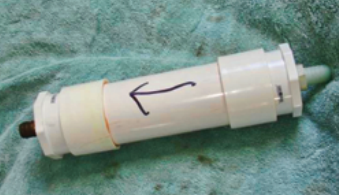
Assembly
- Cut the PVC pipe to a suitable length for the space you have available.
- Glue the sleeves to the ends of the PVC pipe.
- Fit the foam discs into the bushings. A drop of glue will hold them in place.
- Glue one bushing into a sleeve. This is the bottom of the filter.
- Mark an arrow on the tube to indicate the direction the filter will be positioned.
- Hand press the top bushing into the other sleeve. Do not glue it.
- Screw the pipe threads of the hose adapters into the bushings.
- Remove the top bushing (you marked the unit with an arrow indicating the top).
- Fill the cylinder with the activated charcoal.
- Refit the top bushing.
- Cut an appropriate length out of your vent hose.
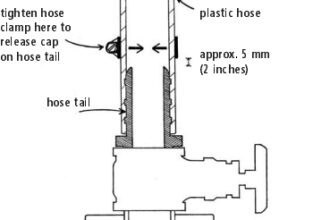
- Install the filter by fitting the vent hose ends onto the hose barbs and clamping them with the hose clamps.
This did the trick. No odor escapes through the vent when the toilet is flushed.
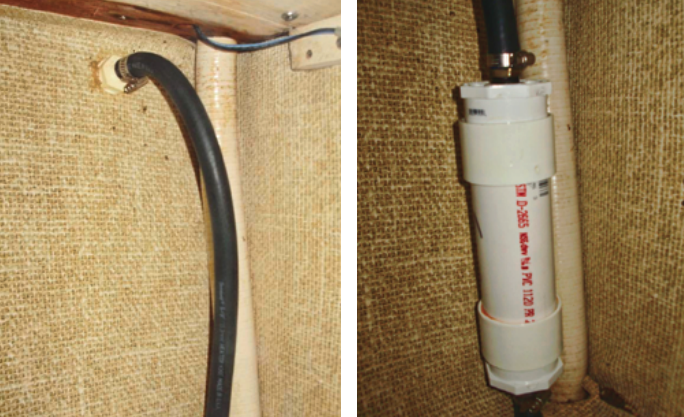
The larger the PVC tube you can construct, the longer the filter will remain effective. Replace the charcoal when the odor returns. To do this, remove the filter from the vent line, pull out the top bushing, dispose of the charcoal, and refill your filter. The total cost of this project should be less than $20 including sufficient activated carbon for 4 to 5 refills.
Bob Tigar and his wife, Joyce, began sailing a board boat on small inland Midwest lakes, then progressed to larger sailboats on Lake Michigan. Since moving to southeast Florida 13 years ago, they sail their Morgan Out Island 33, Diversion, on weekend excursions near home, longer adventures in the Florida Keys, and annual trips to the Bahamas.
Thank you to Sailrite Enterprises, Inc., for providing free access to back issues of Good Old Boat through intellectual property rights. Sailrite.com